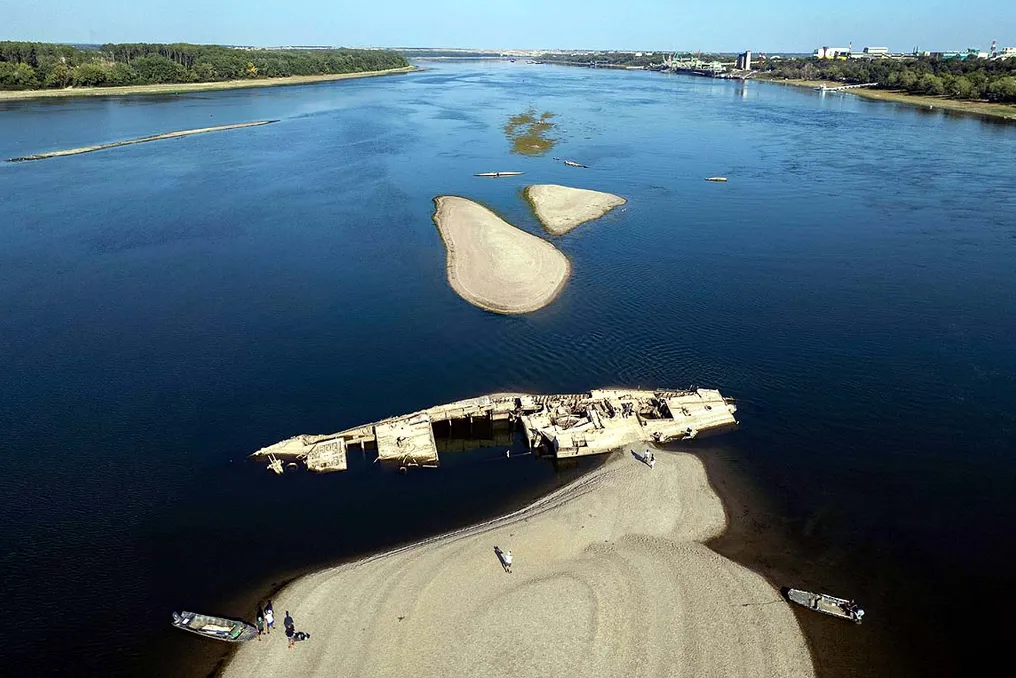
The effects of El Niño are also being seen in European rivers due to intense heat and drought. In the Prahovo area of Serbia, where the water level in the Danube has dropped, a German warship sunk in 1944 has reappeared. This ship was sunk by the German army as it retreated during World War II in September 1944.
Although the low water level exposes the wreckage of old vessels, it also raises concerns regarding power generation. The Danube is one of Europe's largest rivers and flows through ten countries. This year, many regions have experienced elevated temperatures and reduced precipitation, which has affected the river's water level.
The drop in water levels is causing concern in Hungary and Romania because the nuclear power plants in these countries use Danube water for cooling equipment. During the German withdrawal in September 1944, as Soviet troops advanced, the German army sank numerous ships in the Danube. The wreckage of these ships is still in the river near Prahovo in Serbia.
When the river level falls, parts of these ships become visible. Wreckage of other old vessels has previously appeared in this area during periods of low water. The drop in water levels is not only observed in Serbia; in Budapest, the capital of Hungary, the water level in the river also significantly dropped at the end of July. This was one of the lowest levels, reaching 28 centimeters, compared to the previous minimum recorded in October 2018 at 33 centimeters.
The situation has also impacted the Pax nuclear power plant in Hungary, which uses Danube water for cooling. Due to the water shortage, this power plant had to reduce electricity generation. This facility provides about half of Hungary's electricity needs. Danube water is also essential for the Sernavod nuclear power plant in Romania.
On August 11, the river's flow reached approximately 1370 cubic meters per second, which is a very low figure. One of the station's two reactors has already been shut down. If the water level continues to fall, the second reactor may also be affected. Both reactors together provide about 20 percent of Romania's electricity, so the low water level is a concern for energy supply. Low water levels in the Danube can also negatively affect navigation and other river-related operations.
Thus, the decrease in water levels in the Danube due to heat and drought in Europe means that the appearance of a 1944 warship is not just a historical event, but a clear sign of the river's diminishing water reserves.