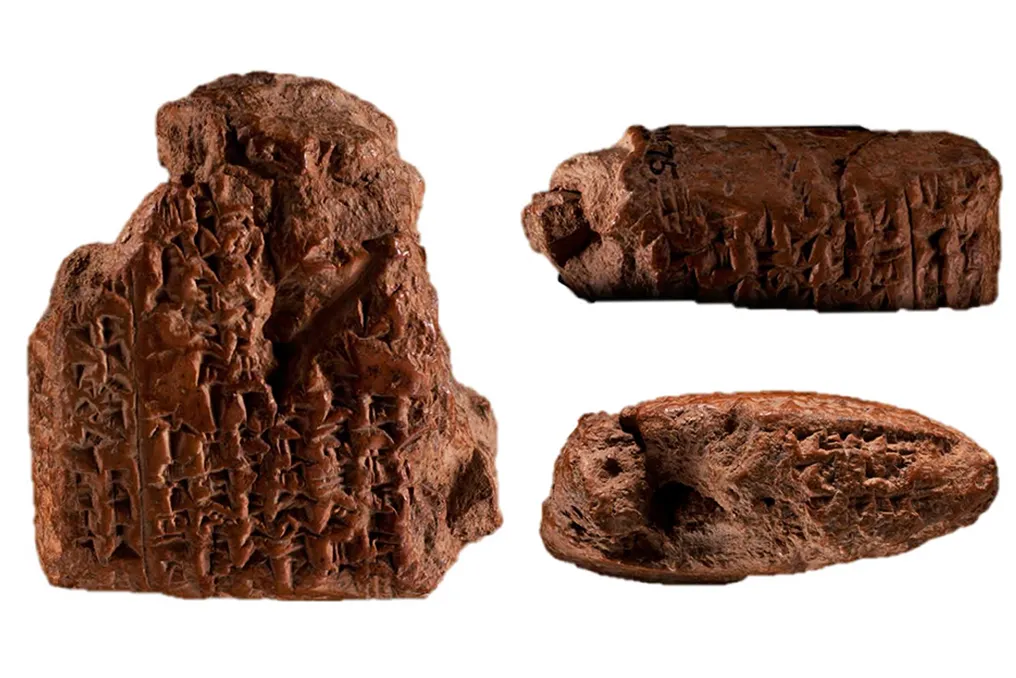
Researchers have discovered the existence of three Assyrian kings who were not listed in the traditional Assyrian King List, a fundamental document for understanding the political succession of the ancient Assyrian Empire.
The passages of the Old Testament mention Ashur, Noah's grandson, who supposedly gave rise to the Assyrian people, a civilization that flourished in ancient Mesopotamia between 2025 BC and 609 BC. Ashur also named one of its major cities, currently located in Iraqi territory, where archaeological sites continue to provide data on this culture.
The main historical source for knowing the Assyrian rulers is the Assyrian King List, preserved on three clay tablets, considered a crucial reference for the empire's chronology. However, scholars recognized that this record is incomplete.
An investigation conducted by scientists from Yale University in the United States and the University of Münster in Germany revealed evidence of three Assyrian monarchs absent from the official document: Tiglath-pileser, Shalmaneser, and Ashur-uballit. These findings were published in the scientific journal Journal of Cuneiform Studies.
The first piece of evidence relates to Tiglath-pileser, who, according to researchers, allegedly ruled alongside Ashur-dan III, his nephew. Information about him was deciphered on a clay tablet belonging to the British Museum collection. The inscriptions indicate a concession made by the king, whose possible reign date is situated between 763 BC and 762 BC, being deposed after initiating a revolt against his nephew. It is noteworthy that the name Tiglath-pileser was already used by another listed ruler, leading researchers to speculate that he may have adopted the name in honor of his predecessor.
The second identified king is Shalmaneser, who probably ascended the throne after Ashur-narari V in late 747 BC. He lost power to Tiglath-pileser about a year later. The name Shalmaneser was engraved on a stele found in Iraq more than a hundred years ago, but it was obscured by the inscription of Tiglath-pileser, which caused it to be overlooked by archaeologists until now.
Finally, researchers located records of Ashur-uballit, who had a brief reign before yielding power to Adad-narari II. His name appears on a tablet documenting the restoration of a vessel by this monarch, and he is estimated to have reigned between 913 BC and 912 BC.
The authors of the study argue that the new views on the ruthless Assyrian scenario demonstrate that the Assyrian King List is not an exhaustive record of all rulers, but rather a selection of those who exercised power long enough and successfully enough to be included in a chronological order idealized by the editors.
This suggests that the apparent totality of the document may be misleading; instead of cataloging every leader, the list likely presented a structured and stable version of the royal succession, which did not always mirror the political reality of the empire.
Consequently, this discovery alters how academics interpret the Assyrian King List and opens new avenues for future investigations.