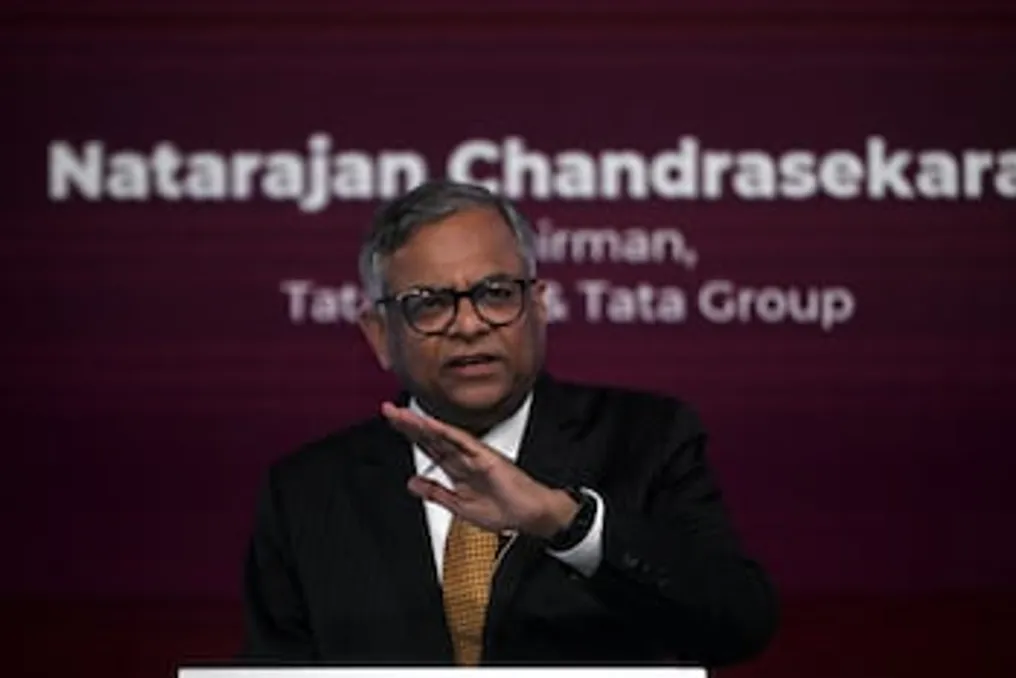
The exit of Natarajan Chandrasekaran, chairman of India's largest conglomerate Tata, has created uncertainty regarding the group's five-year investment plan. While the company is implementing a massive reinvestment program, Chandrasekaran's decision to step down in February leaves a leadership vacuum.
According to sources familiar with the situation, some current and planned projects of the conglomerate may slow down, be scaled back, or be stretched over time until a new leader is appointed. This transition is particularly significant as Noel Tata, chairman of Tata Trusts, now plays a decisive role in managing the holding company.
Noel Tata recently voiced objections to the expansive spending led by Chandrasekaran, which amounted to $120 billion over the next five years. Instead, he favors a more measured approach to capital expenditure with quicker returns.
The Significance of Tata to the Indian Economy
The conflict between the two leaders has reached a climax and will impact the entire country, as Tata is a reflection of the broader Indian economy. The company's brand portfolio includes luxury cars Jaguar Land Rover, the Taj hotel chain, Air India, and everyday goods like Tetley tea. Beyond the consumer sector, the group has made strategic bets in areas such as semiconductors, electric vehicle batteries, and AI-based data centers, making it an important partner in implementing Prime Minister Narendra Modi's program to transform India into a global manufacturing powerhouse.
Mumbai-based stock strategist Kranti Batini noted that 'the ball is now firmly in Noel Tata's court.' He added that replacing a technocrat of Chandrasekaran's caliber, who deeply understands rapidly changing technological landscapes, will be a serious challenge.
The Chairman of Tata Trust leads a collective of 13 charitable organizations that hold a two-thirds stake in Tata Sons. Noel's tightening control over the conglomerate was prompted by disagreements with Chandrasekaran regarding the pace and duration of capital allocation. Chandrasekaran's departure resolves the issue of competing visions for the conglomerate but does not offer an obvious successor.
Utkarsh Sinha, Managing Director of boutique investment bank Bexley Advisors, stated that Chandrasekaran 'controlled the investment-intensive transformation of Tata Group in aviation, electronics, semiconductors, and the digital sphere.' He suggested that his departure might signal a greater emphasis on financial discipline, consolidation, and extracting profits from these investments, rather than continuing at the same pace of expansion.
Proof of Return
Sources reported that the board of directors of Tata Sons began pushing for strategic adjustments even before Chandrasekaran's resignation was announced. Led by Noel, the directors insisted that senior management review or slow down many of the most capital-intensive projects, particularly investments in the flagship chip factory, the airline, and the emerging consumer technology business.
The board demands proof of return before approving further spending. Unlike his younger brother Ratan Tata, who acquired Jaguar Land Rover and Corus in the UK and had a penchant for nation-building projects, Noel oversaw the disciplined expansion of the fast-fashion giant Trent Ltd., which he managed for over ten years. This focus on profit is increasingly influencing decisions within the Tata Group since he took office as chairman of Tata Trusts in 2024 following Ratan's death.
Few industrial competitors of Tata have taken such risks in investing in advanced technology sectors. V.K. Unni, Professor of Public Policy and Management at the Indian Institute of Management Calcutta, noted that competitors such as Reliance Industries Ltd. and Adani Group have focused on land-related infrastructure, energy, fiber, and cloud computing that powers AI, utilizing 'core strengths with far less technological risk.' However, Unni emphasized that Tata aims for higher returns with a riskier strategy, requiring 'constant reinvestment of billions to match global return curves.'
Under Chandrasekaran's leadership, the Group was willing to take this risk, following its history as a company that stepped forward whenever policymakers decided the country needed expertise it did not yet possess. This spirit contributed to the development of domestic steel, commercial aviation, and IT industries.
Company leaders fear that new leadership, unwilling to ambitiously spend on long-term projects, may fail to replicate this success in sectors such as semiconductors, aviation, and industrial battery cells.
No project is more significant than the Tata Sons chip factory—an attempt to create a giant comparable to Taiwan Semiconductor Manufacturing Co. For the Modi administration, Tata's development offers the prospect of transforming Dholar into an innovation hub comparable to Silicon Valley. This also aligns with India's declaration to foreign tech investors as an attractive alternative to China and the national goal of reducing dependence on its Asian neighbor.
This project has an unusual level of oversight. One participant in the project revealed that the factory team reports not only to Tata management but also to the Government of India.
However, Chandrasekaran's successor will have to contend with the slow technological progress that has hampered the semiconductor venture. Although the Tata Electronics chip packaging plant in Assam remains on schedule for opening next year, sources indicated that various operational and technology access delays have prompted the group to temper expectations, starting with less complex technology.
Meanwhile, a kind of contraction is occurring in the Agratas battery division. Facing a widening cost gap compared to Chinese manufacturers and failing to secure previously explored technology partnerships, the business has abandoned plans for accelerated commercial production of battery cells. The focus is on proving the technology before investing billions in scaling up.
The revival of struggling Air India is another huge challenge after the airline incurred record losses for the year ending March 31 due to a plane crash in June 2025 and geopolitical conflicts that extended flight routes. The group has already scaled back its ambitions for the airline, acquired four years ago in one of the country's largest privatizations. It will soon have a new CEO.
Noel is also raising standards in non-manufacturing areas. When management requested approval for additional funding of around $1 billion to support operations and cover ongoing losses in Tata Digital, the consumer technology business directors objected. The board demanded a more detailed plan explaining how the business would reduce losses, improve execution, and justify further investment.
This response triggered a wide restructuring within Tata Digital. The company is cutting management layers, reducing staff in certain parts of the organization, and bringing in new leadership in key areas to improve operational efficiency.
A more cautious approach to investment comes as Tata Consultancy Services Ltd.—the financial backbone of the conglomerate for many years—enters a more uncertain period. India's largest software exporter continues to bring in billions of dollars annually, but slowing corporate technology spending and a shift towards AI have undermined its strong position, according to sources.
In a preemptive move to strengthen the company's balance sheet, the TCS board appointed a new layer of senior executives under CEO K. Kritivasan over the last 18 months, including an COO, Chief Strategy Officer, and Head of M&A. TCS is also actively exploring acquisition opportunities and AI infrastructure investments after historically relying almost exclusively on organic growth.
Cathedral Thinking
Attention now shifts to whom Noel will appoint as Chandrasekaran's successor. The question of succession has always been complex within the Group, unlike its strictly family-run counterparts. Founded in 1868 by Jamsetji Tata of Parsis descent, the conglomerate was managed by the Tata family until Ratan Tata handed over control to Cyrus Mistry in 2012. Just four years later, Ratan led a corporate upheaval to remove his successor, leading to a race for a new chairman, as Ratan, being a lifelong bachelor, left no children to take the post.
Chandrasekaran became a suitable candidate at that time. As a technocrat who spent 30 years at TCS—eight of them as CEO—he had already transformed the software giant into India's most valuable company and was considered a reliable pair of hands. Despite being the only non-founder and non-heir at the helm of a major Indian conglomerate, Chandrasekaran formulated his vision for Tata with unusually long-term goals. He termed the conceptual framework of these extended project timelines 'cathedral thinking,' borrowing the term coined by Australian philosopher Roman Krznaric to evoke medieval builders in Europe laying foundations for structures they would never see completed.
His successor is unlikely to have such room for dreaming. Deven Choksey, Managing Director of investment advisory firm DRChoksey FinServ, stated that whoever takes the chairmanship 'will face a harsher environment.' He added that 'an increasingly assertive board of trustees will make it harder for the next leader to act with the same degree of autonomy.'
}} , 2. {