NOUSBOT, a company specializing in high-precision transmission components such as planetary roller screws and linear actuators, has completed an A+ funding round worth nearly 100 million yuan. The round was led by Shunwei Capital, followed by Wangqian Capital, which is affiliated with CATL. The capital raised will be used to expand the production capacity for miniature screws, improve products, and enter foreign markets.
This is the fourth round for the company; previous investors included the venture fund SAIC Motor, Pudong Science and Technology Innovation, and Lenovo Capital.
NOUSBOT was founded in July 2023 and evolved from a family business with over thirty years of experience in screw manufacturing. The company conducts forward development and full-cycle in-house production of planetary roller screws and linear actuators. Its R&D center is located in Shenzhen, while its production bases are in Shanghai and Suzhou.
Founder Xu Yang holds a master's degree in mechanical engineering from Tongji University and previously worked at Valeo, gaining experience in automotive transmission and precision manufacturing.
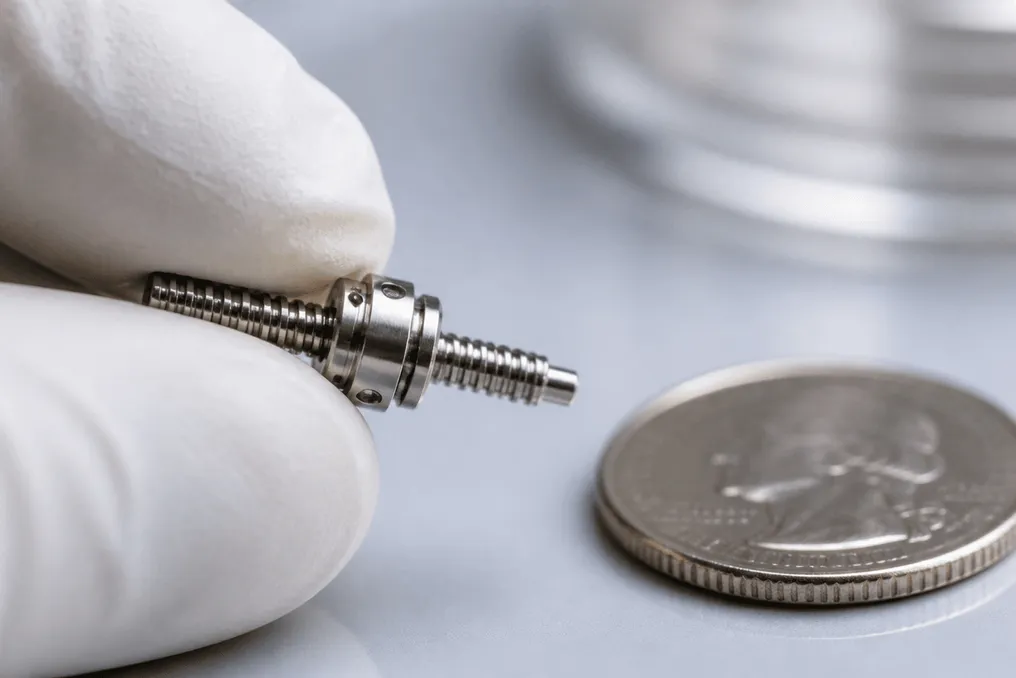
The company produces what is called the world's smallest planetary roller screw: it has a diameter of 1.5 millimeters, a 5.5-millimeter diameter nut, C5 accuracy, a positioning repeatability of plus-minus 0.01 millimeters, and a load capacity of 50 Newtons. Integrated into a micro-linear actuator the size of a USB drive, it provides a thrust of 15 kilograms. The next-generation actuator is equipped with force feedback with an oscillation accuracy of 1%, positional feedback, and temperature feedback with motor degradation alerts, transmitting multidimensional data to the robot's brain for a closed loop of fine manipulation.
According to Xu Yang, the market has undergone significant changes in just eight months. If most decisions before the last closing in December 2025 were based on the Tesla approach, now the number of companies involved in dexterous hands has doubled, directions are diversifying, and demand for transmission extends to wrists, forearms, and even necks and faces, with neck mobility increasing from one or two degrees to four to six.
Xu argues that screw mechanisms will surpass linear connections: unlike rotary joints, which struggle to combine high force and small size and suffer from motor overheating due to stopping, integrated linear connections based on screws use natural self-locking, allowing motors to operate intermittently, thereby reducing heat generation, saving energy, and extending service life.
The main limitation is production capacity. The factory in Suzhou operates around the clock at full capacity, producing 3 million screws per year, which is still insufficient to meet demand. With a forecast of one million humanoid robots in the future, the annual demand for screws could reach 30 million, while global effective capacity is extremely inadequate. The company aims to achieve a production of 10 million screws per year by the end of the year. Its product matrix covers thrust from 3 to 1000 kilograms and targets surgical robots, lithium-ion battery coatings, semiconductor optical modules, and low-altitude economy. In the automotive industry, its high-force density microactuator has secured eight successful project wins with Yanfeng Seating and recognition from SAIC.
Xu noted that the unit price has already reached hundreds of yuan, and the company's strategy is based on a power matrix platform, not on defending the market with a single product.