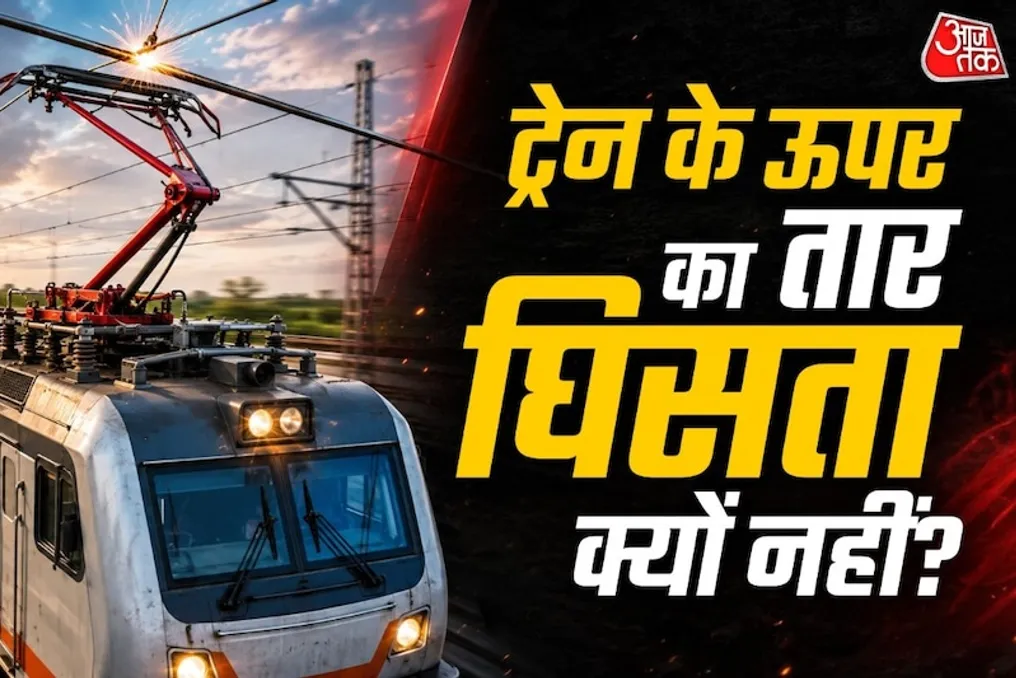
Above the railway track, electric wires can often be seen, under which hundreds of trains pass daily. It is noteworthy that the pantograph installed on the roof of the train constantly contacts this wire. Since the train moves at high speed, the pantograph continuously glides along the wire. The question arises: why, despite the passage of such a large number of trains, does this wire not wear out quickly? In fact, there is a special technology behind this, used in railways. This wire is not an ordinary electrical cable; it is designed and installed in a way to minimize wear, even with constant contact from the train's pantograph.
How do trains receive electricity?
First, it is necessary to understand the function of this upper element. An electric train requires energy to operate its engine. The wire located above the railway track is called the contact wire or overhead equipment. On the roof of the train is a device known as a pantograph. It rises and makes contact with the electric wire. Energy flows from the wire through the pantograph into the train's electrical system, where it powers the engine. Here is an interesting point: because constant contact is maintained between the pantograph and the wire, friction occurs. If an ordinary wire were used, it could wear out quite quickly.
Why doesn't the wire wear out?
The wire does wear out, but very slowly. They do not try to completely prevent wear; rather, they control it. To this end, the wire is made of special metals. Usually, durable copper-based materials with good electrical conductivity are used. These materials have properties that allow them to efficiently transmit electricity and withstand constant friction. Furthermore, the part of the pantograph that contacts the wire also has a special contact strip. This part is designed so that it can be easily replaced if necessary. Thus, railways do not just make the wire strong, but also provide for the replacement of the wearing part of the pantograph. The advantage is that instead of replacing the expensive and large system, only the wearing element is replaced.
Why is the wire not installed in one place?
This is also an important part of this system. If the wire were perfectly straight and constantly touched the same part of the pantograph, one section of the pantograph's contact strip could wear out quickly. Therefore, the overhead wire is placed over the tracks with a slight zigzag. That is, the wire does not lie in a perfectly straight line, but deviates slightly left and right. When the train moves forward, the contact part of the pantograph touches the wire in different places. This distributes the wear not in one spot, but along the entire length. You can imagine it this way: if you rub a wooden surface in the same place many times, a mark will quickly appear there. But if the point of friction changes slightly, the entire surface will wear down gradually.
Influence of train speed
Increasing the train speed complicates maintaining contact between the wire and the pantograph. At high speeds, the wire may oscillate up and down, and the pantograph tries to maintain constant contact with it. Therefore, railways carefully determine the height, tension, and position of the overhead system. The wire is held under appropriate tension to ensure correct contact with the train's pantograph. In addition, railways periodically inspect these wires. Necessary repairs are carried out where increased wear is observed.
The wire wears out, but not as quickly as ordinary ones. Thanks to durable materials, special design, the zigzag system, proper tension, and regular maintenance, the service life of the wire is significantly increased. And most importantly, railways are aware in advance of the inevitable friction between the wire and the pantograph. Therefore, the entire system is designed taking this factor into account. That is, trains continue to pass one after another, the pantograph constantly touches the wire, but the system continues to work for a long time. There is no magic behind this, but rather engineering, proper design, and constant maintenance.