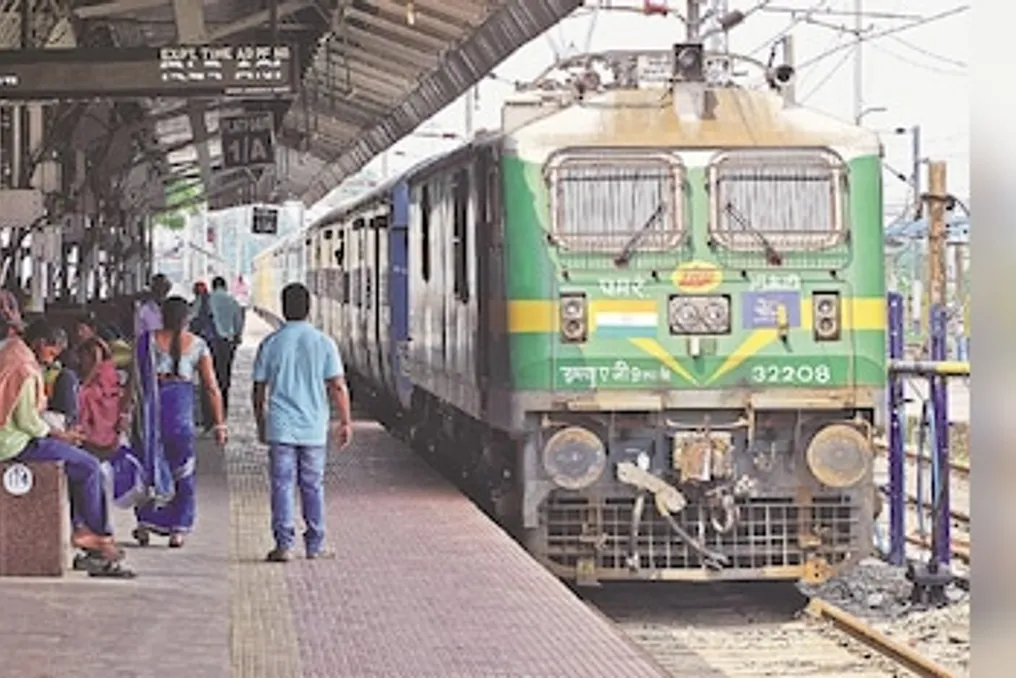
The Ministry of Railways has changed its approach to six proposed Public-Private Partnership (PPP) projects valued at 31,814 crore rupees. These projects have been transitioned from a revenue-sharing model to a Hybrid Annuity Model (HAM), which reduces risks for private investors.
According to the protocols of an official meeting, the ministry attempted to enter the infrastructure project market based on risks for the first time but encountered difficulties. Consequently, the six projects were converted from a revenue-sharing model to a de-risked Hybrid Annuity Model (HAM).
At the meeting of the Public-Private Partnership Assessment Committee (PPPAC), chaired by the Secretary for Economic Affairs Anuradha Thakur, approval was granted on August 1st for the development of six new railway lines with capital expenditure of 31,814 crore rupees under the HAM model.
These six railway projects include four projects in Odisha, one in Telangana, and one in Jharkhand. Previously, in April, PPPAC had given 'principle' approval to these projects under the Design-Build-Finance-Operate-Transfer (DBFOT) model.
As revealed in the protocols published on Tuesday, after analyzing market feedback, the Ministry of Railways revised the project structure and proposed implementation through HAM. Under the proposed HAM structure, the Ministry of Railways will bear the risks associated with traffic and tariffs, and it will provide 40 percent of the Project Cost as a grant during the construction period.
Experts welcomed this move, stating that revenue-sharing systems can cause future uncertainty, whereas HAM will be a good start for the ministry. Kuljit Singh, Partner and Infrastructure Head at Ernst and Young, noted that since toll-based projects require significant planning and stakeholder consultation regarding the proportions and methods of distributing ticket and freight revenue between railways and developers, it is currently prudent to structure these projects either as HAM or as traditional annuity projects. He added that BOT Toll structures could be proposed later once the private sector gains successful implementation experience.
Despite the shift to the HAM model, experts emphasize that this remains the railways' first attempt to build large-scale roadside infrastructure under a PPP regime, which will open up new opportunities for the industry. The Ministry informed the Finance Ministry that the proposed structure aims to attract long-term private capital into railway infrastructure.
The Railways told the committee that Alternative Investment Funds (AIFs) and other financial investors would evaluate these projects based on the stable and predictable returns offered by HAM compared to other investment opportunities. Their participation would also help expand the investment ecosystem and deepen private sector involvement in railway infrastructure over time.
According to the operator's presentation, this structure opens the door for participation from financially strong entities, including infrastructure investment funds and other investors who lack the necessary technical expertise, through legally binding agreements with technically qualified Engineering, Procurement, and Construction (EPC) contractors.
The Railways informed the committee that the tender documents will define the applicable terms, including the minimum agreement duration, the roles and responsibilities of the EPC contractor, and the circumstances under which such agreements will be resolved.
The projects, totaling 15,975 crore rupees, include Balaram-Putgadia-Tentuloi (Internal Corridor) in Odisha, Budhapank-Tentuloi-Luburi (External Corridor) in Odisha, Jajpur-Keonjhar Road-Aradi-Dhamra Port in Odisha, Tikiri station to Valtair bauxite mines in Odisha, Manuguru–Ramagundam in Telangana, and Pakur/Nagarnabi to Godda in Jharkhand.
Under the new proposal, the relevant body within the Railways will be responsible for land acquisition, obtaining permits, and making the initial 40 percent payment during construction, while the Concessionaire will undertake the design, financing, and construction of the project. During the operational period, the body will manage trains, provide rolling stock and crew, and carry out annuity payments, as well as operation and maintenance (O&M) payments. The Concessionaire will be responsible for maintaining project assets, station upkeep, and asset replacement when necessary, excluding tracks.