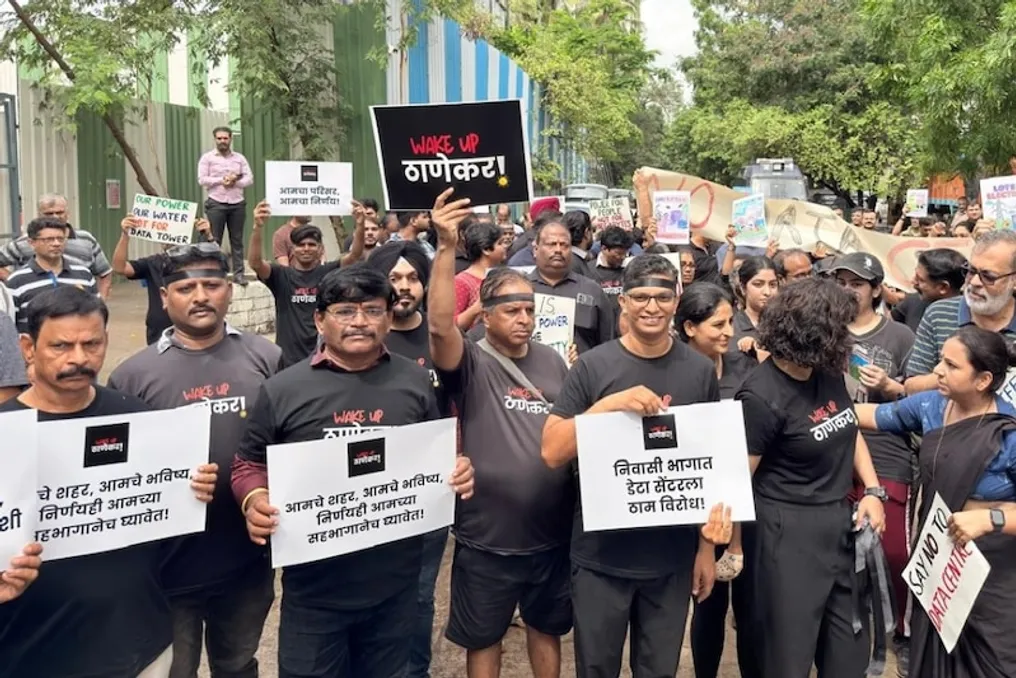
Local residents of Tane, Maharashtra, continue to express disagreement regarding the planned Amazon Web Services (AWS) data center. Activists under the banner of the group 'Wake Up Thanekar' (WUT) are questioning the location of the center, which is being built in the Balkum area. Amazon Data Services India is developing this facility on a plot of about 53 acres. This project, estimated at approximately 47 thousand crore rupees, could become one of the largest data centers in the Greater Mumbai region.
Local residents emphasize that their protest is not against the data center itself, but against its placement in a densely populated area. Resident Anuradha Rode noted that three villages, as well as high-rise residential buildings, schools, hospitals, and public transport, including the metro, are located near the proposed site. In her opinion, this location is unsuitable for constructing such a large facility.
Previously, members of WUT organized a human chain protest on July 18. Local residents also held a meeting with Amazon representatives, but they stated that the answers received to their main technical and environmental concerns were unsatisfactory. Mega Shetty, a local resident, reported that after consulting specialists, she voiced her questions at the meeting, with her primary concern related to the construction of such a massive data center in the middle of a densely built residential area.
Protesters also raised issues concerning the heat generated by the data center, noise from around 190 diesel generator units, emissions, and other environmental consequences. In response to these concerns, Amazon published detailed clarifications on its website. The company asserts that the data center in Tane will not use water for cooling, and that none of its existing data centers in India currently use drinking water for cooling.
According to the company's statement, the permitted water supply volume for the Tane data center is 0.01 million liters per day, and it is intended exclusively for basic staff needs such as drinking water and toilets. Amazon states that air-cooled chillers and closed-loop cooling technology will be used in the center.
Local residents fear that the intensive use of air conditioning systems to maintain machine coolness will lead to the creation of a 'heat island' effect in the Balkum, Dhokali, and Majiwara areas. Amazon refutes this hypothesis, stating that the heat emitted by the servers will be effectively removed using cooling and air processing systems, and this will not affect the air temperature in surrounding communities.
Questions were also raised regarding energy consumption and noise. Applicant Jatin Kotare noted that the hyperscale data center would require a constant supply of about 420 megawatts of electricity, especially since power outages have previously occurred in the area. Amazon assured that a separate high-voltage substation would be built for the data center, and electricity would not be diverted from the distribution network that powers local residents and commercial consumers. Regarding noise, the company stated that construction would comply with established limits according to the Noise Pollution Rules of 2000, utilizing technologies such as sound-absorbing materials, insulation, acoustic enclosures, and mufflers.
Furthermore, demonstrators questioned the government permits issued for the project. They believe that an adequate assessment of the potential impact on thousands of nearby residents should have been conducted before granting permission for such a large project.