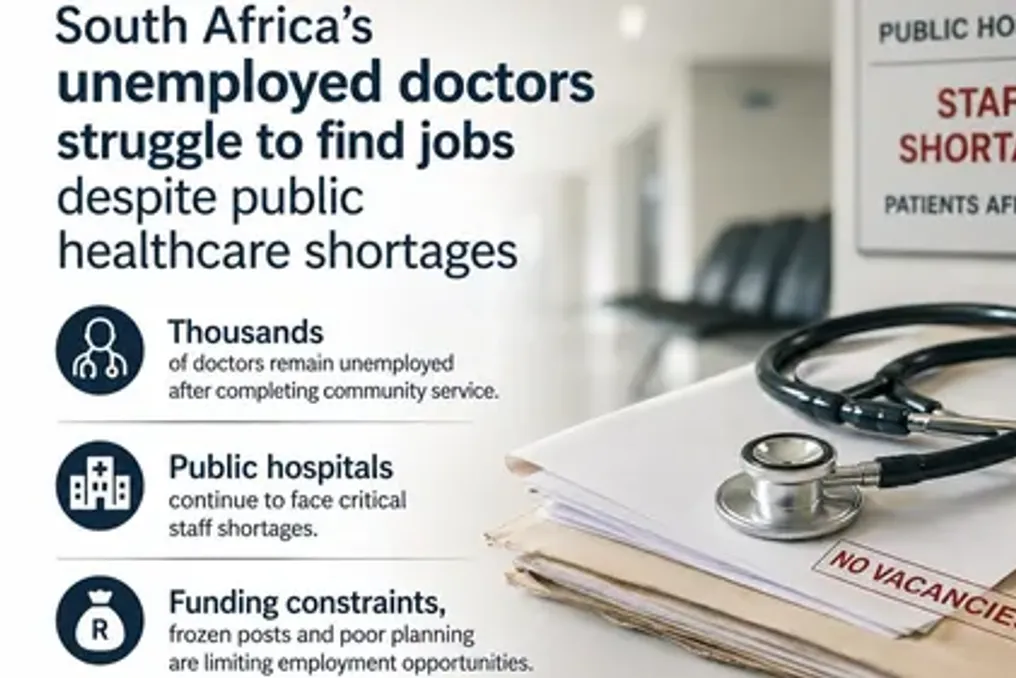
Due to the critical shortage of personnel in South Africa's healthcare system, medical organizations strongly urge the government to hire qualified unemployed doctors. They emphasize the urgent need for sustainable solutions to reduce the burden on overworked healthcare workers.
Unemployed doctors in South Africa could help alleviate pressure on the overburdened public healthcare system, where current doctors are forced to work overtime, and staffing gaps negatively affect service delivery and patient care.
Medical organizations have warned that existing doctors are forced to take on excessive workloads, work extended shifts, and perform overtime hours to keep services running.
Nlankhla Mtize, General Secretary of the provincial branch of the Health Workers and Other Public Servants Union of South Africa (HOSPERSA), expressed concern over the apparent contradiction between the existence of qualified unemployed doctors and the persistent doctor shortage in the public healthcare system. He stated that this issue should be viewed not merely as an employment problem, but as one concerning the healthcare system and patient safety.
Mtize noted that prolonged strain can lead to fatigue and burnout, which will hinder the retention of experienced doctors in the public health system. Furthermore, the union warned that exhaustion can negatively impact concentration, clinical judgment, and decision-making, potentially increasing the risk of medical errors.
The union questioned the viability of constantly relying on overtime work. Mtize suggested that instead of continuously paying extra time to current doctors to compensate for vacancies, the government should assess the possibility of hiring available qualified doctors to fill identified and permanent staff gaps.
The pressure on staff is not limited to doctors; nurses, allied health professionals, administrative staff, and other healthcare workers are also facing increased workloads due to insufficient medical staffing. The union pointed out that staff shortages can lead to longer waiting times and delays in examinations and treatment, especially where there are too few doctors to effectively manage patients.
As an example, Gauteng Forensic Pathology was cited, where some facilities, including Springs and Bronkhorstspruit, have only one assigned doctor. If this doctor is unavailable due to illness or leave, post-mortem examinations are not conducted, directly affecting service delivery and contributing to backlogs. This example highlighted the need for sufficient staff capacity to cover routine absences, rather than depending on the constant availability of a single specialist.
South Africa also risks losing doctors who have already been trained. The union warned that qualified doctors who are unemployed may seek opportunities in the private sector or abroad, leading to a loss of skills after significant public investment in their education and training.
Dr. Mzulungile Theo Nodikida, Chief Executive Officer of the South African Medical Association (SAMA), stated that the situation jeopardizes the future specialist workforce of the country. He emphasized that doctors require continuous clinical experience to remain competitive when applying for residencies, while long periods away from clinical practice can complicate specialist training.
The association highlighted areas such as anesthesiology, surgery, emergency medicine, obstetrics and gynecology, pediatrics, psychiatry, radiology, and family medicine as areas of particular concern, although the deficit varies between provinces and between urban and rural areas. Nodikida noted that 'doctor unemployment and doctor shortage are two sides of the same workforce planning problem.'
He added that provinces may have a real need for doctors without having a sufficient number of funded, approved, or advertised vacancies. Both organizations stressed that unemployed doctors cannot simply be placed in any available position. Recruitment must consider the availability of funded posts, qualifications, registration requirements, specialization, and the operational needs of individual institutions.
HOSPERSA demanded a comprehensive assessment of doctor vacancies and staffing needs across the entire public healthcare system, including specialized services such as forensic pathology. The union insisted that this must determine where real vacancies exist and what qualifications and specializations are required. HOSPERSA concluded: 'The current situation is unsustainable: we cannot have doctors who are unemployed on one hand, while doctors already working in public service are working overtime, experiencing burnout, bearing an unbearable load on patients, and potentially leaving the system on the other.'
SAMA called for the development of an integrated workforce plan that links medical education, internships, public service, post-public service employment, and specialist training, as well as increasing investment in registrar positions and specialist training potential.