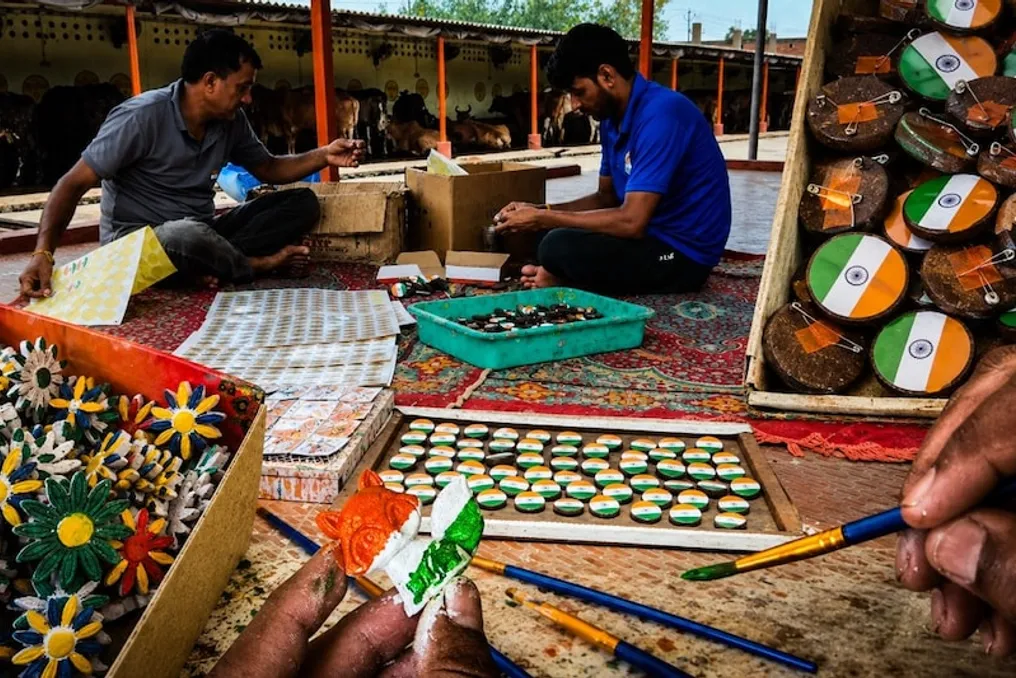
Various experiments related to the use of manure and livestock preservation are being conducted at the Maa Shakambri Kanhha Gaushala, managed by the Saharanpur Municipal Corporation. As part of this initiative, tricolor lapel badges for August 15th and Raksha Bandhan bracelets are being prepared from pure manure, which are sold both online and offline and are in high demand in the market.
According to Dr. Sandeep Kumar Mishra, an animal welfare officer at the municipal corporation, 547 head of cattle are currently under protection at the gaushala. The innovations created using manure at the gaushala have received numerous awards and recognition. In connection with the upcoming festivals of August 15th and Raksha Bandhan, 5,000 tricolor lapel badges and bracelets are planned to be produced.
The tricolor lapel badge manufactured at the gaushala costs only 10 rupees. Officials state that it is made entirely from pure cow dung and has the advantage of biodegradability. Dr. Sandeep Kumar Mishra reported that the pilot project was launched in 2024, during which 1,000 such badges were made. Following positive public reaction, 3,000 badges were made last year, and the quantity has been increased to 5,000 this year.
In the opinion of an official, plastic lapel badges are often discarded after use, causing environmental damage. Furthermore, improper disposal of tricolor badges can raise questions about respect for the national flag. Unlike them, manure badges are biodegradable; after use, they can be placed in a pot at home where they will serve as fertilizer. Thus, through one product, they are trying to convey a message of patriotism and environmental conservation.
This year, a special experiment was also conducted at the gaushala for Raksha Bandhan: the bracelets prepared here are in the shape of the tricolor. Bracelets with children's cartoon designs are also being made. The cost of these bracelets is also set at 10 rupees, and they can be purchased both online and offline. A special feature of these bracelets is that a tulsi seed is placed inside them.
After use, the bracelet can be planted in a pot or soil, from which a tulsi plant may grow. Thus, the bracelet will not be limited only to Raksha Bandhan but will also contribute to environmental preservation after use. Dr. Sandeep Kumar Mishra noted that the tulsi plant holds special significance, so using tulsi seeds in bracelets is a beneficial ecological initiative.
Dr. Sandeep Kumar Mishra, an animal welfare officer at the municipal corporation, stated that the Maa Shakambri Kanhha Gaushala has received numerous awards and certificates for its innovations and manure-based product manufacturing. He specified that the gaushala has achieved a world record and is named the first gaushala in India to receive the GMT certificate. Additionally, the gaushala has received ISO certification and the IVR Achiever Award from India Book. These awards were given for the innovations conducted at the gaushala and for the products made from manure.
The goal of the experiments conducted at the gaushala is to create products that can be a better alternative for the environment by utilizing manure. In the case of lapel badges, manure badges are produced as an alternative to plastic. Meanwhile, in the bracelets, tulsi seeds are used to convey a message of environmental protection. The bracelet can turn into a tulsi plant in the soil after use. Dr. Sandeep Kumar Mishra emphasized that the tulsi plant is considered very important, so the experiment of adding tulsi seeds to bracelets is a beneficial ecological initiative. Currently, 5,000 tricolor lapel badges and bracelets are being prepared at the gaushala for August 15th and Raksha Bandhan, priced at 10 rupees, and they are sold both online and offline.
This initiative combines patriotism, the utilization of livestock-related resources, and environmental conservation. The tricolor badge conveys the message of August 15th, while the tricolor bracelets with tulsi seeds link Raksha Bandhan with environmental protection.