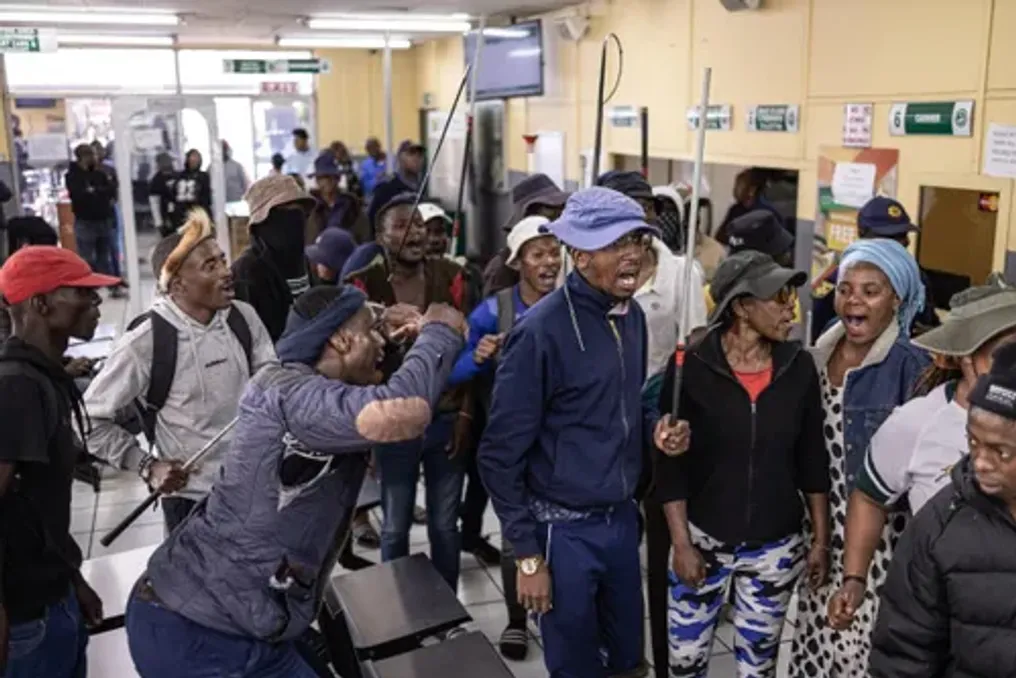
During a demonstration on July 30, 2026, protesters gathered outside the Department of Internal Affairs offices in Alexandria town, demanding the eviction of illegal immigrants. The article's author argues that migration is not solely a problem for South Africa, but a challenge for all nations.
Referencing an old African proverb stating that 'when the roof leaks in one house, the rain wets the entire village,' the author compares migration to this rain, which affects all borders, cities, and states across the continent and the world. He emphasizes that blaming only one country ignores the essence of the problem. Accusing South Africa of migration difficulties is an evasion of examining the true causes of migration.
Migration is a common task for all countries, whether it is the Mediterranean, the US-Mexico border, the Persian Gulf, or Europe, Nairobi, Lagos, or Johannesburg. Every government faces the same questions: who enters, how they are documented, and how to ensure the safety of both citizens and arriving individuals.
In Africa, South Africa hosts the largest number of migrants, both legal and illegal. The reason for this lies in the fact that after 1994, the country opened its doors to the world, creating an economy, constitution, and institutions that, despite their flaws, provide shelter, employment, education, and healthcare. For many people, South Africa becomes a destination.
The author calls for an honest inquiry into why public outcry is so intense in one place and so quiet in others. In some parts of North Africa, the migration route has been accompanied by horrors documented by investigations from the International Organization for Migration (IOM), the UN, and international media. These reports document the detention of African migrants in holding centers, sale in slave markets, beatings, and exploitation, as well as mass deportations of sub-Saharan Africans into the desert without food or water.
In some Persian Gulf countries, African workers face the 'kafala' system, passport confiscation, and conditions resembling modern slavery. However, this does not justify criminal acts and vigilantism in South Africa; the government has unequivocally condemned such actions and stressed that law enforcement agencies are pursuing those responsible.
The author questions the silence of Africa in this dialogue. When South Africans voice legitimate concerns about crime and the strain on social services, the continent responds by labeling it 'Afrophobia' or 'Xenophobia'—terms that have become associated only with South Africa. This, according to the author, is an avoidance of responsibility.
South Africa cannot single-handedly bear the weight of the continent's push factors. Responsibility lies with all nations of the world, which must work to reduce irregular migration by creating a favorable socio-economic environment in the home country, including providing jobs, security, governance, and opportunities. If prosperity is not developed where people are born, they will perpetually pursue it at the borders.
At the same time, it is necessary to acknowledge the difficulties faced by host countries like South Africa: overcrowded public clinics, full schools, and long waiting lists for housing, while resources are stretched to include foreigners. South Africa is likely one of the few African countries that assists undocumented migrants by providing them with treatment in public hospitals, education for children, and legal protection. The author believes that few countries show such kindness to migrants as South Africa, and does so due to its identity.
South Africans raise legitimate questions about crimes committed by untraceable illegal migrants, which put pressure on communities and services. When these concerns are voiced, they are quickly labeled 'xenophobic,' whereas similar phenomena in some of their own countries are named differently: 'security operations,' 'urban renewal,' or 'illegal aliens.' The author argues that this is not division, but an expression of democracy—the people's demand for governance from their government.
No country in the world can tolerate illegal migration; the law must prevail. The suggestion that South Africa should open its borders without rules is equivalent to demanding what no other nation will do. In 2015, the African Union adopted a resolution for a continental conference on migration, which has yet to take place, acknowledging that this is a continental, not a country-specific, problem. The resolution clearly stated that migration must be managed jointly, with dignity and order, but this conversation happens too infrequently, and countries remain in cycles of mutual accusation.
Bottlenecks include documentation, border management, data exchange, job creation, and law enforcement, and they cannot be solved by pointing to one country. The rain falls on us all, so we should stop arguing about whose roof is leaking and fix it together, because migration is not just a South African problem, but a global challenge requiring a global and African response.