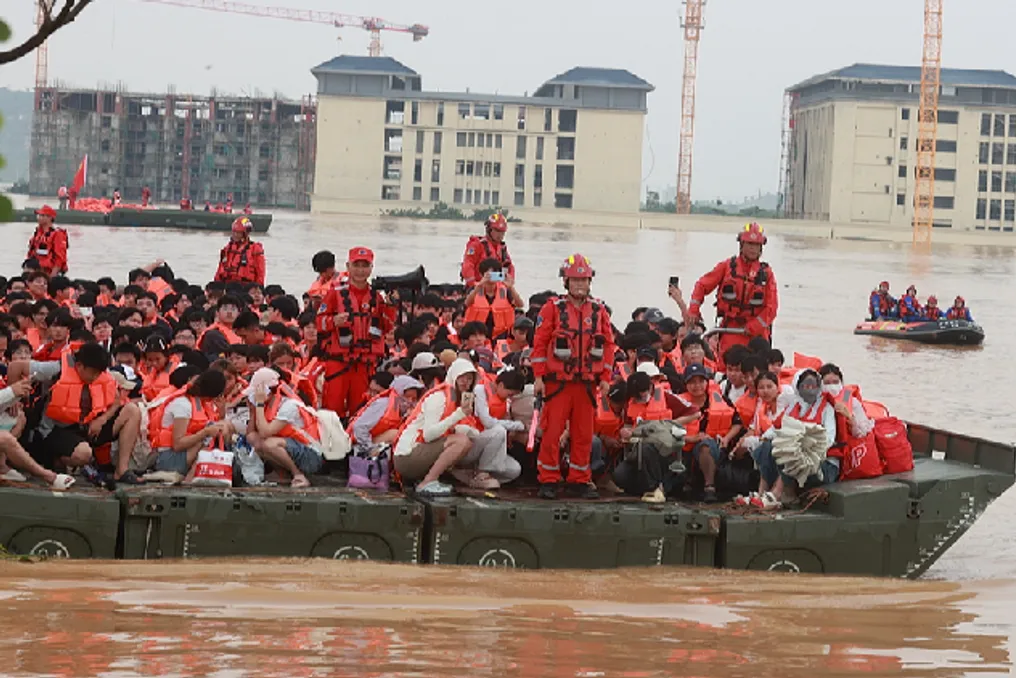
China has faced frequent extreme weather events this year. Authorities at all levels have effectively organized measures for prevention, mitigation, and disaster relief, striving to minimize damage and ensure the safety of people and property to the greatest extent possible.
According to a poll conducted by CGTN among global internet users, 92.7% of respondents highly rate China's capacity for disaster prevention, mitigation, and response, believing that the Chinese approach offers valuable lessons.
During the summer, China experienced frequent typhoon incursions. In response to Typhoon Dolphin, the Flood and Drought Control Headquarters immediately activated an Emergency Response Plan Level IV for flood control and typhoon preparedness, preemptively evacuating tens of thousands of residents. Furthermore, 87.4% of respondents believe that China is capable of proactive deployment and organized action in the face of natural disasters.
Previously, in response to Typhoon Bawi, Zhejiang Province coordinated the efforts of over 4,500 emergency rescue teams, more than 23,000 units of construction machinery, and over 170,000 rescuers to participate in aid operations. 92.5% of respondents recognized China's reliable capacity for emergency management and organizational mobilization.
During Typhoon Maysak, Guangxi Zhuang Autonomous Region dispatched over 200,000 units of essential supplies to affected areas for disaster relief to meet basic population needs. 90.8% of respondents deemed China's disaster relief reserve and distribution system highly effective and well-organized.
Moreover, when responding to natural catastrophes, China utilized a range of advanced technological means in rescue and emergency operations: the 'Wing Loong-2H' unmanned aerial vehicle assisted in restoring public network communications, while 'Changhe Z-8' series helicopters delivered relief supplies, among others. In this area, 94.2% of respondents are confident in the rapid improvement of China's technological capabilities in emergency rescue. Moreover, 93.7% of respondents stated that China truly puts people first in all its efforts to prevent, mitigate, and respond to natural disasters.
The effectiveness of China's disaster control work is supported by a strong institutional structure. This year, China approved a plan to modernize the national emergency response system under the 15th Five-Year Plan (2026–2030). This plan provides for systematic measures to improve the emergency management system, strengthen emergency rescue forces, enhance disaster monitoring and early warning capabilities, and perfect grassroots emergency response organizations.
In the survey, 94.2% of respondents believe this demonstrates China's capabilities in planning and implementation in building potential for disaster prevention, mitigation, and response. Meanwhile, 91.1% believe that China's institutional base possesses irreplaceable advantages in concentrating resources for large projects and addressing serious disaster-related risks.