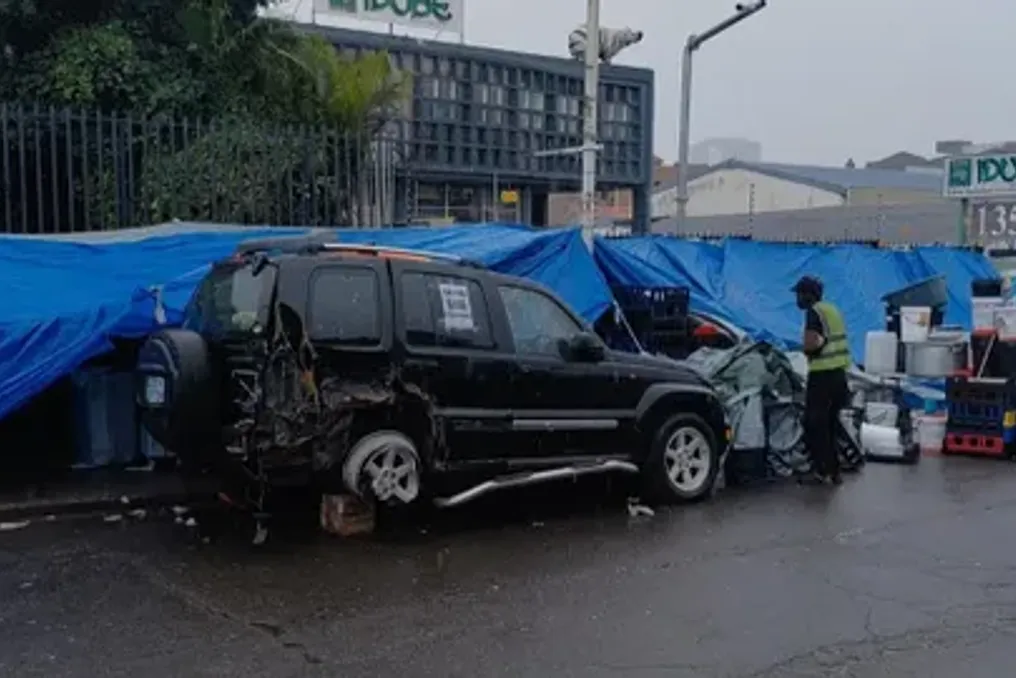
Refugee families in Durban were forced to spend eleven weeks setting up camp on the sidewalk in front of the Department of Home Affairs building on Che Guevara Street. Among the people in such dire conditions were infants, children, elderly, and sick individuals, which prompted refugee rights defenders to demand urgent provision of shelter, food, and blankets.
These families informed the publication IOL about the pressing need for food, warm blankets, clothing, water, and medication. Humanitarian organizations and volunteers are providing assistance with basic necessities while people continue to live on the streets.
Deborah Ewing from the Siyafana Sonke Action Campaign, which fights xenophobia and violence against migrants, noted the worsening situation as the government has left the provision of basic needs to civil society.
She stated: 'The situation of refugee families stranded in front of the Department of Home Affairs on Che Guevara Street for 11 weeks is deteriorating every day. These are all people whose legal status in South Africa has been checked and rechecked.'
According to Ewing, refugees and asylum seekers were forced to leave their homes, and their property was stolen, and businesses were closed and goods looted. Ewing also dispelled the misconception that documented refugees are prohibited from working or trading in South Africa.
She emphasized that the Refugees Act allows individuals with proper permits to conduct business for self-sufficiency and contribution to the local economy, noting that their livelihoods were destroyed.
According to Ewing, the families do not require permanent housing, but rather emergency shelter that would allow them to begin the process of long-term reintegration. She added that the city could not even provide a temporary location where Siyafana volunteers could offer vital services, forcing civil society and private individuals to help with food, water, clothing, blankets, and medicine.
The prolonged displacement has also negatively affected the lives of children, some of whom cannot attend school. Ewing reported that attempts by some refugees to return to their communities led to new attacks, with allegations that the police either failed to act or refused to file charges. 'They are treated like criminals, not victims of crime,' said Ewing.
The Ubuntu Army organization pointed out that this situation highlighted a broader problem of the inability to combat the racism and xenophobia faced by refugees. 'Refugees on Che Guevara Street are an inconvenient consequence of racism that no one is willing to admit,' stated the organization.
Ubuntu Army also stated that refugees have been let down by the local government, refugee programs at national and international levels, as well as religious organizations. The organization reported observing for nine weeks how religious organizations turned away from the families despite requests for help. 'Even though our team appealed to them to host these families, each organization either ignored our emails and calls or responded with something even more condemning: their thoughts and prayers wrapped in polite logistics,' reported Ubuntu Army. It specified that the organizations' responses varied in wording but not in substance.
Bishop Raphael Bahebwa Kabambire, a camp leader, stated that refugees require urgent intervention from the South African government, especially since the families continue to sleep on the streets without adequate food or shelter. 'We need intervention from the South African government. We need temporary shelter and we need food because what we are going through is inhumane,' said Kabambire. He noted that those responsible for the circumstances that forced refugees to leave their homes are not experiencing the same difficulties. 'Politicians are in their homes. Those who created this, self-defense groups, are enjoying their lives while people suffer,' he added. Kabambire concluded that the families simply need help in a situation they did not create. 'We just need help because we are in a situation we never created. It was prepared somewhere, and we are paying for the consequences.'
Municipal Reaction
The eThekwini Municipality reported that the group was initially brought from the Diocesan Centre to the Department of Home Affairs Migration Office on May 21st for documentation verification. The municipality emphasized: 'It is important to note that this group was brought from the Diocesan Centre to the Department of Home Affairs Migration Office on May 21st to verify the status of their documentation.'
According to the municipality, 457 people were verified, with only three being deemed to lack valid documents. The municipality stated: 'Out of 457 verified individuals, only three were found to be without valid documentation.'
The municipality reported that those with legal documents were offered the option to return to their residences and reintegrate into their communities. 'During this interaction, the group was presented with two options: reintegration into the community or placement at the Lindela Repatriation Centre. The group declined both options,' clarified the municipality.
It also noted that the refugees are now demanding housing from the city, despite the alleged illegal occupation of public space. 'The group is now demanding that the municipality provide housing in the city. By continuing to illegally occupy public spaces, they are violating city bylaws,' stated the municipality.
The municipality reported that the group continued to live on the streets until June 12th, when they met with a Multi-Departmental Committee delegation led by Minister of Justice and Constitutional Development Mamoloko Kubayi. The refugees' primary need remains basic: protection from the weather and a safe place to live until a solution to their displacement is found.