
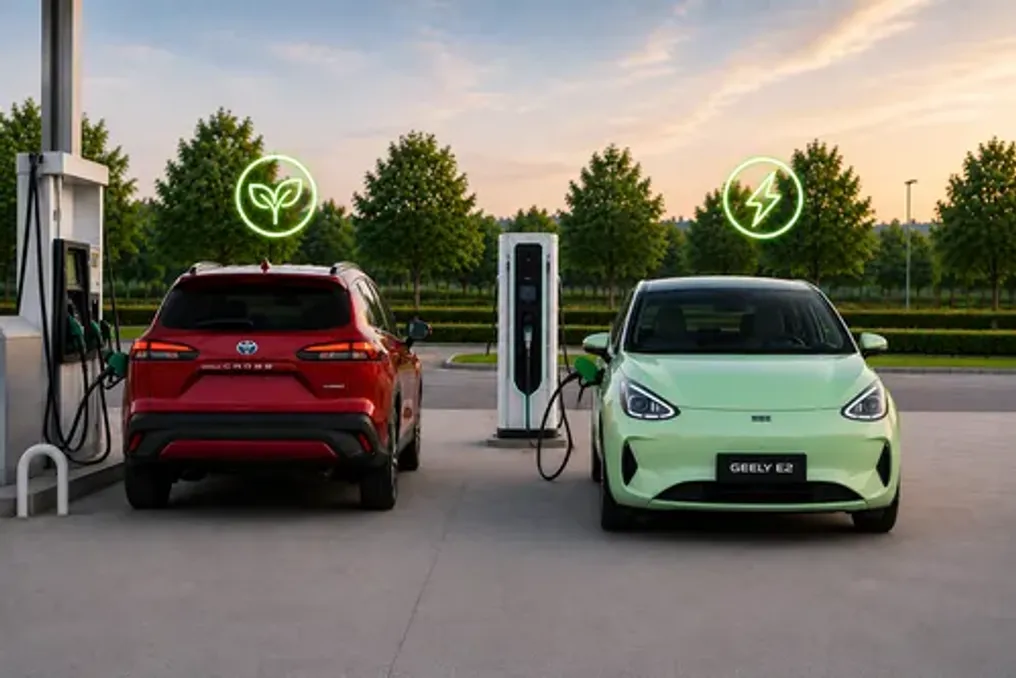
There is an increase in sales of New Energy Vehicles (NEVs) in South Africa, but hybrid models maintain their leading position in the market despite the appearance of affordable electric cars such as the Geely E2.
New data published by Naamsa this week sheds light on the dynamics of the NEV market and the share they hold in the total sales volume for 2026. This data also shows that hybrid cars are significantly more popular than fully electric vehicles (EVs).
According to the Naamsa report, 13,193 NEVs were sold in South Africa from January to June 2026, accounting for 4.1% of the total new car market.
Dominance of Hybrids in NEV Sales
More than half of all NEV sales went to traditional hybrid cars: 6,667 units were sold in the first half of the year, securing them a 50.5% share of the NEV market. They were followed by plug-in hybrids (PHEVs) with sales of 4,623 units, representing a 35% share, while battery electric vehicles (BEVs) accounted for 14.4% of the NEV market, selling 1,903 units.
Furthermore, Naamsa presented data for June, according to which the share of NEVs in the total market volume rose to 5.5%. During this month, 3,045 NEVs were sold, demonstrating an annual growth rate of 104.2%. The most popular hybrid in South Africa is likely the Toyota Corolla Cross.
In June, traditional hybrids continued to dominate the NEV category, showing a 48.9% share with 1,488 units sold. Plug-in hybrids (PHEVs) accounted for 990 units sold with a 32.5% share, while battery electric vehicles (BEVs) registered 419 sales, corresponding to a 13.8% share. Commercial electric vehicles added another 148 sales, making up 4.9%.
Naamsa notes that the steady growth across all three technology categories indicates that consumers are increasingly adopting electrified vehicles as awareness and the variety of NEV offerings grow. The company also emphasized that the current market composition provides important insight into the electrification trajectory of South Africa: instead of a rapid shift to BEVs, the local market is following a diverse technological path, with hybrid technologies continuing to contribute the most to the growth of electrified vehicles.
Naamsa added that this reflects existing market conditions, including issues of affordability, consumer driving habits, availability of charging infrastructure, and technology choice. However, the industry organization cautioned that South Africa's policy framework for the automotive industry must remain 'technologically neutral,' allowing manufacturers and consumers to choose the most suitable technologies as the market develops.
Growing Interest in Electric Vehicles
Separate data from AutoTrader indicates an acceleration in interest in electric vehicles in South Africa, albeit from a low base. A study conducted by OLX Group showed that the number of EV listings on the platform increased by 154.6% year-on-year in June 2026, marking the second-largest growth rate among five analyzed markets.
Nevertheless, South Africa is at an earlier stage of EV adoption compared to European markets. Chinese brands currently attract demand primarily for pickups and crossovers with gasoline and hybrid engines, rather than electric models. Chinese automakers accounted for 7.31% of demand among Chinese brands on the platform—the highest share among studied markets—but only 0.3% of this demand was for EVs.
However, Chinese brands are expected to play a significant role in South Africa's eventual transition to EVs as they continue to release more affordable models. In fact, every fully electric vehicle sold in South Africa priced under 800,000 Rand is a Chinese-made model, and 13 different models compete in this price segment.
Chery South Africa plans to launch the fully electric hatchback Chery Q in September. Among the most affordable models are the new Geely E2 Aspire, starting from 339,900 Rand, and the BYD Dolphin Surf, starting from 341,900 Rand, while the expected Chery Q hatchback is also anticipated to cost less than 400,000 Rand.
The cheapest hybrids available in South Africa include the GWM Ora 5 from 424,900 Rand, the Chery Tiggo Cross CSH for 439,900 Rand, and the BYD Atto 2 DM-i for 449,900 Rand. Naamsa has not published detailed data showing sales volumes of individual electric and hybrid models in South Africa.