The long-awaited day has arrived for Spanish citizens, as a total solar eclipse will occur this Wednesday (12th) crossing the Iberian Peninsula for the first time since 1905. This event also represents the first total solar eclipse to traverse the European continent in over two decades.
Spectators can follow the phenomenon in real time through various Olhar Digital platforms, with a live broadcast led by Bruno Capozzi, the portal's executive editor, and astronomer Marcelo Zurita, starting at 1:30 PM Brasília time. This eclipse is considered one of the most significant of the decade.
Eclipses are defined as astronomical occurrences where one celestial body totally or partially obscures another star due to the interposition of a third luminous body. In 2026, a total lunar eclipse, known as the 'Blood Moon,' and an annular solar eclipse that created a 'Ring of Fire' in the Antarctic sky have already been recorded.
The year will feature two more celestial events: this Wednesday's total solar eclipse and a partial lunar eclipse scheduled for the nights of August 27th and 28th, visible across Brazil.
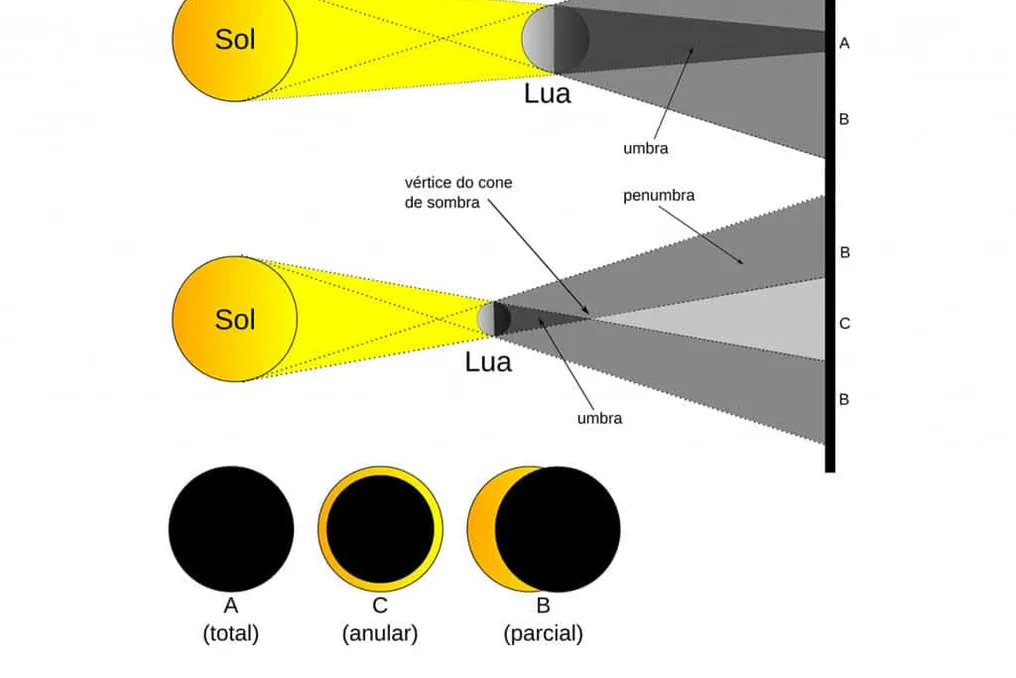
The distinction between eclipse types lies in the arrangement of the celestial bodies. In the case of a solar eclipse, the Moon is positioned between the Sun and the Earth, casting its shadow onto a portion of the planet. In a lunar eclipse, the Earth is intermediate between the Sun and the Moon, causing the Earth's shadow to reach the natural satellite.
It is estimated that more than 15 million people will be located within the path of totality of this solar eclipse, while approximately 980 million may witness the event, at least in its partial phase. The Sun will be completely covered in regions of the Arctic, Greenland, Iceland, northern Spain, and a small area of Portugal. In other areas of Europe, North Africa, and the eastern part of North America, the Sun will be partially obscured by the Moon.
According to Time and Date platform data, the eclipse begins at 12:34 PM (Brasília time) in the Arctic Ocean, north of Siberia, and will end at 4:55 PM in the Mediterranean Sea, west of Italy. The moment of greatest intensity of the spectacle will occur near the west coast of Iceland, where totality may last up to 2 minutes and 18 seconds. In Spain, the complete darkness will be shorter, lasting about one minute.
A notable aspect is the coincidence of this phenomenon with the peak of the Perseid meteor shower. The brief daytime darkness can create ideal conditions to spot a 'shooting star,' while also allowing the observation of the solar corona, which is the Sun's outer atmosphere, usually obscured by its intense brightness.
Unfortunately, Brazil will not be part of this event. The last time a total solar eclipse was seen in the country was over thirty years ago, on November 3, 1994. According to Time And Date, the next such event visible in Brazilian territory is predicted for August 12, 2045, almost twenty years from now.
On this future occasion, the path of totality should predominantly cross the North and Northeast regions. Among the capitals that can see the Moon completely covering the Sun are Belém, in Pará; São Luís, in Maranhão; João Pessoa, in Paraíba; and Recife, in Pernambuco. The duration of totality will vary depending on the observation point, potentially exceeding four minutes in certain central locations, allowing for the viewing of the solar corona. Outside this restricted path, the eclipse will only be visible partially.
This occurrence signals the return of total solar eclipses to the European continent after more than two decades. The last widely observed event in Western Europe occurred in 1999, and the last time the path of totality crossed continental Europe was in 2006, covering Greece and Turkey. In Spain, expectations are even higher, given that the country has not registered a total solar eclipse on its continental territory for over a century.
Another relevant point is that the shadow's trajectory will cover inhabited and strategic areas, passing through parts of Greenland, Iceland, and Spain. The passage of the path of totality through easily accessible and highly tourist-attracting locations should generate intense movement of visitors, enthusiasts, and scientific teams along the entire route.
The duration of 2 minutes and 18 seconds at the peak of alignment is considered satisfactory for an event of this magnitude, offering adequate time for detailed analysis of the structure of the Sun's outer atmosphere.
For the scientific community, the darkening of the solar disk provides a crucial window for investigation. According to NASA, with the blocking of the intense brightness of the photosphere, researchers will be able to record the solar corona, monitor coronal mass ejections, and map variations in the solar magnetic field under optimal observation conditions.
Given this rare scientific opportunity, the two largest global space agencies will also pay attention. NASA will conduct research aboard a WB-57 aircraft, flying at about 15.2 km altitude to track the lunar shadow and extend the observation time of the solar corona. This aircraft will be equipped with cameras capable of capturing images in various wavelengths, assisting scientists in studying solar prominences, the extreme heating of the corona, and its connection to the solar wind.
In Iceland, 80 scientific balloons will be launched before, during, and after the eclipse to study the atmosphere's reaction to the passage of the lunar shadow. In Spain, six additional balloons will be equipped with 360-degree cameras and sensors to monitor the shadow and ozone levels. This data will help understand how variables such as temperature, humidity, time, and season affect atmospheric changes caused by the total solar eclipse.
The European Space Agency (ESA) has organized a special schedule to follow the event, including observations, live broadcasts, educational activities, and scientific outreach. ESA will also use the eclipse to highlight missions studying the Sun and its influence on Earth, such as Solar Orbiter, Smile, and Proba-3, composed of two spacecraft investigating the solar corona.
One of the central points will be an international live broadcast from the Javalambre Astrophysical Observatory in Spain, located within the path of totality, where specialists will explain the phenomenon and related studies of the Sun. ESA will also promote a free public observation in León, with lectures, educational activities, and live broadcasting in collaboration with the University of León and the local city council.
The campaign will also have an educational focus, providing materials about eclipses in English and Spanish for educators and science communicators. The material covers explanations of the phenomenon, guidelines for safe observation, and didactic activities. ESA also contributes to the Spanish project 'Trio de Eclipses,' supporting scientific dissemination and providing accessible information about the sequence of eclipses that will affect the country.
When the Moon obstructs the Sun's light during a total solar eclipse, the day turns into night for a few minutes, the temperature drops, and animals change their behavior. Furthermore, according to NASA, the phenomenon temporarily modifies an invisible layer of the atmosphere that influences the propagation of radio waves.
However, can these changes cause internet outages, GPS failures, or communication interruptions? The concise answer is yes, but temporarily, locally, and distinct from the alarmist scenarios of a 'technological blackout.'
For those in the path of totality, the event offers a unique chance to observe and photograph the solar corona, the Sun's outer atmosphere that is normally hidden by the star's intense brightness. However, recording this moment requires caution. Pointing any camera, cell phone, binoculars, or telescope directly at the Sun without appropriate protection can damage the equipment and, primarily, vision.
The primary rule is to use specific solar filters for astronomy during all phases when the Moon has not yet completely covered the Sun. This applies to cameras, lenses, telescopes, and other optical instruments. It is essential to remember that image magnification provided by lenses or telescopes does not guarantee eye protection. Looking directly at the Sun, even for a short period, can result in serious eye injuries. The only safe phase to remove the solar filter from an optical instrument is during totality, when the Moon completely covers the solar disk. As soon as the intense sunlight returns, the filter must be reapplied.