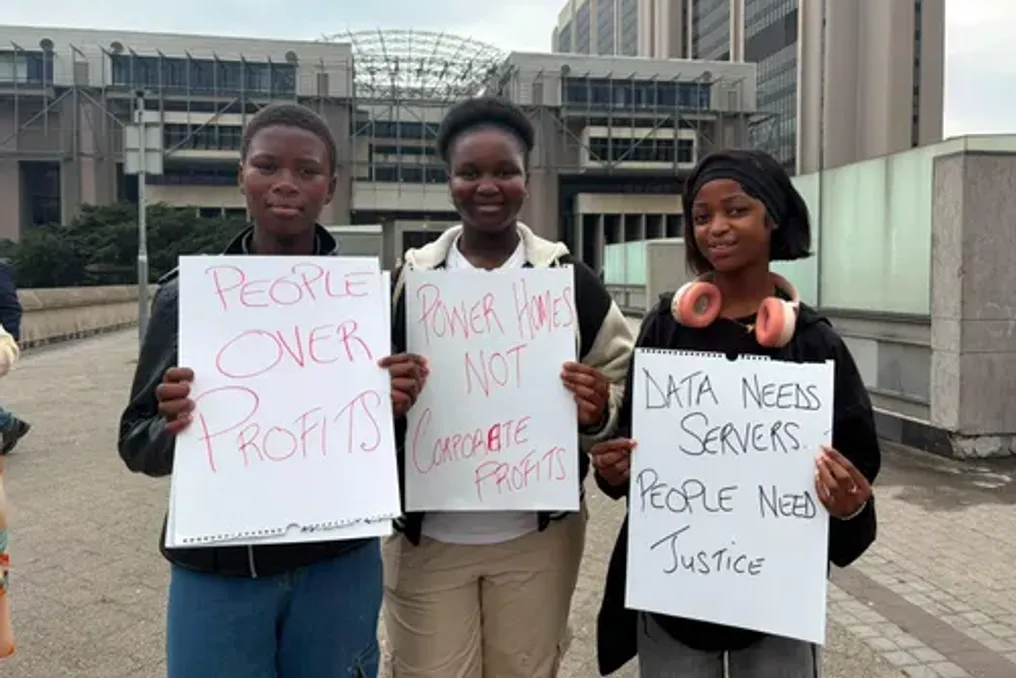
The Cape Town municipal planning tribunal approved a controversial zoning change for the construction of a new hyperscale data center by Equinix, despite serious opposition from local groups concerned about environmental and community impact. Article author Hassan Lorgat analyzes the discrepancies in discussions about AI data centers in the US and South Africa, emphasizing the urgent need for critical discussion and regulatory oversight.
In South Africa, the public discourse on AI data centers, according to the author, is insufficiently critical and vigilant regarding the potential dangers these facilities pose. Mainstream media often exhibits self-congratulation, asserting that South Africa is Africa's largest economy with developed digital infrastructure, including undersea cables, allowing it to host 70% of the continent's data centers that support cloud computing and artificial intelligence.
However, the situation is drastically different on the other side of the Atlantic. Just a few days ago, data centers became the subject of sharp criticism rather than praise. On Wednesday, August 6th, two progressive candidates—Abdul El-Said and William Lawrence—achieved significant success by drawing attention to the functions of data centers.
These candidates won their primaries and became Democratic Party nominees for the upcoming November elections, defeating Republicans. Their victories intensified the fight against data centers, turning the issue into a political battleground. These successes are also viewed as a victory for real industry regulation, which Trump considers a new source of economic growth.
President Donald Trump, who has close ties to technology companies, actively supports the expansion of AI data centers, calling them vital 'money-making machines.' He hopes they will stimulate economic growth, create jobs, and help maintain US technological, AI, and military superiority over the People's Republic of China. Nevertheless, accelerating this process faces serious obstacles, as local communities increasingly complain about a lack of genuine consultation when these facilities are built near their neighborhoods. Issues cited include noise, excessive consumption of electricity and water, land use, and other factors straining local resources.
Theoretically, the administration issued Executive Order No. 14318, concerning the federal permitting process and efforts to accelerate data center construction. This order is linked to the Consumer Protection Promise, which requires large tech companies to finance their own power plants, but this has not convinced many of its benefits.
One of the winners was young organizer William Lawrence, who co-founded the Sunrise Movement. He won the Democratic primary in Michigan's 7th district on August 4, 2026, defeating two more moderate opponents. The central theme of his campaign was the introduction of a moratorium on data center construction. This paved the way for his participation in the highly competitive congressional race in November against a Republican. He garnered support from influential progressives such as Roy Khanna and Bernie Sanders.
The other winner was Abdul El-Said, who won the Democratic primary for Michigan Senate against a more moderate representative, Hayley Stevens, who spent over $65 million on him. El-Said stated at an event in July before the election: 'People truly hate data centers.' And he was right.
As expected, this victory was not positively received by Donald Trump, who stated on Fox News that American democratic socialists or their members would 'destroy our country.' Although El-Said was not endorsed by the DSA, he was supported by democratically socialist legislators Alexandria Ocasio-Cortez and Bernie Sanders.
Trump made statements: 'When you come to these cities taken over by socialists and communists, they are always dirty, disgusting. Besides crime and all other problems—there is no work, nothing, no money—they are always dirty, disgusting, and that is what you will get.'
Despite these slanderous remarks, it seems US citizens have finally realized their true interests: control over politicians.
These tense victories are part of a near-complete progressive success in other states, such as in Tennessee's redrawn 9th congressional district, where anti-corporate funding activist Justin Pearson won the Democratic primary. Organizer Lawrence accused both parties of adopting a corporate agenda regarding data centers and the so-called AI bubble. In his victory speech, Lawrence outperformed more moderate and better-funded Democrats by focusing on public resistance to data centers. During the campaign, he highlighted the impact of data centers and praised the ability of people to demand accountability from authorities.
Ultimately, everything turned out as Lawrence told his supporters after the win: 'It turns out that if you don't take money from Silicon Valley, you can fiercely fight for a federal moratorium on data centers. Today, the residents of Michigan's 7th district sent a clear signal: they are tired of Silicon Valley billionaires and Washington insiders dictating the future of our cities and our country.' Lawrence also had the advantage of facing two candidates—former US Ambassador to Ukraine Bridget Brink and former US Marine Matt Masdam—who could split the vote. He now faces incumbent Republican and first-term Congressman Tom Barrett.
It is important to note that both these candidates achieved significant victories through active resistance, not problem distortion. All progressive candidates opposed corporate funding of US politics, objected to data centers due to massive energy consumption, freshwater depletion, and rising utility bills, and were proponents of grassroots organizing, dedicating time to listening to communities and solving their problems.
Thus, much work lies ahead, as exponential growth in both narrative and practical activity is expected. A common story is that the growth of AI data centers is driven by cloud computing, artificial intelligence, and digitalization, although the scale and timeline of this growth remain uncertain. While South Africa is the continent's largest data center hub, it is negligible compared to the 5,500 data centers in the US. People are slowly starting to ask questions, but answers are coming slowly. Another issue is that recognizing this problem as an activist one has not yet gained widespread traction. When it does, it will open opportunities for the revival of community activists from various movements—water, environmental, land, and broader ecology. This is the challenge that data centers pose to our democracy.
In the US, the right to ask questions is often ignored. The Trump administration, as seen in Boulder City, Nevada, unilaterally approved a data center on public land within the city's jurisdiction during the summer months, denying residents a vote and failing to conduct a project-specific environmental assessment. This appears typical and happens in other parts of the world.
A small step was the submission by the Data Center Watchdog Group to the South African Human Rights Commission (SAHRC) of an investigation into data centers titled 'AI Force Humanitarian Crisis.' The report provocatively asserts that none of the 56 AI data centers have provided adequate public environmental and human rights impact assessments, and calls on developers to prove otherwise by providing evidence of proper public consultation. Any deficiencies must be rectified within a strict timeframe (e.g., three months), or operations must be suspended.
The submission argues for a more viable, scientifically grounded alternative: 'distributed, scaled-down data center infrastructure that prioritizes resource sovereignty, community benefit, ecological sustainability, and agricultural protection over brute extraction.' It is argued that through regulatory standards mandating distributed infrastructure, comprehensive human rights impact assessments, and community consent, South Africa can protect both constitutional rights and the environment.
Historically, South Africans have a strong tradition of organization, but the author fears they may have lost their sharpness. They can learn from the US. Americans have truly returned to basics—valuing every union member, every neighborhood resident as a worthy resource for building an accountable democracy. It seems that these primaries rejected corporate control over politics. This is the only reason they managed to put the potential harms of AI data centers and demand their regulation on the agenda. Some of these lessons are worth learning.