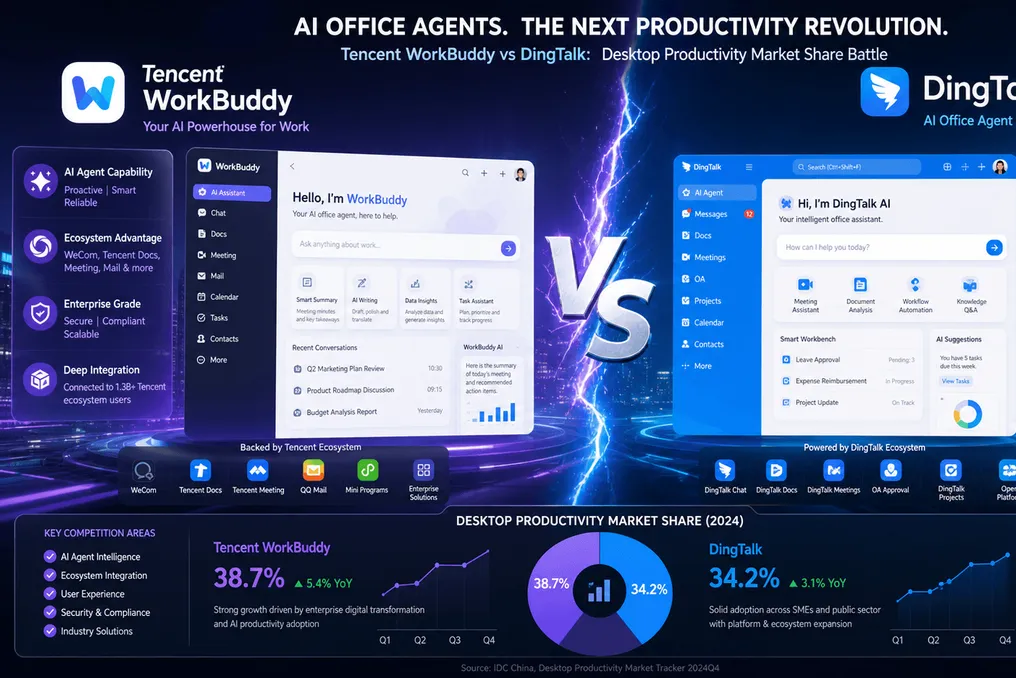
The monthly active user count for Tencent WorkBuddy reached 20.97 million visits in June, surpassing the combined portfolio of all Alibaba artificial intelligence products. This situation put pressure on DingTalk's new CEO, Chen Yusen, who decided to launch Qianwen Office within 46 days of consolidating three existing products.
Strategic Recognition and Priorities
Ma Nan personally praised WorkBuddy during Tencent's quarterly report, calling it the most widely used AI efficiency agent in China. Furthermore, President Martin Lau mentioned WorkBuddy three times in the same call, while Yuanbao was mentioned only once, signaling a strategic priority for Tencent.
WorkBuddy's Appeal
WorkBuddy's success is attributed to its integration with WeChat, including QR code login, mini-program integration, and setup without specialized knowledge. Non-technical employees use this tool for creating reports, presentations, coding, and participating in meetings. Tencent captured the ecosystem niche while Alibaba focused on internal competitive races, and ByteDance positioned Kouzi as a developer tool.
Limitations and Advantages of Ecosystems
However, WorkBuddy faces structural limitations when deeply penetrating the corporate sector. WeCom functions more as a customer communication tool rather than an enterprise workflow operating system. Core business data, approval processes, and organizational rights are handled in DingTalk or Feishu, not WeCom. Qianwen Office, conversely, can directly interact with ERP interfaces, approval mechanisms, and permission systems within the closed DingTalk ecosystem. This allows for tasks such as financial reconciliation requiring ERP inventory data, budget comparison, multi-level approval, and generation of payment orders, all within a single seamless process.
Comparative Analysis of Approaches
WorkBuddy is forced to extract data from external ERP systems, process it, and then write it back, creating an additional step, delay, and security risk for regulated industries. Meanwhile, DingTalk serves over 26 million enterprise organizations with deep workflow integration, despite the paid conversion rate remaining below 1%. The competitive dynamic is shifting from consumer feature competition to the depth of integration into corporate workflows. WorkBuddy's strategy, based on expanding the skills ecosystem and gradually introducing enterprise functions through partnerships with ZTE, Meituan, and Ping An Bank, represents a long-term peripheral approach. In contrast, Qianwen Office's strategy, focused on deep integration with DingTalk, aims for the position of an enterprise operating system, where AI becomes an integral part of every workflow—from expense reimbursement to hiring and sales analysis.
Future of the Office AI Market
The battle line runs between the advantage of WorkBuddy's consumer ecosystem and the depth of DingTalk's corporate integration. The ultimate winner will depend on which approach converts more effectively into paid corporate subscriptions. Tencent faces the challenge of gaining enterprise trust without an enterprise operating system infrastructure, whereas DingTalk struggles with the task of converting its massive base of free users into paying customers. Both approaches have yet to prove their effectiveness at scale for office AI agents, making the desktop office AI market the most significant strategic battleground in Chinese consumer-enterprise technology.