Millions of astronomy enthusiasts worldwide are preparing to witness the rare total solar eclipse on August 12. At the moment of maximum totality, the Moon will completely cover the Sun for up to two minutes and ten seconds.
According to data from the Astronomical Center, the eclipse trajectory will pass through parts of Greenland, Iceland, and Spain, and will also cross a small area of Portugal. The longest period of complete darkness is expected over the North Atlantic, west of Iceland.
Eclipses occur when the Moon passes directly between the Sun and Earth, casting a narrow band of shadow onto our planet. During this phenomenon, a strange twilight sets in, temperatures drop, shadows fall at unusual angles, and some animals fall asleep.
Although residents of the UAE will not be able to see this eclipse, they can follow it online. NASA will begin a live broadcast at 17:15 UTC (9:15 PM UAE time). The broadcast will include live footage from different points along the path of the eclipse and detailed scientific commentary. The NASA stream is available on YouTube, Twitch, NASA+, Facebook, Instagram, and Amazon Prime.
Additionally, the Time and Date channel will launch its live broadcast on YouTube from the city of Leon in northwestern Spain and from the island of Mallorca, starting at 17:00 UTC (9:00 PM UAE time).
For observers in Spain, the total eclipse will last less than two minutes shortly before sunset. In the northern city of Burgos, darkness will set in approximately between 20:26 and 20:31, depending on the location. The duration of the total phase will be from one minute and fifteen seconds to one minute and forty-six seconds.
The Astronomical Center reports that in the Skorsby Sund region of Greenland, the total phase will begin around 16:35 local time (21:35 UAE time) and last one minute and forty-six seconds.
In Iceland, totality will begin at 17:45 in Snæfellsjökull and last about two minutes and ten seconds, while Reykjavik will experience totality for about one minute starting around 17:48.
Millions of people in Europe will see an impressive partial eclipse. Approximately 91 percent of the Sun will be hidden in London, 92 percent in Paris, 94 percent in Dublin and Lisbon, and 99.96 percent in Madrid.
This will be the last total solar eclipse visible from Earth until 2027, although a ring solar eclipse will occur on February 6, 2027, over parts of Africa and South America.
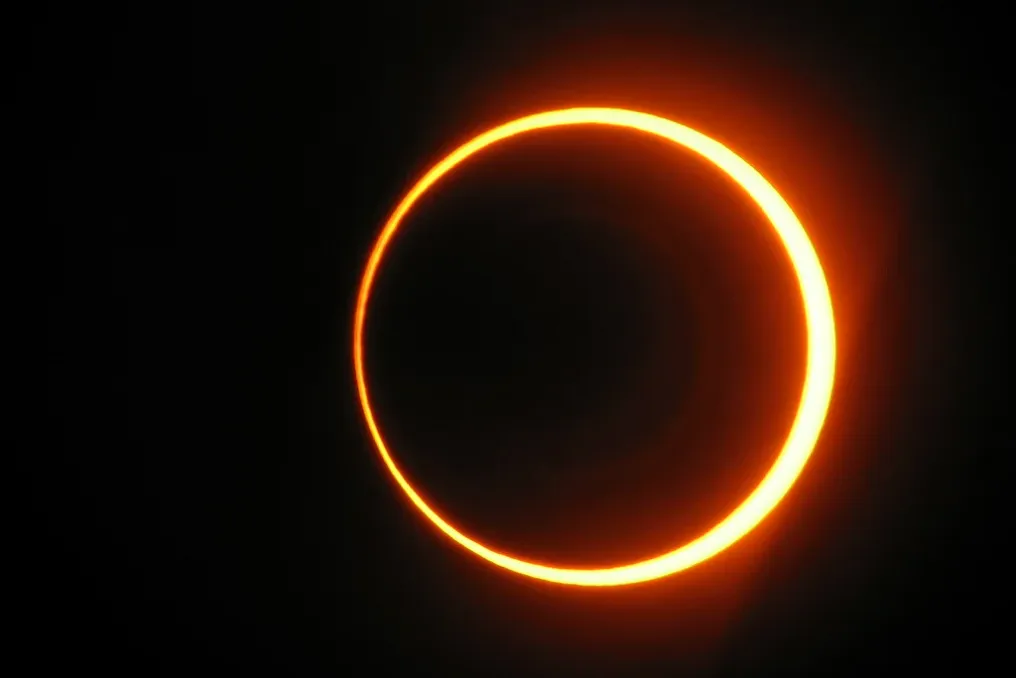
A ring solar eclipse occurs when the Moon passes directly in front of the Sun while being at its farthest point from Earth. Because the Moon appears smaller than the Sun, it leaves a bright visible outer ring known as the 'crown of fire.'
Solar eclipses happen roughly once a year, but due to the narrow band of totality, the same area may have to wait up to 400 years to see such an event again.
Another total solar eclipse will occur on August 2, 2027, crossing southern Spain, North Africa, and the Arabian Peninsula. Its total phase will last six minutes and twenty-three seconds. A longer eclipse will not occur until 2114.
Spain will again experience an eclipse on January 26, 2028, when a ring eclipse, or 'crown of fire,' passes over the southern regions.
Experts strongly advise against looking directly at the Sun during an eclipse, as this can cause serious eye damage. Special eclipse sunglasses are recommended, which filter ultraviolet radiation and comply with ISO 12312-2:2015 standards. Since there are no pain receptors in the eyes to warn the brain of injury, problems only manifest later. Studies have shown that after the total solar eclipse in the USA in 2024, there was a sharp increase in searches for queries like 'my eyes hurt.'