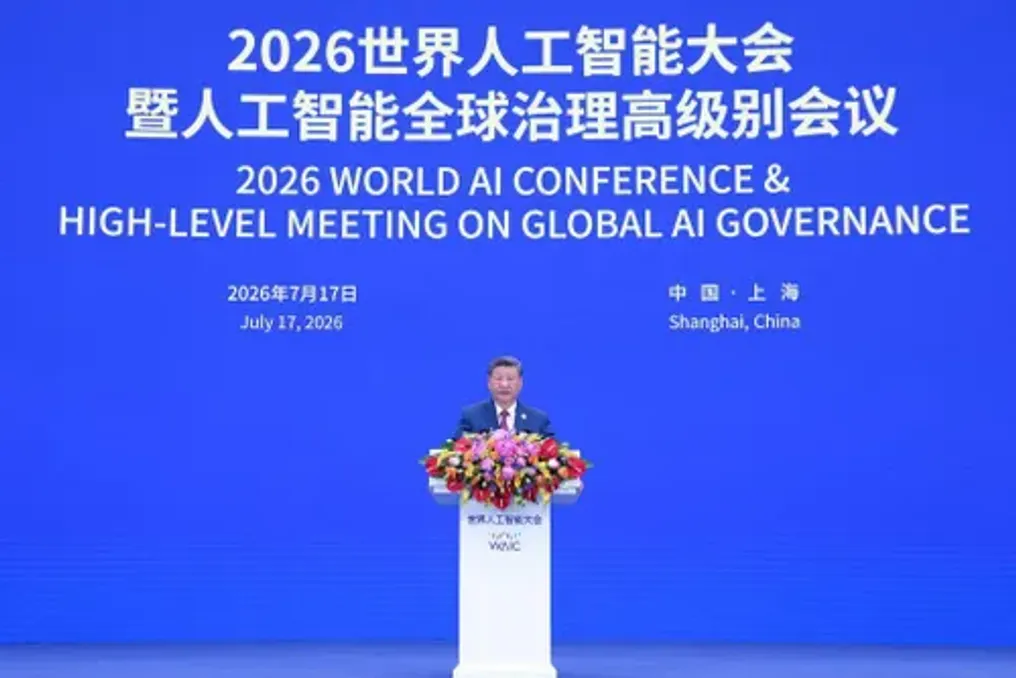
At the opening of the World Artificial Intelligence Conference 2026 and the High-Level Meeting on Global AI Governance in Shanghai on July 17, 2026, Chinese President Xi Jinping delivered a keynote address. He presented a concept for an alternative structure to regulate one of the most significant technologies of the century.
In his speech, titled 'Joint Efforts to Build a Fair and Equitable System of Global AI Governance,' Xi Jinping outlined a vision that merges China's internal industrial aspirations with a targeted appeal to the Global South. A day earlier, twenty-nine countries signed an agreement establishing the World Association for Artificial Intelligence Cooperation (WAICO)—a new intergovernmental body headquartered in Shanghai, positioned as the first entirely dedicated to AI cooperation and governance.
Collectively, the speech and the new organization mark an important stage in the global contest to define the rules of artificial intelligence operation.
Xi Jinping began his address with a historical reference to the 1956 Dartmouth Workshop, where American scientists first coined the term 'artificial intelligence.' He noted that after seven decades, the world finds itself at a similar turning point, but now the stakes are civilizational rather than academic. He then described a period of accelerated technological revolution and industrial transformation, during which intellectual connectivity, human-machine collaboration, and cross-sector integration unleash immense power carrying both exceptional opportunities and serious governance challenges.
He framed the problem through four unresolved questions that, in his view, humanity must answer together: how to coexist with thinking machines, how to ensure the safety of decision-making processes increasingly influenced by algorithms, how to manage the ethical dilemmas posed by adaptive technologies, and how to guarantee that AI benefits everyone, given that the gap between rich and poor countries in AI continues to widen.
These questions reflect a genuine concern shared among capitals from Pretoria to Jakarta and Brasilia that the AI revolution could reproduce or exacerbate the inequalities of previous waves of industrialization, when technological leadership concentrated wealth and strategic power in the hands of a small number of states.
Xi Jinping's address was structured around four observations that collectively form a comprehensive governance philosophy. The first concerned a call for openness and mutually beneficial cooperation to stimulate innovation. Xi Jinping strongly urged countries to embrace open development, joint research, and common application of AI across traditional, emerging, and future industries so that the technology's benefits are not limited to a few companies or states. This aligns with China's own trajectory. Beijing pursues an unusually open AI strategy compared to the United States, with Chinese firms such as DeepSeek, Alibaba's Qwen, and Zhipu AI releasing freely licensed large language models that have garnered significant interest among developers in Africa, Southeast Asia, and Latin America—markets least able to afford the computational costs and licensing fees associated with proprietary Western models.
The second pillar focused on risk awareness and governability. Xi Jinping called for the creation of laws, regulations, technological monitoring, early warning mechanisms, and emergency response systems capable of preventing misuse and ensuring that AI always remains under human control. Notably, he also called on countries to jointly oppose the excessive expansion of national security concepts into AI, a clear reference to the export controls, chip restrictions, and investment screening measures applied by the United States and its allies against Chinese AI firms in recent years. This governance framework is simultaneously cautious about technical AI risks and critical of what Beijing perceives as the securitization of technological policy by Washington.
The third pillar—inclusivity and mutual learning between civilizations—reflects a theme present in China's foreign policy discourse for several years, dating back to the Global Civilization Initiative, which Xi Jinping first proposed in 2023. Applied to AI, the argument is that the values embedded in algorithms should reflect the common and diverse ethical traditions of humanity, not the norms of any single civilization. This is an implicit response to concerns that AI systems trained predominantly on Western data and created by Western firms risk encoding a narrow set of cultural assumptions as universal standards.
The fourth pillar, solidarity and improved global governance, marked the transition from principles to institutional building. Xi Jinping called for genuine multilateral cooperation, a stronger role for the United Nations, and closer coordination of AI development strategies, governance rules, and technical standards to create a consensus-based global governance system without delay. He stated directly that this must include capacity building support for Global South countries, presented not as charity, but as a way to prevent what he termed a new historical injustice in AI—a phrase deliberately echoing language often used to describe colonial resource and technology extraction from the developing world.
Xi Jinping did not present these principles in a vacuum. He grounded them in China's own achievements, noting that the fifteenth Five-Year Plan of China begins this year, which, according to him, defines the country's economic and social development for the next five years and creates opportunities for the international community. He pointed to the interaction between an efficient market and a well-functioning government as the foundation of China's AI innovation strategy, emphasizing that the core sectors of its smart economy are now valued at over one trillion yuan, equivalent to approximately $140 billion USD at the current exchange rate, with intellectual production being named the defining characteristic of what Chinese officials call Chinese modernization.
He also carefully stressed that this growth has not occurred at the expense of governance discipline. China, he said, continues to refine its laws, rules, policies, application norms, and ethical principles so that AI development proceeds safely, reliably, and in a manner that remains, in his metaphor, a fine steed running both fast and steadily. This balance between rapid adoption and regulatory caution is a tension recognized as vital and unresolved in the contexts of many governments, including those of South African policymakers working on the president's AI Master Plan.
The most significant outcome emerging from Shanghai was not the speech itself, but the institution it established. Since 2023, Xi Jinping has worked toward this moment through a series of proposals: the Global AI Governance Initiative, the UN General Assembly resolution on international AI capacity-building cooperation, the AI Capacity Building Action Plan for Good and for All, and the AI Cooperation Plus International Initiative. On July 16, a day before Xi's key address, representatives from twenty-nine countries signed an agreement officially establishing WAICO in Shanghai, with Chinese Foreign Minister Wang Yi signing the document on behalf of the Chinese government.
The foundational membership list is itself a telling document. It encompasses Asia, Africa, Latin America, and parts of Europe, including South Africa, Kenya, Ethiopia, Senegal, Algeria, Cameroon, Congo, Lesotho, Mozambique, as well as Brazil, Indonesia, Malaysia, Pakistan, Kazakhstan, and Russia. As several international commentators noted, this list closely mirrors China's existing partnership network within the Belt and Road and BRICS. No G7 country or major Western AI power joined as a founder, underscoring that WAICO is positioned not so much as a universal successor to bodies like the OECD AI Governance Framework, but as an alternative institution rooted in the Global South, open in principle to all states but built in its initial iteration upon China's existing diplomatic relationships.
South Africa's participation as a founding member is highly significant for Pretoria's positioning. It places South Africa, alongside Kenya, Rwanda, and Nigeria, among the African nations best equipped to help shape new global AI rules at an early stage, rather than merely receiving standards set elsewhere. Given South Africa's simultaneous roles in BRICS, the G20, and the African Union, its membership in WAICO provides a potential channel for aligning continental AI priorities, including those outlined in the African Union's Continental AI Strategy, with the capacity-building resources pledged by China.
United Nations Secretary-General António Guterres personally attended the signing and opening ceremony of WAICO, which Chinese state media quickly highlighted as confirmation of the initiative's multilateral merits. In his remarks, Guterres and other attending heads of state and government, including Kazakh President Kassym-Jomart Tokayev, Cambodian Prime Minister Hun Manet, and Thai Prime Minister Anutin Charnvirakul, highly praised China's contribution to global AI governance and supported the call for equitable distribution of AI benefits, overcoming what Xi Jinping termed the AI gap and the broader North-South development divide.
What distinguished this year's WAICO from previous editions was the specificity of the outcomes announced by Xi Jinping, transforming the Global AI Governance Initiative from a declarative principle into a measurable commitment. Over the next five years, China will provide 5,000 opportunities for training and workshops on AI to developing countries. It will also establish AI application cooperation centers with the Association of Southeast Asian Nations, the League of Arab States, the African Union, the Community of Latin American and Caribbean States, the Shanghai Cooperation Organization, and BRICS. Furthermore, it will expand access to China's AI-based meteorological early warning system, MAZU, to thirty countries—a practical application clearly relevant to African nations struggling with climate instability and extreme weather events.
These commitments are significant because they translate abstract governance discussions into infrastructure, curricula, and applied tools that developing economies can use immediately. For a continent like Africa, where computational infrastructure, cloud capacity, and AI talent pool remain low compared to global demand, the proposal of structured cooperation centers and training venues addresses a real and frequently cited constraint on AI adoption, even if it raises legitimate questions about dependency, data governance, and long-term technological sovereignty that African governments must carefully weigh.