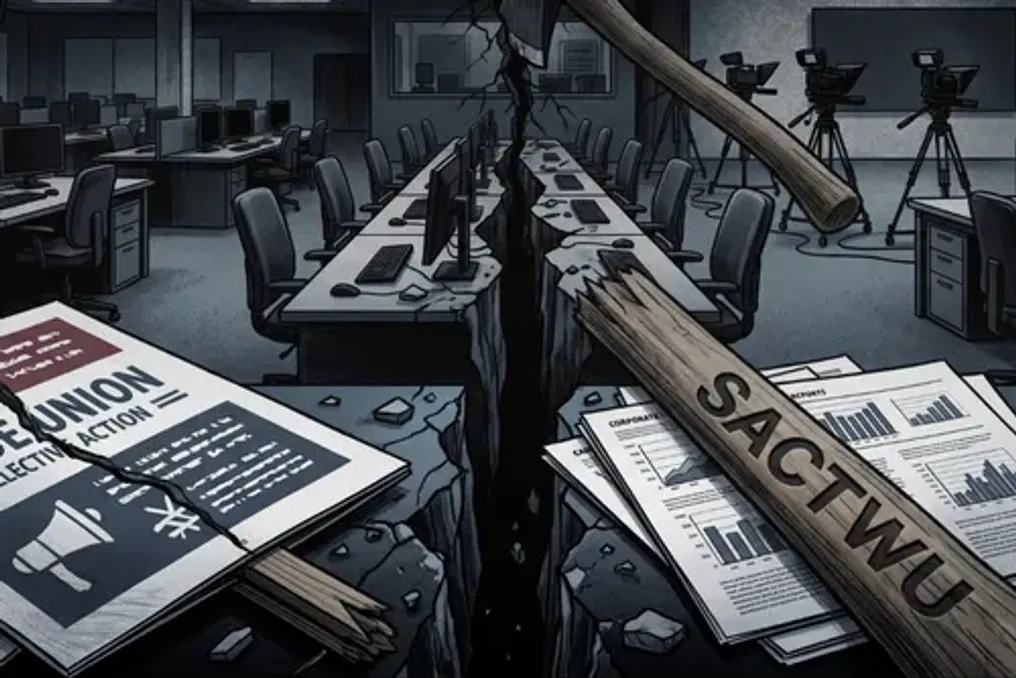
The South African Textile and Garment Workers Union (SACTWU) is facing criticism over its dual role—serving as both a union and a major investor in the corporate group HCI, which is linked to eNCA through ownership structure. The television channel has initiated Section 189 consultations, which may affect 171 of its 309 employees due to plans to create a more compact digital-focused newsroom.
Despite no evidence of SACTWU participating in eNCA's decision to begin the reduction process, the union's position in the ownership structure and its reluctance to answer questions about the proposed layoffs have drawn attention to potential conflicts of interest arising when a union is a significant corporate investor.
eNCA, launched in 2008 as South Africa's first 24-hour television news channel, is part of eMedia Investments—a broadcasting group that owns e.tv, Openview, and eNCA. eMedia Holdings owns 67.7% of eMedia Investments, with the remainder held by Venfin Media Beleggings, a subsidiary of Remgro. The main shareholder of eMedia Holdings is the JSE-listed company Hosken Consolidated Investments (HCI), which in turn considers SACTWU its principal shareholder.
This chain of ownership grants SACTWU significant economic and shareholder interest in the group, but it does not mean the union directly owns, manages, or controls eNCA.
Risk to 171 Jobs
The issue intensified after eNCA initiated the Section 189 consultation process, which could impact 171 out of 309 workers. eNCA Managing Director Norman Munzelele reportedly informed staff that the planned restructuring is driven by changes in traditional television viewing models, specifically the decline in consumption of 24-hour television news. The proposed cuts align with eNCA's efforts to transform its newsroom into a smaller, digitally focused entity.
When IOL contacted eMedia, the company declined to comment on the reduction process. eMedia Marketing Director Lynn Adams stated that 'eMedia acknowledges receipt of your request. As a matter of principle, eMedia does not publicly comment through the media on its internal business operations, confidential employee matters, or internal processes.'
IOL also reached out to SACTWU's National Industrial Policy Officer, Etienne Vlocq. The union confirmed receipt of the request and stated it would respond, but no reply was received. Subsequent attempts to contact the union by phone and WhatsApp were unsuccessful. SACTWU's stake in HCI makes its response particularly relevant in the context of questions regarding the intersection of its union role and its interests as an investor.
From Union to Major Investor
SACTWU's relationship with HCI spans nearly three decades. The union helped provide capital and equity during HCI's development and remains its largest shareholder. Since then, HCI has expanded interests into sectors such as media, hospitality, gambling, resources, transport, and energy. These relationships have also provided financial benefits to SACTWU.
The union's need for more stable income became increasingly important as its direct stake in HCI decreased. A transaction announced in 2025 initially involved reducing SACTWU's direct stake in HCI from approximately 23.8% to 18.4% through HCI share deals and three properties valued at about R549.7 million. Under this arrangement, HCI's subsidiary Squirewood Investments 64 was set to acquire 1.1 million HCI shares from SACTWU for R144.1 million. Additionally, HCI was selling its stakes in Gallagher Estate Holdings, HCI Rand Daily Mail, and HCI Solly Sachs House to the union for approximately R549.7 million. HCI explained that this agreement was intended to help SACTWU meet its cash needs and acquire assets capable of generating more regular income. This agreement was subsequently revised.
Revised Deal with HCI
According to the revised deal announced in September 2025, SACTWU will acquire 54.5% of Squirewood. If all transactions are executed and the option for additional HCI shares is utilized, Squirewood will hold about 21.7 million HCI shares, equivalent to approximately 25.3% of HCI's issued shares excluding treasury shares. HCI shareholders approved the related transactions at a general meeting in January 2026. The revision aimed to meet SACTWU's cash flow needs while preserving its strategic role in HCI's B-BBEE ownership structure.
HCI CEO Johnny Coplan argued that maintaining these relationships is vital because several HCI businesses operate in sectors where equity holds commercial or licensing value. Previously, SACTWU stated that its financial obligations included scholarships for members' children, employment initiatives for workers facing factory closures and redundancies, pension benefits, and funeral support. SACTWU spokesperson Andre Criell stated in a 2025 interview that the union agreed to acquire assets that 'will bring much more money,' allowing it to continue playing what he described as its 'positive key role' in HCI.
Active Investor Challenges Relationship
The relationship between HCI and SACTWU has also drawn criticism from investors. Aktiv Investment Management, which criticized HCI's performance and corporate structure, argued that the group trades at a significant discount to its net asset value, and that splitting the investment company could unlock shareholder value. Adrian Zetter of Aktiv called the revised deal a 'terrible deal for Sactwu' in a 2025 interview. Zetter argued that the structure could strengthen Coplan's control over HCI, leaving SACTWU with less transparent investing, and minority shareholders with limited growth prospects. HCI rejected the broader activist argument for group spin-off. Coplan characterized such an outcome as 'nothing but value destruction.'
This dispute relates to the eNCA layoffs as it demonstrates the scale and limits of SACTWU's economic interest in the corporate structure above the broadcaster level. However, it does not establish that SACTWU directed, approved, or consulted on eNCA's employment decisions.
GIWUSA Questions Union Investment Model
The General Industries Workers Union of South Africa (GIWUSA) took a more critical stance, condemning the proposed cuts and calling for public support for affected workers. GIWUSA President Mamete Sebey stated that the situation illustrates a contradiction his union has long believed exists in unions that own investment companies. He noted: 'I mean, the situation at eMedia is a complete confirmation of our position in the constant confrontation with the idea of union investment companies, which we have always defended.'
Sebey said such structures can create competing obligations for union leaders. He told IOL: 'They link, you know, union leadership structures, particularly with corporate interests that act exclusively and relentlessly based on the logic of capital accumulation, which leads to worker exploitation.'
Sebey argued this tension was evident in the eNCA reduction process. Nevertheless, there is no proof that SACTWU controls eNCA's operational decisions or participated in the decision to start the reduction process. Sebey also questioned whether mere price pressures explain the proposed cuts, pointing to eMedia's reported revenue and profit, as well as CEO Khalil Sherif's remuneration. These figures alone are insufficient to determine if eNCA can retain the affected positions. The Section 189 process is a consultation process where alternatives to reduction can be considered before final decisions are made.
Nonetheless, Sebey contended that the dispute highlighted a broader tension between the union's role in advancing workers' interests and its role as a corporate investor.
Questions on SACTWU's Dual Role
The proposed cuts have once again brought attention to SACTWU's position as both a union and a major investor in HCI. There is no evidence that SACTWU ordered, approved, or consulted on the proposed job reductions. However, its economic interest in HCI raises a legitimate question about how the labor organization balances its mandate to advance workers' interests with its role as an investor in profit-seeking enterprises.
IOL asked SACTWU to confirm its current direct and indirect interest in HCI following the restructuring and to explain the level of influence it exerts on HCI's management and decision-making. The union was also asked about any involvement in the operational decisions of HCI's portfolio companies, including eMedia Holdings and eNCA, and whether it was consulted regarding the proposed eNCA cuts. IOL also inquired how SACTWU manages potential conflicts between its union role and investor interests when companies linked to its investments downsize their workforce. It was also asked if it had interacted with HCI or eMedia regarding the eNCA restructuring, and if so, what concerns or proposals it raised.
Questions were also directed to HCI, asking it to clarify SACTWU's current interest in the company and the extent, if any, of the union's influence on eMedia or eNCA. No response from SACTWU or HCI had been received by the time of publication.