
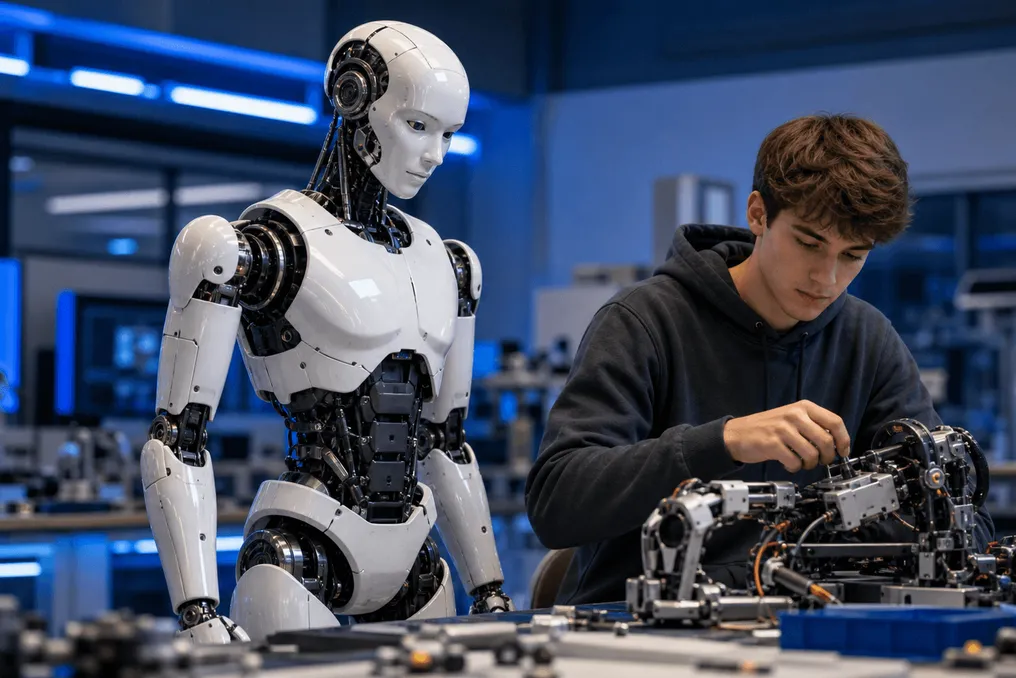
Chinese humanoid robot manufacturer Unitree Robotics is actively building a network of national industrial colleges while preparing for its upcoming Initial Public Offering (IPO).
According to the 21st Century Business Herald, the company has established partnerships with over ten universities across ten Chinese manufacturing hubs since December 2025. These cities include Qingdao, Luozhou, Zhengzhou, Jiaozuo, Hefei, Shamen, Suzhou, Ningbo, Guangzhou, and Wuhan. The latest agreement was signed on August 7th with the Changjiang Technical and Vocational College and the University of Earth Sciences in Wuhan.
The selection of these cities was deliberate, as they are all major industrial centers with high demand for specialists in humanoid robotics. For instance, only the Hefei ecosystem encompasses 190 companies covering the entire spectrum of intelligent robotics—from chips to full-body systems. Each industrial college is developed jointly, taking into account the needs of local industries. The bachelor's degree model focuses on talent in research and development and composite engineering, while vocational training partnerships concentrate on operational, maintenance, and debugging roles that are currently most in demand.
This talent acquisition strategy is also a customer engagement strategy. Unitree's prospectus indicates that scientific research and education accounted for over 70 percent of revenue from humanoid robot sales in the first quarter of 2025, whereas purely industrial applications made up only about 9 percent. Consequently, universities and research institutes serve as Unitree's largest client group, rather than just a supply channel. Integrating Unitree's technical standards into curricula, laboratory equipment, and student projects forms a stronger bond than a single equipment sale, ensuring Unitree's long-term presence in cities where the scaling of humanoid robot adoption is likely to occur in the future.
The shortage of skilled personnel is acutely felt across the embodied AI sector. Industry estimates suggest this gap amounts to about one million workers in China. Furthermore, the number of vacancies in the humanoid robotics category increased fifteenfold compared to the previous year between January and April 2026, with an average annual salary of about 406,100 yuan. The supply side is failing to keep pace with this growth: only a small number of Chinese universities have launched bachelor's programs dedicated to embodied AI. Unitree co-founder Chen Li publicly stated that the company spent its first decade training its own workforce because such specialists were unavailable in the domestic market.
Although the IPO timeline has not been officially set, the current campaign holds commercial viability. Unitree is the world's largest supplier of humanoid robots and a clear leader in the category; however, the broader market has yet to define a single mandatory industrial application. Concluding educational partnerships at the city level now allows the conversion of current research and education revenue into future demand for industrial deployment. The cities that first implement Unitree's industrial colleges are quietly competing with each other to secure long-term advantages in talent supply for humanoid robotics.