Google announced on Tuesday (11) a new phase of expansion of its network in the Americas, named Americas Connect. This set of new submarine cable routes was designed to increase the capacity, robustness, and recovery capability of the digital links connecting Latin America, the Caribbean, the United States, and Europe.
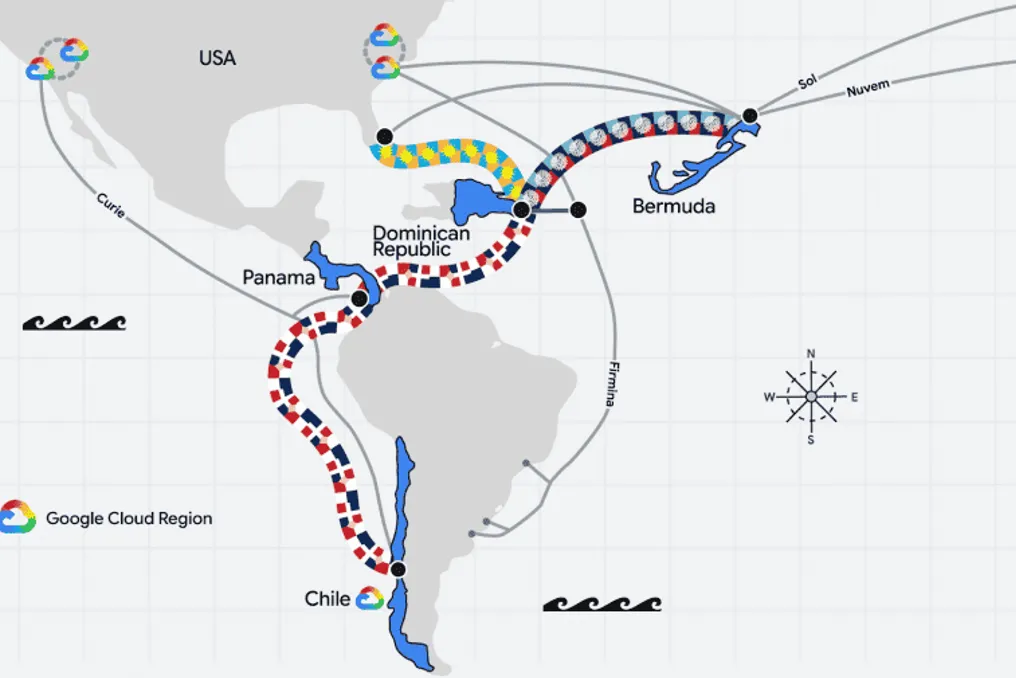
The initiative incorporates three new submarine cable systems—Alisios, Canoa, and OlaLuz—in addition to an extension of the Firmina cable. These new elements complement Google's previous investments in the Curie, Nuvem, and Sol systems.
The company emphasizes that using multiple geographically distinct routes will enable the creation of alternative paths for data flow. This reduces dependence on a single link, making the infrastructure more resilient to potential failures.
Details of the New Cable Systems
The first system, Alisios, establishes a direct link between the Dominican Republic, Panama, and Chile. The name refers to the trade winds, tropical and Caribbean currents historically used by navigators to travel between continents, echoing the flow of data through the new underwater routes.
Next, Canoa will connect the Dominican Republic to the Bermuda Islands. Its name comes from a word in the Taíno language meaning canoe, referencing the maritime history of the North Atlantic and the Caribbean. Integrated with the Nuvem and Sol cables, this new system aims to establish a more resilient connection between the Caribbean and Latin America, as well as with parts of Europe and North America.
The third system, named OlaLuz, will create a direct link between the Dominican Republic and Florida. The name is a combination of the Spanish words 'ola' and 'luz', referencing the light waves used in transporting data through the cables laid on the ocean floor.
According to Google, this new route will substantially increase communication capacity between the Caribbean and the east coast of the United States, while also offering an alternative path for data traffic in that area. Additionally, a new branch of Firmina has been announced, which will terminate in the Dominican Republic, expanding the cable's connection capacity, originally intended to link North and South America in the Caribbean.
Importance of Submarine Infrastructure
Although it relies on infrastructure installed on the seabed, a significant portion of international digital communication depends on these submarine cables to move large volumes of data between various continents. The availability of these connections is crucial for digital applications such as telemedicine, artificial intelligence (AI), scientific research, and cloud computing services.
For this reason, in addition to increasing transmission capacity, Google is focusing on the geographical redundancy of its routes. By having paths separated geographically, an interruption in one specific segment does not necessarily compromise all communication between two regions.
Americas Connect was specifically designed to improve three aspects of the infrastructure: reach, reliability, and resilience. The Dominican Republic plays a central role in this project, hosting the Alisios, Canoa, and OlaLuz systems, along with the new Firmina extension. Thus, the island becomes a vital connection point between the routes of the Caribbean, Latin America, the United States, and Europe.
Luis Rodolfo Abinader Corona, President of the Dominican Republic, stated that the country's participation in the project supports efforts to expand digital connectivity, reduce access disparity, and foster professional development and economic opportunities related to technology.
José Raúl Mulino, President of Panama, also highlighted the country's strategic role in the new infrastructure, mentioning that the location is relevant for the deployment of the submarine network and linking the project to Panama's national digital transformation strategy.
The Bermuda Islands will benefit from the first direct submarine cable link with the Dominican Republic through the Canoa system. This action adds to the arrival of the Nuvem and Sol cables and the expansion of the Bermuda Digital Exchange Port, scheduled for June 2026.
In Chile, the new Alisios should strengthen the country's link with Panama and the Dominican Republic. The Chilean government indicated that this infrastructure could help increase the speed, security, and resilience of national connectivity.
This expansion is part of a broader Google strategy to enhance its global cloud computing infrastructure. The company assures that the new connections will be able to keep pace with the increasing digital demands of the region and will serve as a basis for future developments. A notable feature of the project is the use of strategically positioned branching units, allowing for the creation of new links in the future without needing to redesign the entire infrastructure. This methodology mirrors what Google used in its Pacific Connect initiative, aiming to form a more open and interconnected cloud network with multiple paths between the main digital areas of the Americas, Europe, and the United States.