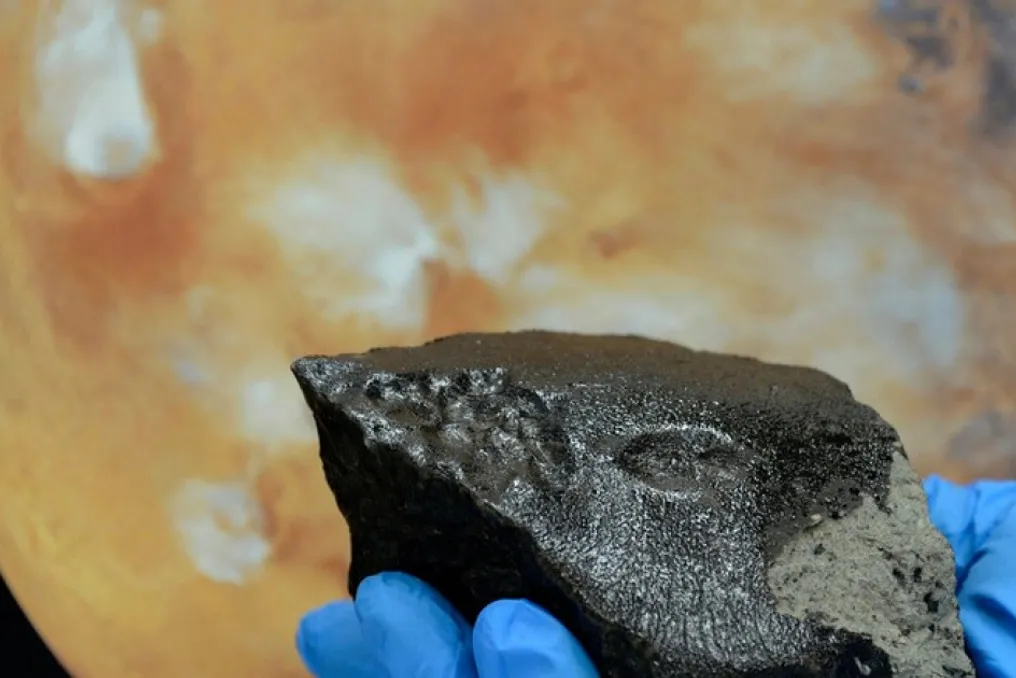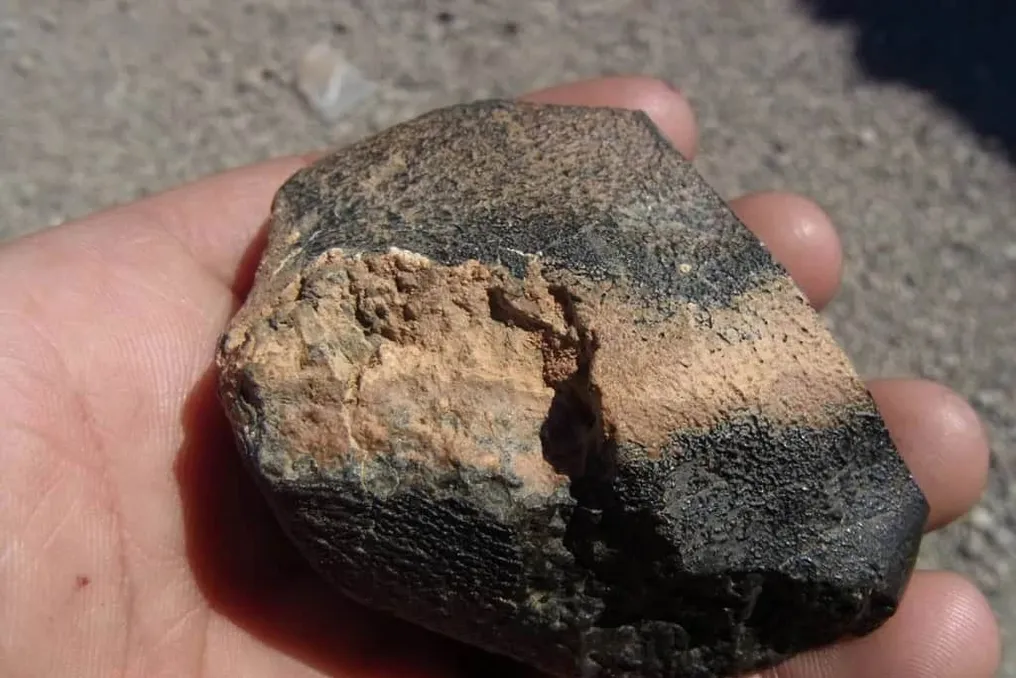
A rare meteorite originating from Mars helps scientists study an little-known period in the planet's geological history. This rock, discovered in Algeria in 2019, is approximately 1.273 billion years old and exhibits an isotopic composition never before observed in a typical Martian meteorite.
Northwest Africa (NWA) 13441
The meteorite, named Northwest Africa (NWA) 13441, was analyzed by researchers from Boston College in collaboration with scientists from Scripps Institution of Oceanography and the Open University in the UK. The research findings were published on August 1st in the journal Geochimica et Cosmochimica Acta.
The age of the rock is particularly significant because it belongs to a period that represents a major gap in our knowledge of Mars' evolution. This makes NWA 13441 especially important: it is a shergottite aged 1.273 billion years, being the first meteorite of this type identified in this age range.
Ethan Baxter, a professor of Earth and Environmental Sciences at Boston College and co-author of the study, stated: "The characteristics of this meteorite were completely unexpected." He added: "No other Martian meteorite of this type is 1.27 billion years old."
Researchers were drawn not only to the meteorite's age but also to its composition. The team analyzed, among other things, neodymium—an element naturally found on Earth and possessing seven isotopes. The isotopic composition of neodymium in NWA 13441 corresponds to a value associated with the early solar system, which has not been observed in any other shergottite.
This pattern is similar to that found in so-called chondrites—a class of meteorites formed from the first undifferentiated aggregates of rocks in the Solar System about 4.56 billion years ago. The presence of this 'chondritic' signature in NWA 13441 is considered particularly surprising, as it suggests that the deep interior of Mars remained virtually unchanged since the earliest moments of the planet's formation.
In other words, the composition found in the meteorite may serve as a kind of preserved record of very ancient materials from the interior of Mars. This feature also helps researchers establish new limits for processes that occurred in the early Solar System during Mars' formation.
According to the researchers, Mars formed quickly, in less than five million years after the birth of the Solar System. Furthermore, the planet does not have tectonic plates like Earth. This difference is important because on our planet, plate movement and other geological processes continuously change and recycle ancient crustal and deep materials.
On Mars, the absence of this mechanism allowed some compositions formed in the initial moments of the planet's history to be preserved for billions of years. The combination of the primordial isotopic signature and the age of NWA 13441 suggests that the meteorite may have originated from a previously unexplored reservoir within the Martian interior, situated between sources of shergottites with different isotopic characteristics, known as enriched and depleted sources.
Thus, the discovery not only provides a sample from an era for which no previous shergottites were known but may also help understand how different regions of Mars' interior formed and evolved.
NWA 13441 was found in Algeria in 2019, but its characteristics have not yet been fully studied. Baxter's team from Boston College received a small meteorite sample from a colleague at Appalachian State University. The material was cleaned and ground, and a thin section of NWA 13441 was prepared on a glass slide.
The researchers worked with scientists from Scripps Institution of Oceanography and the Open University to confirm the Martian origin of the rock, determine its crystallization age, and compare its chemical composition with other Martian meteorites. For this, they used highly precise methods based on radiogenic isotopes. Analyses showed that the meteorite crystallized approximately 1.273 billion years ago.
Dylan M. Syll, a graduate student at Boston College and co-author of the study, explained: "Martian meteorites of this type are less than 600 million years old or approximately 2.4 billion years old." He continued: "We dated this sample at 1.273 billion years, filling a gap of about two billion years for which we had no shergottite samples to provide information on Mars' magmatic and volcanic activity."
This discovery gives scientists a new opportunity to study Mars' magmatic and volcanic activity during a period for which there has been little direct evidence until now. At the same time, the isotopic composition of the meteorite provides clues about processes that occurred even earlier, when the planet was forming.
The fact that NWA 13441 retains a signature similar to materials from the early Solar System indicates that certain deep regions of Mars may have remained relatively untouched by processes that changed other parts of the planet over billions of years.
Baxter and his team continue to analyze the sample. The next step will be to study other isotopic systems to better understand how this unique meteorite relates to other early Martian rocks. Baxter stated: "Our goal is to analyze additional isotopic systems that will help us better understand how this unique sample relates to other early Martian meteorites."