Taizhou Zhongfu New Materials, a private company from Taizhou, Zhejiang province, founded by Ku Lun, a former Christmas garland exporter, has managed to break the long-standing Western monopoly on high-performance solid materials for deep-sea buoyancy.
The company was established in May 2012 and spent ten years and over 200 million yuan before achieving full-scale production around 2022. In 2024, a new production base was launched in Taizhou with an annual capacity of 10,000 cubic meters. By the end of 2025, the company captured over 30% of the domestic market and reached the break-even point.
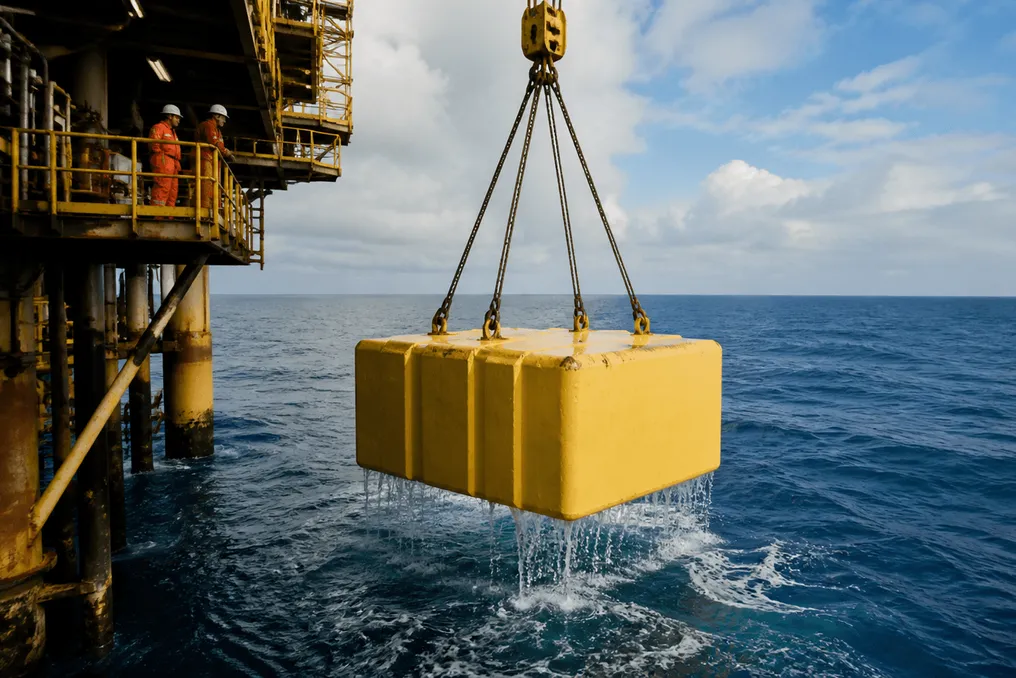
The product is a specialized foam that provides buoyancy at depth. It wraps around cables, subsea equipment, and bathyscaphes to reduce weight, tension, and wear over its service life. The deep-sea grade material is designed to operate at full ocean depths up to 11,000 meters, withstands pressure of 150 megapascals, equivalent to 1,500 standard atmospheres. Its density is half that of seawater, meaning every ton of finished material generates one ton of effective net buoyancy, sufficient to keep a fully loaded SUV afloat.
This technology is particularly in demand in floating offshore wind farm projects. Off the coast of Wannian, Hainan, there is one of the world's largest commercial floating offshore wind energy projects, where turbines weigh thousands of tons and subsea cables exceed 20 kilometers. The solid buoyancy materials support the entire floating structure. Zhongfu's breakthrough is also applied in oil and gas platforms, underwater robots, and deep-sea scientific research.
The path to success was challenging. Early attempts at mass production were accompanied by sharp fluctuations in quality and low productivity. In 2014, Ku traveled with a team to the United States to establish a local R&D department, but around 2017, he faced charges of trade secret theft that lasted seven years before being dropped. This cost the company the best production window and a significant portion of its staff. Ku financed this decade using profits from his Christmas garland manufacturing business, reinvesting over 200 million yuan.
The turning point came in 2017 when a major domestic oil and gas company, aiming to localize deep-sea equipment supply chains, made Zhongfu a partner, setting requirements that met international advanced standards. After many years of refinement, the product passed acceptance, with some metrics surpassing imported counterparts, leading to the start of mass production.
Commercial viability is now clear. Imported high-quality buoyancy material cost approximately 180,000–190,000 yuan per ton with delivery times of nine to twelve months, and foreign suppliers could arbitrarily increase prices or delay shipments. Zhongfu's product costs more than 30% less than imports, and delivery times are reduced to three to four months. For deep-sea projects, where daily construction costs amount to hundreds of thousands of yuan, shorter supply cycles significantly reduce overall timelines. The company forecasts that production volume will reach 500 million yuan within three years. Ku continues to run the Christmas garland manufacturing business in parallel: the old business funds the new one.