The landscape project titled 'Tales of Water' (AR-AR) by Martínez Arquitectura y Paisaje is an initiative to promote reforestation and the recovery of a cloud forest area located in the rural zone of the municipality of Villamaría, in the department of Caldas, along the Condor Route, specifically in the Claro River sub-basin and the Chinchiná River basin.
Previously, this land was used for pasture and livestock activities, which resulted in the deforestation of native forest to make way for invasive pasture areas. To enable restoration, the property was segmented into three distinct reforestation zones, also incorporating contemplation shelters that serve as both temporary housing and an environmental education center.
Each planting zone was adapted to its specific characteristics, aiming to foster ecosystem diversity. In the upper and western section, pioneer species will be planted with the goal of regenerating the soil damaged by cattle farming. On the eastern side, near a stream, the planting will focus on protecting fertile soil and providing refuge for species in the watershed corridor.
The lowest zone, characterized by high humidity and the presence of native forest, will be planted with trees and shrubs intended to support local and migratory birds.
In Andean and high-Andean ecosystems, water movement in its gaseous and liquid states is fundamental for ecosystem survival. This water, stored in tiny suspended structures in the air, circulates through plants such as mosses, epiphytes, and ferns towards the river basins. These biodiverse environments depend on tree cover, which performs vital functions such as thermal regulation, soil protection against erosion, and the formation of ideal microclimates for vegetation.
The recovery of this vegetation cover is considered crucial to reestablish natural dynamics and ensure controlled water flow towards the rivers.
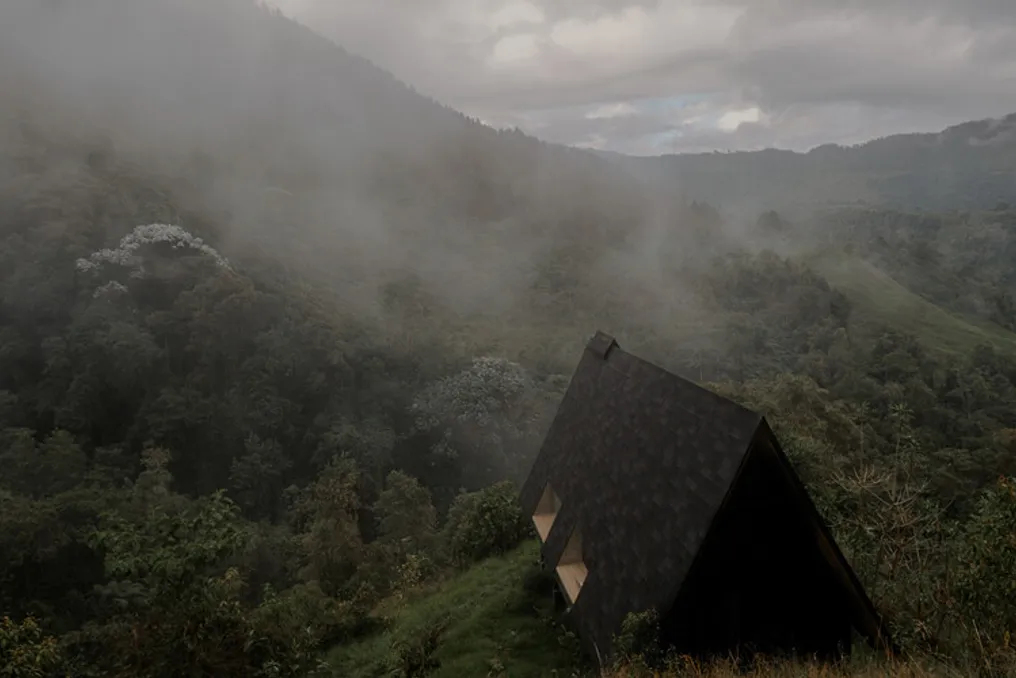
The shelter designated for birds provides an intimate connection with the surrounding environment; from inside, one can perceive the native forest surrounding it and the sound of water from various streams. The new vegetation integrates with the shelter, transforming into a welcoming element. The design of this space seeks to make the experience there a direct extension of the ecological restoration process, allowing the architecture to become visually and sensorially discreet in the natural setting.
The constant combination of mist, water sounds, humidity, and the variety of birds stimulates contemplation and understanding of the cycles inherent to the Andean forest, reinforcing the bond between individuals and the territory.
The viewpoint shelter is positioned at a strategic point on the mountain, offering a spectacular view of the canyon carved by the Taguambí and Claro Rivers. The waters of these rivers descend from the Los Nevados National Natural Park, shaping the landscape and nourishing regional ecosystems. This cabin demonstrates how ecological restoration interventions have enabled the gradual return of vegetation, strengthening biodiversity, soil stability, and the ecological interconnection of the area.