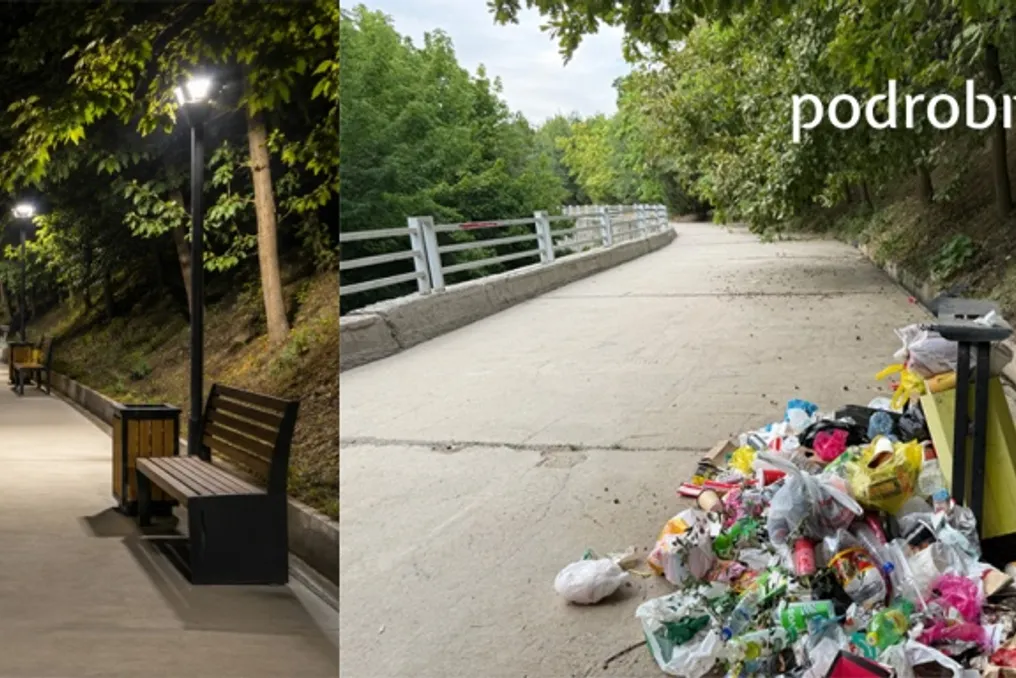
In the center of Tashkent, between the Yunus Rajabi and Beshagach mahallas, there is an embankment along the Burdshar Canal that has significant potential to attract residents. However, due to a destroyed descent, lack of lighting, benches, and regular cleaning, this area has turned into an underused and abandoned place.
Although this area is in close proximity to busy city routes, most passersby ignore the canal itself. The path along Burdshar offers coolness, shade from mature trees, and silence broken only by the sound of water, making it a natural place for walks. Nevertheless, the condition of access to the water, including destroyed steps and the absence of basic landscaping elements, prevents its full use.
How can the embankment be improved?
Currently, the embankment is losing its potential due to a lack of lighting, bins, and benches. Developing this area does not require major construction; it is enough to ensure convenient access, safety, and basic maintenance. Restoring the descent, installing lighting, and placing resting elements can transform the forgotten canal section into a full-fledged urban embankment.
Special attention should be paid to the lighting, which must be intelligently designed. It is recommended to use autonomous LED lamps with solar panels and batteries that accumulate energy during the day and provide light at night. In shaded areas under trees, hybrid systems can be used to increase reliability and reduce operating costs.
Benches play a key role because they encourage people to slow down and stay in the space, turning a passage into a place of dwelling. Furthermore, the presence of regularly serviced bins is critical for maintaining cleanliness, which is a matter of both infrastructure and culture.
The joint implementation of these elements helps change the logic of territory use, attracting runners, cyclists, parents, and the elderly. The principle of 'eyes on the street' by Jane Jacobs is also applicable: the more people use public space, the safer it is due to natural surveillance.
What is the estimated cost of the work?
A study conducted by Podrobno.uz showed that even using budget solutions, improving this area will cost approximately 250 million soms. This amount covers cleaning, path repair, installation of eight lights, five benches, and five bins, as well as minimal landscaping of the adjacent area.
For comparison, the president stated that in 2026, about 5.5 billion soms is allocated on average for infrastructure development in each mahalla. Thus, the embankment can be brought into order using less than 5% of this budget. The result of such an investment is transforming a neglected concrete path into a full-fledged urban route for recreation and sports.