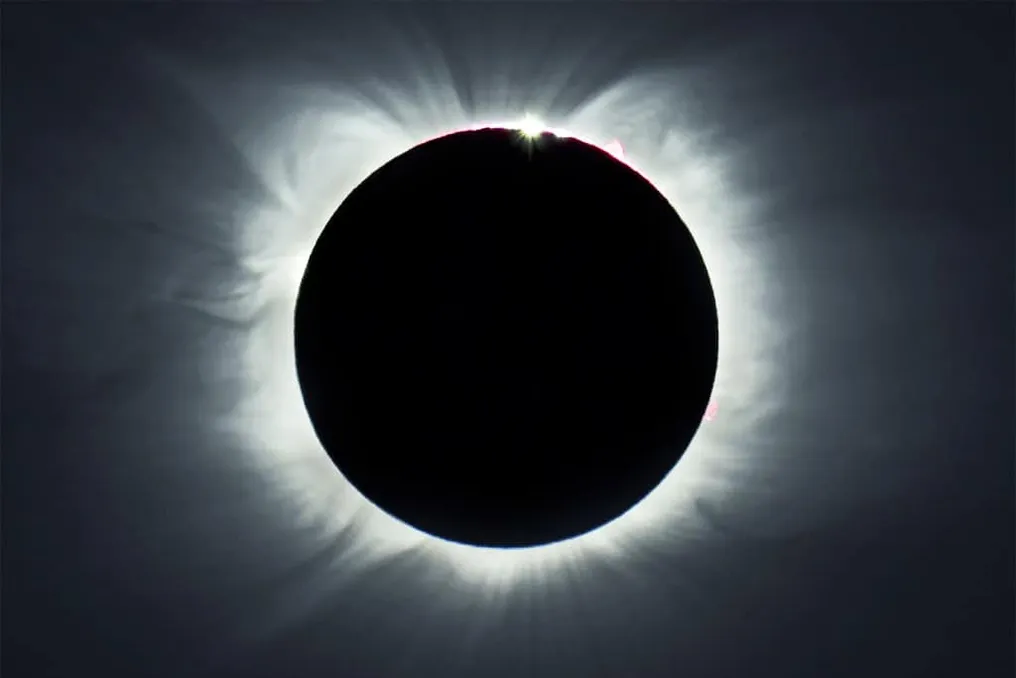
This Wednesday (the 12th) will feature one of the most significant solar eclipses of the decade. In addition to marking the return of total solar eclipses to the European continent after more than 20 years, it will be the first such event in continental Spain in over a century.
More than 15 million people will be in the path of totality, while about 980 million will be able to observe the phenomenon partially. Unfortunately, Brazil's sky will not be the stage for this astronomical spectacle this time, but all details are available to view in real-time via Olhar Digital.
Viewing Locations and Event Timeline
During the event, the Sun will be completely obscured in the Arctic, Greenland, Iceland, northern Spain, and a small part of Portugal. The partial phase will be visible across the rest of Europe, North Africa, and the eastern part of North America.
The event will begin at 12:34 Brazilian time in a remote point of the Arctic Ocean, north of Siberia, when the Moon's shadow first touches Earth, starting the partial eclipse phase. The spectacle will conclude just over four hours and 20 minutes later, at 16:55, in the Mediterranean Sea area, west of Italy.
The most impressive moment is expected near the western coast of Iceland, where totality may last up to two minutes and 18 seconds. In Spain, which has not recorded a total solar eclipse on its mainland territory since 1905, the total darkness will be shorter, lasting about a minute.
Safety Precautions for Photography
For those in the path of totality, this is a rare opportunity to view and photograph the solar corona—the Sun's outer atmosphere, which is usually hidden by the star's intense glare. However, special precautions are required to capture the moment. Pointing a camera, mobile phone, binoculars, or telescope directly at the Sun without proper protection can lead to equipment damage and, more importantly, vision damage.
According to EarthSky.org guidelines, the primary rule is to use specialized solar filters for astronomical observations at all stages until the Moon completely covers the Sun. This applies to cameras, lenses, telescopes, and other optical instruments.
It is also important to remember that zooming in with a camera or telescope does not mean the equipment protects your eyes. Observing the Sun directly, even for a short time, can cause serious retinal damage.
The only phase when it is safe to remove the solar filter from optical equipment is during totality, when the Moon completely covers the solar disk. As soon as the bright sunlight reappears, the filter must be immediately put back on.
Technical Aspects and Shooting Tips
With necessary safety measures observed, there are several ways to capture the eclipse. A smartphone is the simplest option for those without specialized equipment. A tripod helps stabilize the device and simplifies framing.
An alternative is using a wide-angle lens to combine the eclipse shot with the surrounding landscape. During totality, zoom can be used to get a closer view of the Sun. A mobile phone can also record video and create time-lapse sequences demonstrating the evolution of the event.
However, during partial phases, it is essential to use an appropriate solar filter to protect the camera. Standard cameras with wide-angle lenses allow for images combining the eclipse with the environment; depending on the composition, trees, buildings, mountains, and other landscape elements can help give the photo context.
It is advisable to prepare the composition before the eclipse begins so as not to waste time setting up the camera during the fastest stages of the event. A tripod also contributes to equipment stability.
More Details:
For those planning to record the eclipse in greater detail via video, a telephoto lens with a focal length of 300mm to 500mm can significantly bring the image of the Sun closer. In this case, using a tripod is especially important.
Low ISO settings help reduce image noise. Aperture and shutter speed should be adjusted according to the eclipse phase and desired result. During the partial phase, a solar filter remains mandatory.
A telephoto lens is also good for obtaining more detailed eclipse photographs. The greater the focal length, the larger the Sun in the picture, but this also increases the need for stability and a carefully planned frame.
Exposure time depends on which moment is planned to be captured. A fast speed, such as 1/1000 of a second, can help capture the details of the solar disk and the surrounding area during certain phases. Those with a compatible camera are recommended to shoot in RAW format, as this format retains more information for subsequent image processing.
To get even closer shots, a telescope equipped with a tracking system can be used. This mechanism tracks the apparent movement of the Sun across the sky, keeping the celestial body in the frame longer. This technique requires extensive knowledge and specialized equipment, as well as a correctly installed solar filter. Consequently, the investment is also higher. However, the system allows for detailed recordings of the eclipse, especially during totality.
Regardless of the equipment chosen, safety must be the priority over photography. The eclipse may last only a few minutes, but improper exposure to the Sun can cause irreversible eye damage. Therefore, the best shot is the one that allows you to enjoy the event without risking equipment and, above all, your vision.