
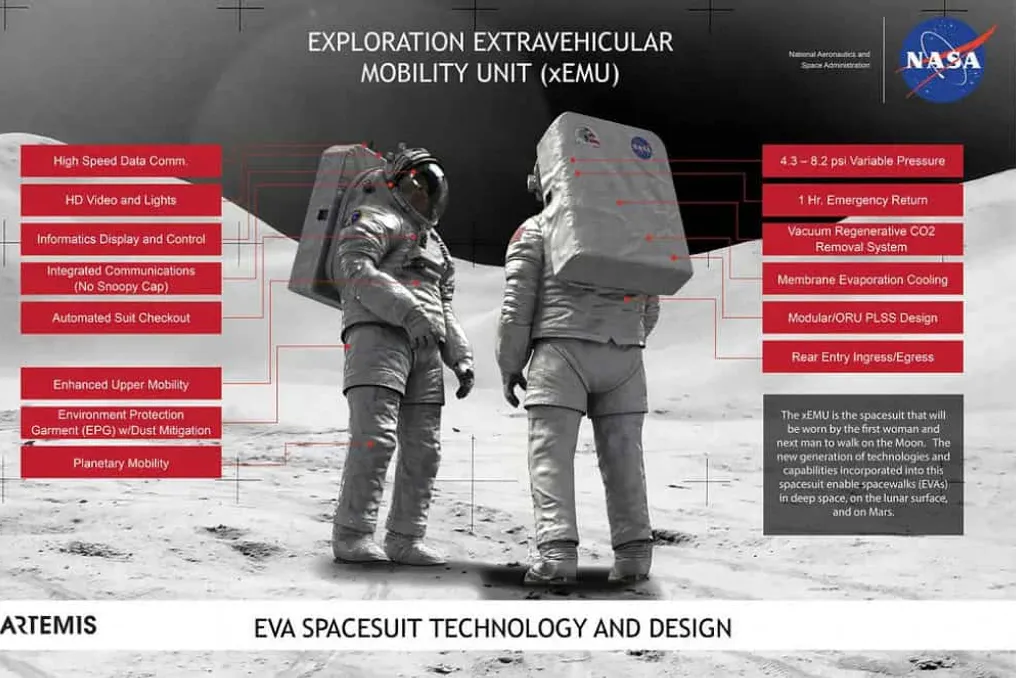
A team of engineers from NASA and industry concluded that the most modern spacesuit developed by the agency is not suitable for Mars missions. This conclusion was presented during the 55th International Conference on Environmental Systems (ICES), as reported by Universe Today.
The suit under review is the Exploration Extravehicular Mobility Unit (xEMU), designed specifically for the Artemis missions on the Moon. This equipment represents a significant advance in modern engineering, weighing 170 kg, and features such as resistance to large pressure variations, high mobility, and modularity.
However, due to Martian gravity, which is 3/8ths of Earth's gravity, the same suit would add an extra weight of 64 kg to the astronaut. In contrast, on the Moon, where gravity is 1/6th of Earth's, this suit would only equate to 28 kg.
Why 64 kg is a real danger
The U.S. National Institute for Occupational Safety establishes a maximum load limit of 23 kg. Spacesuits have an advantageous feature: their internal pressure acts like a balloon, relieving approximately 22 kg of the weight borne on the astronaut's shoulders.
Considering these elements and using a female astronaut at the 5th percentile of body weight (approximately 50 kg) as a basis, engineers estimated that the maximum acceptable weight for a suit intended for Mars would be 104 kg. This value implies a 40% reduction compared to the existing xEMU. To meet this need, a new suit called the MxEMU (Mars Exploration Extravehicular Mobility Unit) was conceived.
Engineers are concerned about emergency scenarios, such as the so-called 'walkback' scenario: if a unpressurized rover breaks down kilometers from the habitat, astronauts would have to return on foot using the suit. With the current xEMU, carrying an additional 64 kg on Mars would make this emergency walk extremely dangerous or even unfeasible. Even after a 40% weight reduction, those responsible suggest a maximum walking radius of only 30 minutes, restricting rover explorations to a range of 1.8 km around the habitat.
How to lose 40% of the weight
Traditionally, about 60% of the total weight of a spacesuit comes from the Backpack Life Support System, known as the Portable Life Support System (PLSS). The remaining 40% corresponds to the structure of the suit itself. Applying this proportion to the MxEMU, engineers determined that the PLSS should weigh 62 kg and the suit itself 42 kg.
One suggested approach involves abandoning the modularity of the xEMU and returning to the integrated architecture used in Apollo-era suits, where different components accumulated structural functions to optimize weight. However, there is an inherent challenge: Apollo suits were designed to withstand only a single simultaneous failure, whereas the current xEMU is capable of tolerating two. This design trade-off is a dilemma that engineers must resolve before any human can set foot on Mars.