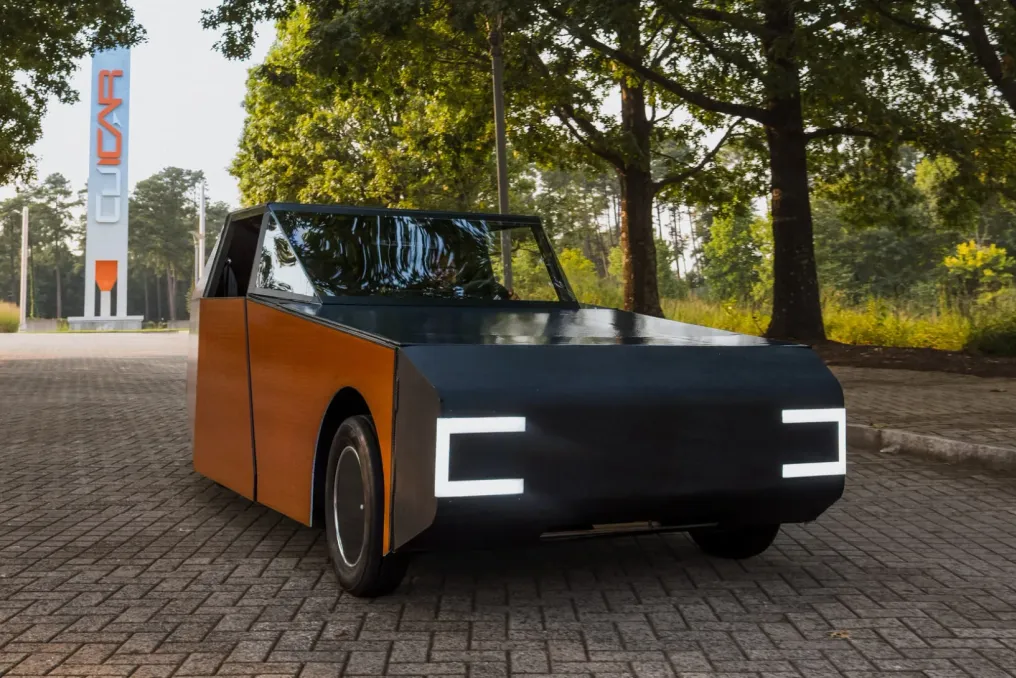
An electric vehicle prototype developed by sixteen graduate students at Clemson University in collaboration with BMW has successfully completed urban use simulations, demonstrating the generation of more energy than was consumed. This car, named Luminetta, is equipped with over 1700 photovoltaic cells on its body and was presented on August 6th at the university's automotive research center in Greenville, South Carolina.
Officially named Deep Orange 17, the two-seater coupe emerged from a task set by BMW's R&D department in the second half of 2024: to create a vehicle that produces more energy than it consumes during daily operation. The project took two years to complete.
Instead of focusing solely on standard test cycles, the group concluded that passenger cars spend most of their time stationary. Photovoltaic cells are capable of capturing light both while moving and when static.
According to Clemson University data, climate and solar insolation modeling in Greenville, Frankfurt (Germany), Madrid (Spain), and Mumbai (India) showed that with a daily drive of 20 km, the system generated surplus energy equivalent to an additional 50 km of range on average across these four cities.
The results depend on characteristics not present in a mass-produced vehicle. Luminetta weighs 550 kg, which is about a quarter of the weight of similar modern vehicles. The chassis combines structural steel for passenger protection, aluminum, carbon fiber, and metal connections manufactured using 3D printing.
The body is designed to minimize aerodynamic drag, drawing inspiration from the shape of a clam fish. In addition to solar energy, the package includes regenerative braking, intelligent torque distribution, and optimized powertrain elements, ensuring high efficiency that exceeds the performance of conventional electric vehicles.
The panels were developed in collaboration with the Fraunhofer Institute for Solar Energy Systems (ISE) in Germany and continue to generate electricity even with partial surface shading. An external film protects the cells and gives the body a color achieved through laser etching.