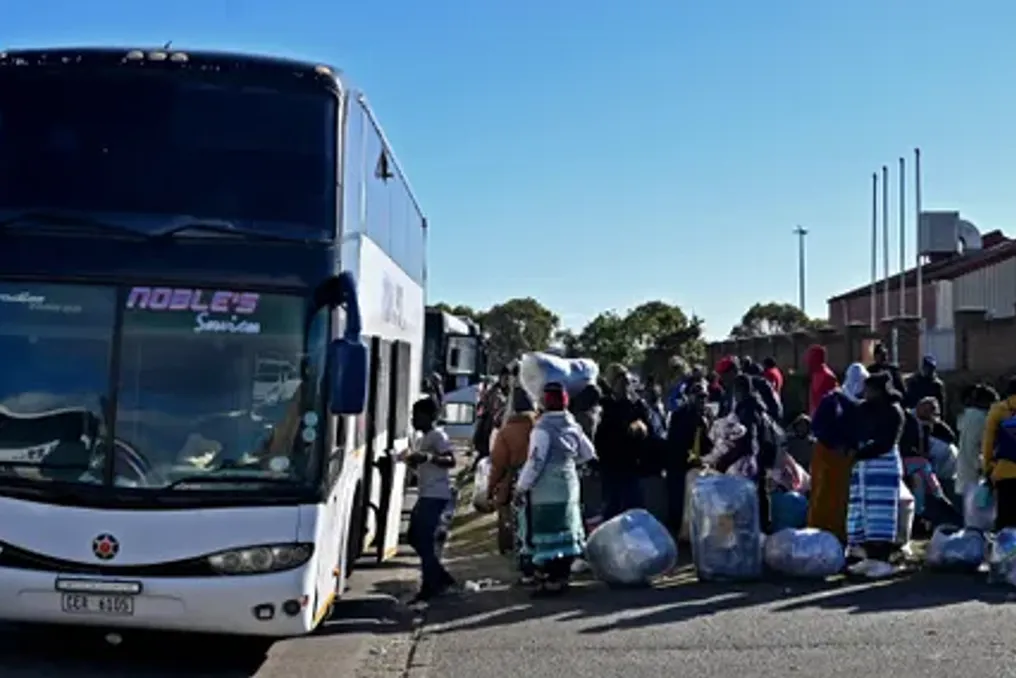
The South African government has spent 292 million rand on the process of repatriating foreign citizens as part of a five-stage plan presented by President Cyril Ramaphosa to combat illegal migration. Consequently, the Department of Home Affairs is now seeking reimbursement for these costs from Malawi, Nigeria, and Ethiopia.
The Director-General of the Department of Home Affairs, Tommy Makhode, informed the Portfolio Committee on Home Affairs on Tuesday that the department has sent requests to the governments of Malawi, as well as to the embassies of Nigeria and Ethiopia through the Department of International Relations and Cooperation (Dirco), demanding compensation for the expenses.
He specified that the department awaits responses from the respective governments. These expenditures occurred following a sharp escalation of migration problems in South Africa, which followed Ramaphosa's address to the nation on June 7, where he announced a comprehensive five-point approach to migration management.
The plan was approved by Cabinet on June 3 and aims to strengthen compliance with immigration legislation, ensure border security, reinforce the immigration system, eliminate gaps in migration laws and policies, and foster cooperation with other African states.
Ramaphosa stated that the government will intensify the identification and deportation of undocumented foreigners with the support of specialized immigration courts, while simultaneously increasing employer checks and strengthening border control.
Protests and Humanitarian Situation
The government's response to migration issues took place against a backdrop of growing anti-immigration protests, including demonstrations organized by March and March 30. These actions were accompanied by calls for the expulsion of undocumented migrants from the country, and clashes with police and violence occurred in some areas. Thousands of foreign nationals have already left areas where they feared for their safety.
Makhode informed the members of parliament that foreigners began gathering in various locations, including Sherwood Park in Durban, as pressure around migration intensified. He noted that by the end of June, the situation had become unbearable both in terms of numbers and in terms of the resulting humanitarian emergency.
He explained that these locations were not official state facilities but were managed by non-governmental organizations and the business community, while state officials checked documents to facilitate either deportation or repatriation.
Subsequently, the government established a Temporary Repatriation Centre in Musina, Limpopo, after the Interdepartmental Committee on Migration ordered the creation of such an institution to manage the growing number of people. Makhode reported that the centre was designed to accommodate up to 20,000 people, although its occupancy peaked at around 1,005 people and has since decreased.
By the end of the working day on August 6, the Department of Home Affairs processed 82,875 people within the processes of repatriation and deportation. Makhode emphasized that this figure includes both repatriates and individuals who underwent the deportation procedure. The highest number was processed during the peak period—4,850 people—after which the number significantly decreased.
He added that the data from Musina does not reflect all processed individuals, as some foreigners went through the procedure in other locations and proceeded directly to entry points.
Operation Costing 292 Million Rand
Makhode characterized the repatriation operation as an 'unfunded mandate' for the Department of Home Affairs and other involved government departments. He explained that the Department of Home Affairs did not budget for this operation, and repatriation was not provided for in its legislative framework.
Of the total amount of 292 million rand, transport constituted the largest expense item. Furthermore, the Department of Public Works and Infrastructure spent 48 million rand on the establishment and operation of the temporary repatriation centre. The cities of Ekurhuleni and Cape Town also provided transport assistance, and the Department of Home Affairs reimbursed Ekurhuleni for the costs.
Makhode reported that the Department of Home Affairs was initially allocated 60 million rand, but the scale of the operation proved unforeseen. The department submitted a memorandum to Cabinet regarding unexpected and unavoidable expenses and also sought the reallocation of funds.
The current fiscal year budget for deportations in Lindela was 257 million rand, but Makhode predicted an overrun of this amount due to the increased volume of deportations. Therefore, the department appealed to the Minister of Finance for the reallocation of certain budget items.
Processing 82,875 People
Makhode clarified that in the previous fiscal year, 44,607 people were deported through Lindela, and in the current fiscal year, 16,078 people between April 20 and July 28. The largest groups consisted of citizens from Zimbabwe, Mozambique, and Malawi. In the last fiscal year, 13,479 Zimbabwean citizens and 12,354 Mozambican citizens were deported; in the current fiscal year, these figures were 4,095 and 4,034, respectively.
Lesotho registered 3,495 deportations in the previous fiscal year and 931 in the current one. The department also recorded deportations of citizens from countries such as Somalia, Bangladesh, Benin, Botswana, Cameroon, Rwanda, the United Kingdom, Vietnam, Algeria, Brazil, Thailand, and Liberia.
Specialized Courts Handle Thousands of Cases
As part of the government's migration strategy, specialized immigration courts were also established to expedite case reviews. Makhode reported that 28,737 cases were concluded through these courts. Gauteng recorded the highest number of cases, followed by KwaZulu-Natal with 4,973 cases, Western Cape with 3,334 cases, and Eastern Cape with 2,019 cases.
In Ekurhuleni, the Chief Magistrate established seven specialized courts between July 1 and July 9. One court operated virtually, maintaining a link with Sherwood, while six operated from Central Durban. During this period, the courts concluded 2,173 cases.
The government is also working to expand the capacity of specialized courts at O.R. Tambo International Airport and Lindela so that immigration cases can be processed 'faster and more efficiently.'
Over 20,000 Declared Undesirable
The department also reported that in the previous fiscal year, 63,090 foreign nationals were declared undesirable, compared to 20,340 in the current fiscal year. Makhode explained that these declarations related to cases where foreigners exceeded the permitted stay in South Africa. He noted that exceeding the period by 30 days results in a one-year ban, and longer periods can lead to bans of two to five years.
The department is also engaged in deportations in accordance with Section 34 of the Immigration Act and undesirable declarations according to Section 30. Makhode assured that the government's approach remains based on the Constitution, human rights, and international obligations. He stressed that the government will not tolerate violence, intimidation, racism, xenophobia, or blocking foreigners' access to clinics, hospitals, schools, and other public services.
The government also stated that the migration strategy must take into account regional factors contributing to migration. Makhode informed the members of parliament that poverty, instability, and limited opportunities in countries of origin will continue to drive migration if these issues are not resolved. He noted that South Africa will use its chairmanship in SADC to raise these issues with regional countries.