Drone manufacturer ideaForge Technology reported mixed results for the first quarter of fiscal year 2026-27, once again posting a loss due to global supply chain disruptions related to component availability.
Drone manufacturer ideaForge Technology reported mixed results for the first quarter of fiscal year 2026-27, once again posting a loss due to global supply chain disruptions related to component availability.
For Q1 FY27, the company reported a loss of 2.6 crore rupees. This figure represents an 89% decrease compared to the loss of 23.56 crore rupees recorded during the same period last fiscal year. Nevertheless, in Q4 FY26 (consecutive quarter), ideaForge actually achieved a profit of 60 crore rupees.
The company's revenue grew by 436.6% year-on-year, reaching 68.58 crore rupees in Q1 FY27. However, when compared to Q4 FY26, revenue was 141 [unit not specified] and showed a decline of 51.3%.
In an official statement, the company noted that issues with global supply chain disruptions and component availability have persisted since Q4 FY26. IdeaForge also emphasized that it continues to focus on fulfilling orders for FY27 by the third quarter, according to client schedules.
According to ideaForge data, its domestic fleet of unmanned aerial vehicles has exceeded one million customer flights under various conditions and across different territories. The company also added that an ideaForge drone takes off, on average, every two minutes to perform critical tasks for clients.
Commenting on the company's performance, co-founder and CEO of ideaForge, Ankit Mehta, stated: 'We started FY27 with an order book worth over 300 crore rupees, which gives us a stronger starting point than last year, and we are working to fulfill delivery obligations according to our clients' timelines.'
The CEO also noted that based on the visibility of the FY27 order book, an acceleration in procurement activities is expected in the third and fourth quarters due to higher operational procurement limits for Indian Armed Forces field commanders under DFPDS 2026.
Amid turbulence in the global market, gold prices have once again shown significant growth. The achievement of a 10-week peak level is due to signals of interest rate easing in the US and active purchases by central banks worldwide.
Gold traditionally remains a preferred asset for wealth preservation, whether during wedding seasons or periods of market uncertainty. However, the recent surge in the precious metals market has attracted close attention from investors. On the international market, the price of gold exceeded the 4300–4400 dollar per ounce mark, reaching its highest level in ten weeks.
Several factors contributed to the rise in gold's value, including signs of weakening interest rates, central bank activity, and growing global instability. Expectations of a slowdown in monetary policy tightness in the US supported demand for gold, as investors began to focus more on this metal.
Furthermore, record purchases by central banks are stimulating price growth, as global banks acquire gold to diversify their currency reserves. According to one report, central banks purchased about 51 tons of pure gold in June alone, with China and Poland leading among buyers.
The geopolitical situation has also influenced the rise in gold prices. Lower crude oil prices and events in the Middle East have brought relief to inflation, strengthening hopes for monetary policy easing. Strong demand from China and the FOMO factor (fear of missing out) are also contributing to the increase in gold's price.
Commodity expert companies believe that this upward trend in gold may continue as long as uncertainty persists in the global market and central banks continue to increase purchases. Analysts suggest that gold support will be maintained due to central bank activity and overall global instability, which in turn implies a steady strengthening of prices in the domestic market.
Given gold's attainment of a 10-week high, ordinary investors are wondering about the advisability of entering the market at this time. Experts advise against large lump-sum investments at current prices and instead consider using a SIP (Systematic Investment Plan) strategy. For starting new investments, it is recommended to use digital gold, Gold ETFs, or small regular contributions through SIP.
Specialists also recommend limiting the share of gold in the overall portfolio to 10–15 percent to ensure portfolio balance. Overall, this rise in gold reflects not just a short-term jump, but the increasing role of gold as a global reserve, which many investors include in their portfolios for diversification and risk management.
The Money Plant is considered one of the easiest houseplants to care for. It can even be grown without soil, as it grows easily in water. However, despite ample watering and careful care, its shoots may hardly develop. The plant remains alive, rare new leaves appear, but the growth rate is so slow that the plant's appearance remains unchanged for many months.
If your money ivy is in this condition, simple watering is not enough. To ensure good development, a balance of many factors is necessary, including lighting, soil, fertilizer, pot, and temperature. Experts have suggested seven simple methods that will help your money plant grow faster, becoming denser and more beautiful.
Firstly, you should choose a location with sufficient, but not direct sunlight. Although the plant requires good light for quality growth, it should not be placed under intense and direct sun, as this can lead to leaf scorching. A spot near a window that receives plenty of, but soft, light is ideal. With insufficient light, the leaves may remain small, and the distance between shoots may increase.
Secondly, it is crucial to avoid daily watering. This is one of the most common mistakes that slow down the growth of the money plant. No plant should receive an excess of water. Constantly moist soil can damage the root system. Before watering, check the top layer of the soil with your finger; watering should only be done when this surface has dried out. Additionally, the pot must have drainage holes. Yellowing leaves or the appearance of dampness and mold smell in the soil may indicate overwatering.
Thirdly, during the vegetative period, the plant needs to be fertilized. Watering and light alone are not enough for constant rapid growth. Light application of nutrients during active growth can significantly accelerate the development of new leaves and shoots. You can use regular liquid plant fertilizers every 4–6 weeks, but you should avoid excessive fertilizer, as this can harm the roots.
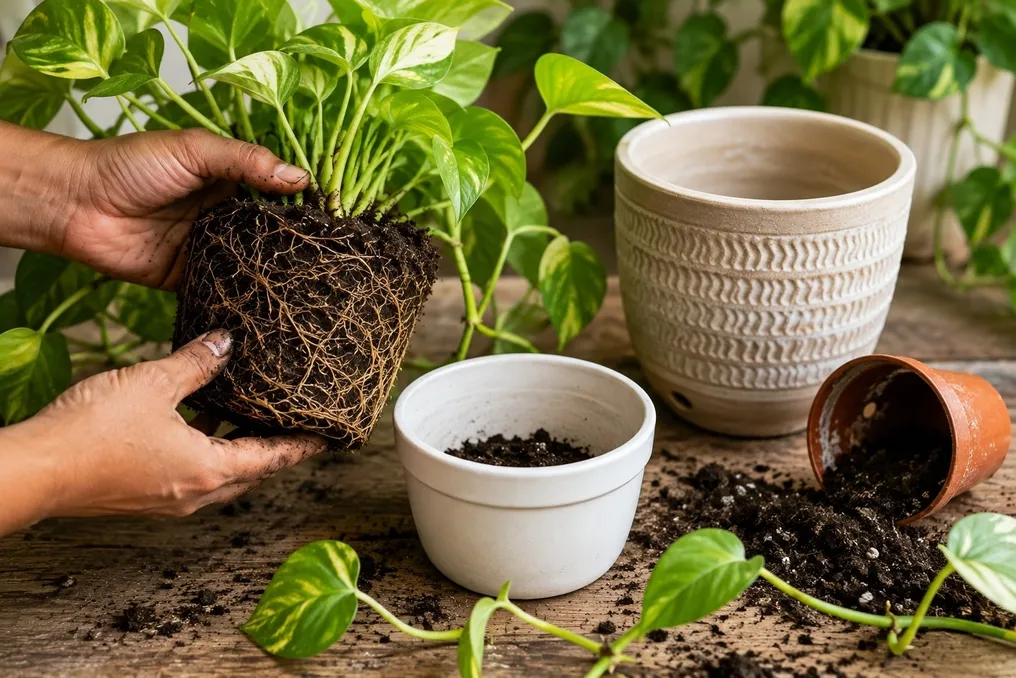
Fourthly, if the plant's roots are outgrowing the pot, it should be repotted into another container. Sometimes the problem lies not in the visible parts of the plant, but in the root system. If the roots start coming out of the drainage holes or completely fill the pot, a larger vessel will be required. When choosing a new pot, it is better to take one slightly larger than the old one, not too large. It is important to use soil with good drainage so that water does not stagnate.
Fifth, instead of letting the shoot hang down, it should be tied upwards. Since the money plant is naturally vining, support allows it to become denser and more attractive, while the leaves become larger and thicker. For this, a coconut or moss pole can be used as support.
Sixth, the plant must be protected from air conditioners and cold air. The money plant prefers warmth and moderate humidity. Direct airflow from the air conditioner, proximity to heaters, or windows with constant cold drafts should be avoided. Sudden temperature changes and severe cold negatively affect plant growth, so a normal room temperature regime is optimal.
Finally, pruning the shoots correctly is necessary. If a shoot has become too long but has few leaves, it can be trimmed slightly. Removing long and weak stems stimulates the appearance of new side branches. The cut parts should not be thrown away: they can be planted in water or soil to produce new roots, and then these cuttings can be used to increase the density of the main plant.
If your money plant does not change its condition for a long time, instead of just increasing watering, you need to pay attention to comprehensive care. Ensuring the plant has proper lighting, adequate water, timely fertilization, use of well-draining soil, sufficient space, and appropriate temperature will significantly improve its growth. A small adjustment in care can turn an ordinary plant into a lush, green, and beautiful one.