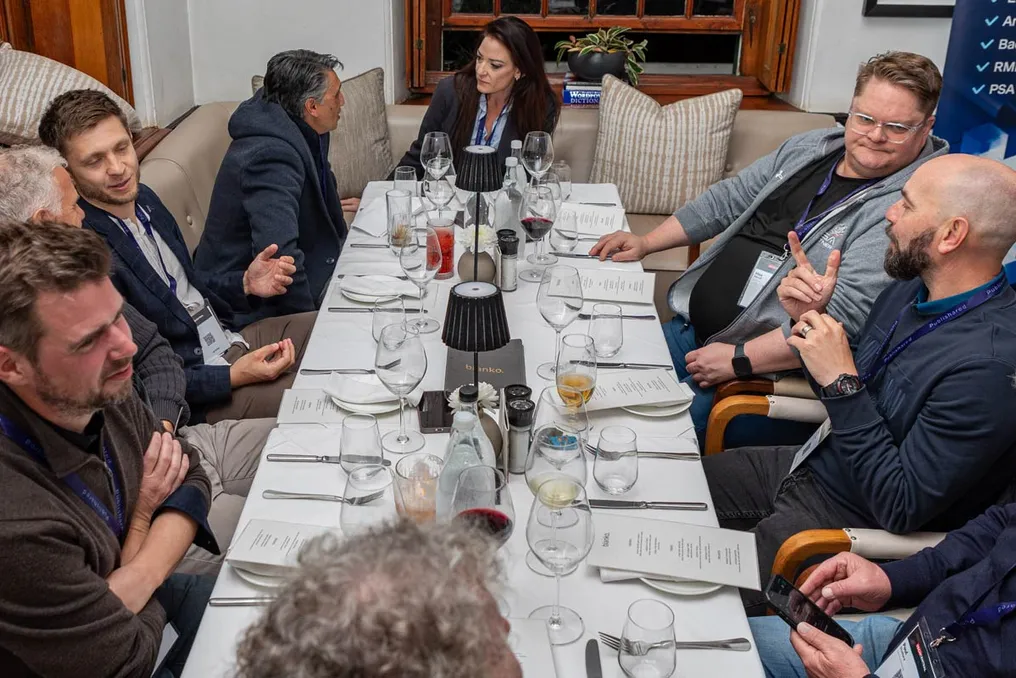
Acronis hosted a closed dinner roundtable for Managed Service Provider (MSP) executives, resellers, and channel partners in Cape Town in June. A pressing issue for the technology sector was discussed: how security solution providers can scale their capabilities amid a shortage of skilled personnel, rising client expectations, and accelerating threats that outpace traditional operational models.
The event focused on the theme 'Autonomous MSP: How AI solves the security talent shortage crisis that MSPs cannot overcome through hiring.' The discussion went beyond simple product reviews, evolving into an candid market conversation about trust, complexity, compliance, talent, and the changing role of intelligent platforms in enhancing the potential of managed service providers.
Approximately thirty participants gathered at two tables—a group that, under other circumstances, competes for the same clients, talent, and commercial opportunities. Nevertheless, the atmosphere was open and engaged.
It quickly became apparent that the focus in cybersecurity has shifted. Clients are now asking more complex questions than just whether the right tools are available. They are interested in risk, resilience, reporting, compliance, recovery, and business continuity.
Real client concerns such as Popia, Fica, cyber risk insurance, and reporting obligations were raised. However, the group quickly moved away from the idea that regulatory compliance equals security. Many participants pointed to a disconnect between regulatory frameworks and the real-world situation. Often, legislation lags behind the threat landscape, and technology evolves faster than governance. In some organizations, compliance becomes a formality rather than a substantive discussion of risks.
Complexity is within the stack
The question debated at the table was not 'what do we need to do?' but 'what should we do?'. Compliance may satisfy minimum standards, but it does not guarantee automatic resilience, faster response times, clear accountability, or better decision-making in critical moments.
For MSPs, this creates both pressure and opportunity. The pressure lies in clients increasingly expecting providers to interpret the complex security environment on their behalf. The opportunity, however, is helping clients move from worrying about compliance to being confident in resilience.
Complexity is not always where clients expect it. More often, it is hidden within the technology stack: in disparate tools, outdated systems, overlapping vendors, fragmented processes, and undefined responsibilities. In many companies, the risk is not the lack of tools, but the excess of interacting elements and the lack of clarity on how they work together when problems arise.
This is where cybersecurity transforms into a business problem. A ransomware incident, data leak, or outage is not just a technical event; it can affect revenue, reputation, business continuity, trust, and executive authority. The conversation repeatedly returned to the fact that cyber risk has become an all-encompassing financial and business risk.
MSPs are required to provide more comprehensive security services, improved reporting, faster response, and stronger advisory capabilities. At the same time, the talent market remains constrained. Skilled cybersecurity professionals are scarce, expensive, and globally mobile. MSPs in South Africa compete not only locally but also with international demand and international pay rates.
This makes time a strategic currency. Every minute spent managing excessive complexity is a minute not spent engaging with high-value clients, proactively identifying risks, or responding more quickly.
An autonomous MSP is not an MSP without staff. It is one that uses intelligent platforms, automation, and integrated services to reduce routine work, improve visibility, and allow people to focus on judgment, prioritization, and customer value. Simply put, it is about giving skilled professionals more space to perform truly important tasks.
Jack Smith, Acronis Country Manager in South Africa, grounded the discussion in local channel realities. The point was not that every MSP needs another tool, but that MSPs need platforms that give them leverage: the ability to reduce tool sprawl, consolidate cyber threat protection, enhance recovery, and deliver better outcomes without building every component themselves.
Partnerships become significant when they help partners respond faster, reduce friction, strengthen reporting, and create value that clients can feel. Acronis positioned itself not merely as a technology vendor, but as a partner helping MSPs scale in a market where acquiring capability is becoming increasingly difficult.
From passive defense to active response
MDR and XDR were discussed during the evening. MDR stands for Managed Detection and Response, a service that helps monitor, detect, and respond to threats. XDR, or Extended Detection and Response, connects signals from different parts of the technology environment for more effective threat identification.
The key point is not the acronym, but the paradigm shift from passive defense to active detection, interpretation, and response. For Acronis, this transition is linked to its broader approach to cybersecurity: integrating cybersecurity, data protection, and endpoint management into a natively integrated platform so that MSPs can protect, detect, respond, and recover through a more unified operational model.
As the evening concluded, the discussion became less technical and more focused on what makes a vendor partnership worthwhile. Ronan McKertin, Acronis Regional Vice President for Europe, Israel, and Africa, emphasized that partnerships must deliver practical benefits—helping MSPs scale capabilities, serve clients better, and build trust during periods of maximum pressure.
McKertin stated: 'We value the hard work of our partners. Partnership is the secret ingredient: it's how we help MSPs scale capabilities, serve clients better, and earn trust.' When clients face a security incident, they don't think about the vendor's architecture. They think about whether their business can keep running. They need confidence, clarity, and the knowledge that their provider will help them recover quickly.
The MSP of 2027 will be defined not by the size of its stack, but by how intelligently it combines people, platforms, and partnerships to create resilience. The next era of cybersecurity will be won not by those with the most tools, but by those who create the most time, trust, and clarity during periods of highest pressure.