
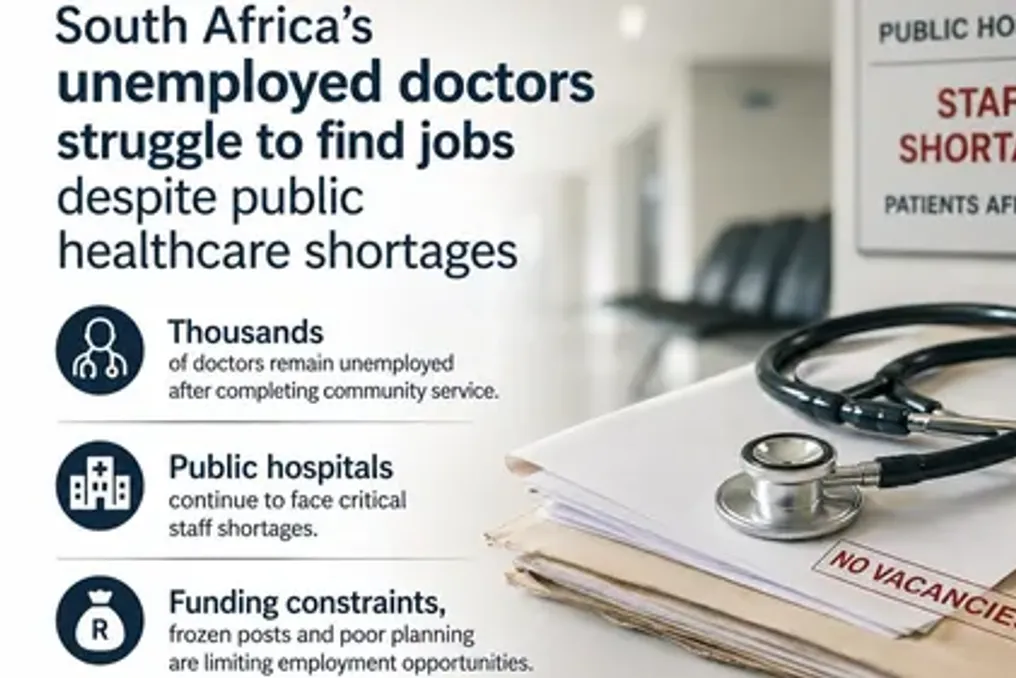
Despite the growing number of qualified doctors in South Africa, many cannot find permanent employment after completing their mandatory community service due to funding issues. Medical organizations warn that budget restrictions, frozen vacancies, and inefficient workforce planning are leaving highly skilled doctors without opportunities, while public hospitals continue to face staff shortages.
In January 2025, the South African Medical Association (SAMA) reported that over 1800 young doctors across the country faced difficulties after finishing community service. As new cohorts of doctors complete this service annually, serious concern remains about how many of them can be employed in funded positions.
The South African Association of Interns and Doctors (SAMATU) noted that the problem is not a lack of demand for doctors, but rather structural and administrative obstacles within the public health system. They pointed to underfunded positions, emphasizing that provincial health departments operate under limited and often shrinking budgets, which restricts their ability to hire suitable doctors permanently.
Furthermore, job freezes and inefficient recruitment processes contribute to delays in filling vacancies, and poor workforce planning can lead to a mismatch between regions needing doctors and available funded positions. SAMATU stated that the rise in qualified doctors remaining unemployed after mandatory service is a worsening problem, indicating a gap between workforce planning and available funded posts.
An example of this situation is a 27-year-old doctor from the Eastern Cape, who wished to remain anonymous. He completed his MBChB at the University of the Free State and served at a district hospital in the North West province in 2025. After completing his service, he applied for approximately 30–50 positions but received neither interviews nor feedback. He moved to Johannesburg seeking better career opportunities but is forced to rely on temporary work in emergency departments and local clinics when opportunities arise.
He also noted that maintaining employability is expensive. He mentioned costs for HPCSA registration, obtaining a practice number (Pm number), and keeping short courses current, each costing around 4000 rand. Additional courses to improve employment chances can cost up to 10,000 rand, and a diploma costs about 20,000 rand. This uncertainty regarding working hours and salary caused him 'anxiety,' while he continues to heavily depend on his savings. He even considered leaving South Africa, stating: 'I feel there might be better opportunities abroad.'
Another 27-year-old doctor, also wishing to remain anonymous, studied and lived in the Free State, completing her community service in KwaZulu-Natal in December 2025. She applied for state doctor, academic doctor, and National Health Laboratory positions but received neither interviews nor feedback. Due to family commitments, she cannot move from KwaZulu-Natal and is forced to work as a temporary employee, including weekends when clinics need extra doctors. She described a significant financial blow, noting that she had to switch from supporting family members to receiving support from them. She added: 'It upset me greatly... I am tired of trying.' She was also considering leaving South Africa but hesitates due to her family and business remaining there.
SAMATU warned that post-community service unemployment could negatively affect doctors' professional development. Without opportunities for clinical placements, doctors may struggle to gain the necessary supervised experience for residency programs. The association believes this could exacerbate future shortages of specialists in fields such as emergency medicine, anesthesiology, obstetrics and gynecology, pediatrics, internal medicine, and surgery.
Health Minister Dr. Aaron Motsoaledi previously stated that the government cannot simply create jobs without resources to fund them. Discussing this issue, Motsoaledi highlighted the country's austerity measures and budgetary constraints. He said: 'You cannot give a job that you cannot afford to pay people for.' In July, Motsoaledi also questioned the availability of reliable data on the number of doctors unemployed after community service. He explained that after completing mandatory training and community service, doctors enter a broader labor market. Some transition to private practice, continue studying, or leave medicine, while others may apply for government positions later. Motsoaledi noted that the government is aware of intern placement because it is legislative, but it is becoming harder to ascertain how many doctors are unemployed after community service.
SAMA called for the immediate creation of jobs for young doctors, increased healthcare funding, and the development of a comprehensive plan to address this crisis. The association warned that ongoing unemployment could worsen staff shortages, increase the burden on existing doctors, and promote emigration. The National Department of Health was polled for comment but did not respond by the time of publication.