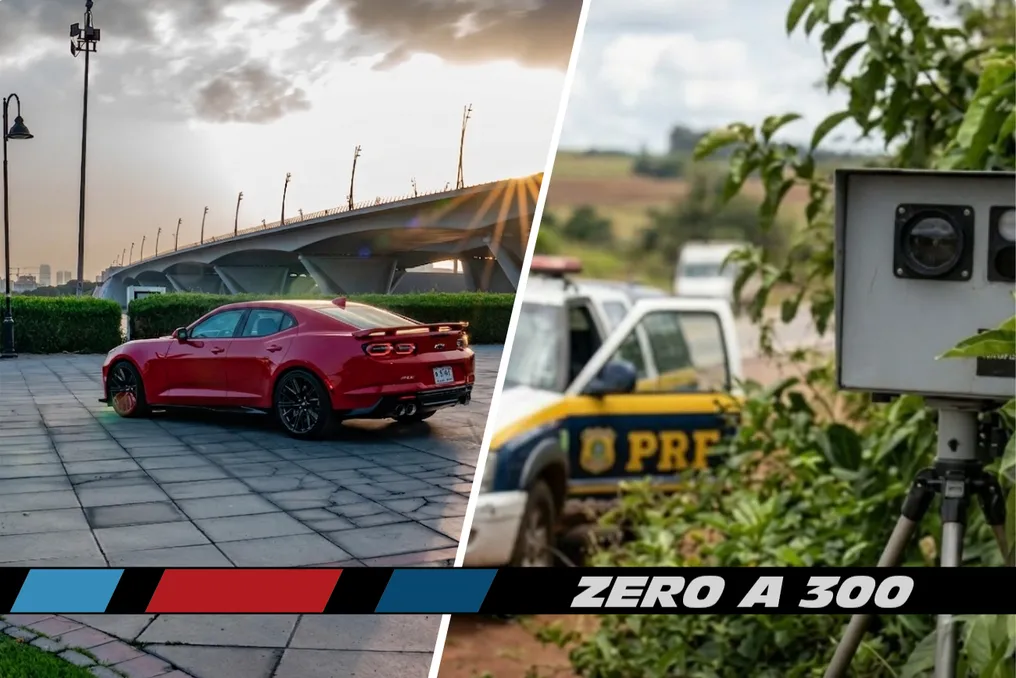
While Dodge works to revitalize the appeal of the Charger for enthusiasts and Ford seeks to increase the profitability of the Mustang in the next generation, the Chevrolet Camaro is on pause, at least temporarily.
Sources linked to the brand, spoken to by GM Authority, provided information about the seventh-generation Camaro, which is expected to launch in 2029. This new model would be significantly different from previous ones, presenting itself as a four-door sedan.
Chevrolet plans to develop this new Camaro using the GM Alpha 2 platform, the same one used in the future Cadillac CT5 and in a sedan that Buick is expected to introduce soon. Production would take place at the GM factory located in Lansing Grand River, Michigan, replicating the manufacturing location of the previous Camaro before its discontinuation in 2024. The sedan would have dimensions comparable to the Chevrolet Malibu.
A positive point is that, following the tradition of American automakers, the new Camaro would not abandon internal combustion; the small block V8 engine is expected to remain under the hood, and, crucially, the manual transmission option would be maintained.
However, the transition to a four-door body raises questions, especially considering that the North American market has driven the migration from sedans to SUVs and pickup trucks. Furthermore, the Dodge Charger itself demonstrates the viability of offering the same vehicle as both a coupe and a sedan.
Despite the optimism, there is some skepticism regarding this information, but the prospect of a Camaro sedan is seen as better than having no Camaro at all.
News on the Royal Enfield Meteor 350 2027
The Royal Enfield Meteor 350, one of the brand's most popular models, has received updates for the 2027 version, including new equipment and color options. All versions of the Meteor now come equipped with assisted and slip clutch, which reduces effort when operating the lever and prevents rear wheel lock during abrupt downshifts.
Additionally, the Tripper navigator, which uses pairing with the mobile phone's GPS to guide the route curve by curve, has been standardized across the entire line, not limited only to the more expensive variants. The Meteor 350 has also started including full LED lighting and a USB Type-C port on the handlebars, features welcomed by long-distance travelers.
The only exception is the entry-level Fireball version, which did not receive adjustable levers, a feature exclusive to the Aurora and Supernova variants. The Supernova, in turn, now features alloy wheels and tubeless tires, while the Aurora retains its spoked wheels. Visually, the Fireball gains the Fireball Orange color, and the other versions are available in Stellar Matt Grey, Aurora Retro Green, and Supernova Black shades.
The prices for the 2027 line are: Meteor 350 Fireball Orange for R$ 24,990; Meteor 350 Stellar Matt Grey for R$ 25,990; Meteor 350 Aurora Retro Green and Meteor 350 Supernova Black for R$ 26,490. The mechanics remain unchanged, maintaining the 349 cc single-cylinder engine, with 20.2 hp and 2.75 kgfm, and the five-speed gearbox.
Bill proposal aims to annul hidden radar fines
A new legislative initiative under discussion in the National Congress proposes to prohibit the imposition of penalties for speed radars installed in a hidden manner or without proper signage. Bill Project 2364/26, presented by parliamentarian André Fernandes, suggests that the Brazilian Traffic Code requires complete visibility of these devices. The central argument of this proposal is that road enforcement should prioritize awareness and accident prevention, rather than acting as a revenue collection tool.
It is important to note that, although the text has begun its analysis process to proceed through the Chamber of Deputies and the Senate, no fine issued to date will be automatically canceled. Current regulation continues to be defined by the National Traffic Council through Resolution 798/2020, meaning that all records made currently maintain their legal validity while the parliamentary debate continues.
According to current regulations, fixed meters require preliminary technical studies and indicator signs on the track, while portable devices must be operated exclusively by uniformed officers and in visible locations. The main innovation of the new measure is elevating this requirement for transparency from the merely administrative level of resolutions to the definitive body of federal law, eliminating opportunities for disguised inspections.
Current rules provide for escalating punishments for disrespecting speed limits: excesses up to 20% constitute a medium infraction (four points and R$ 130.16); transgressions between 20% and 50% are considered serious (five points and R$ 195.23); and violations exceeding 50% are classified as a very serious offense, resulting in a debt of R$ 880.41 and immediate suspension of the driver's license.
Aston Martin launches DB12 S inspired by 1950 Le Mans cars
Aston Martin prepared three special editions of the DB12 S for the Monterey Car Week. The distinctive aspect of these units is subtle, as the colors were inspired by the Aston Martin DB2 that competed in the 24 Hours of Le Mans in 1950. At that time, the vehicles were identified by British plates starting with 'VMF' and had grilles painted in distinct colors to facilitate identification on the track: one in red, another in yellow, and the third in blue.
This specific detail is what differentiates this special series from other DB12S. The three models received Carbon Black paint, but each incorporates one of the Le Mans colors in the grille: the VMF 63 sports Rosso Red, the VMF 64 features Speed Yellow details, and the VMF 65 uses Ellwood Blue. These colors also appear on the carbon fiber side intakes and in small interior and exterior trims. Aston Martin also added the silhouette of the competition DB2 to the bottom of the rear spoiler, functioning as a surprise element, whose design is also embroidered on the seats.
In terms of specifications, they are identical to the DB12 S presented last year, equipped with a 4.0-liter AMG V8 biturbo engine, generating 700 hp, an eight-speed automatic transmission, carbon-ceramic brakes, recalibrated Bilstein adaptive dampers, and stiffer stabilizers than those on the standard DB12. Aston Martin has not yet confirmed whether these three cars will be marketed after the Monterey Car Week, but given the company's situation, it is likely they will be sold to the brand's most engaged customers at a price yet to be disclosed.
Winning Lola rotary from Le Mans goes to auction
One of the most notable cars that participated in Le Mans is available for sale. The Lola T616-Mazda, chassis HU-2, which won the C2 class at the 24 Hours of Le Mans in 1984, will be auctioned during the Monterey Car Week, with an estimated sale price in the range of US$ 300,000, a considerable amount for a car that was not a main protagonist of the event.
Its highlight lies, firstly, in the Mazda 13B engine, the famous 1.3-liter two-rotor Wankel, and in the fact that it won its class at Le Mans using street tires. In fact, the T616 was part of a BF Goodrich project aimed at promoting radial tires. The company already supplied tires for Mazda RX-7s in the United States but decided to create its own team to compete in endurance races with C2 class prototypes.
They prepared two Lola T616s with the 13B engine from the RX-7 and tires that maintained the structure of street tires, only adapted in size for the prototype wheels. Despite having a street compound and carcass, the prototype finished the race in tenth overall but won the C2 class. The second Lola of the team achieved third place in the category and twelfth overall. This participation also entered Mazda's history, marking the second consecutive victory of a car with a Wankel engine in its class at Le Mans, seven years before the conquest of the 787B in 1991.
Both cars survived and were restored by members of the project in the 2000s, participating since then in historical events and races. Currently, both will be sold by Mecum Auctions. The HU-2, the Le Mans winner, is valued at about US$ 300,000, while its sibling, the HU-3, is expected to reach approximately US$ 200,000.