The website uses a security service to protect against cyberattacks. The action you performed triggered this protective system.
The website uses a security service to protect against cyberattacks. The action you performed triggered this protective system.
There are several actions that can lead to such a block, including entering a specific word or phrase, executing an SQL command, or submitting incorrect data.
Users are advised to contact the website owner to report the block. When contacting them, they should specify what actions were being performed when this page appeared, and also provide the Cloudflare Ray ID, which is located at the bottom of the page.
Students at ILS Law College in Pune who were denied the right to take semester law exams due to insufficient attendance have received permission from the Bombay High Court.
On Monday, the Bombay High Court allowed these students to participate in the examinations for the 2025-26 academic year, deciding it was a 'strictly one-time measure'. Judges Riyaz Chagla and Farhan Dubash relied on a recent Supreme Court ruling from July 21, which also granted students the opportunity to take exams for the 2025-26 academic year as temporary assistance.
Schools in South Africa are increasingly facing threats that extend far beyond the classroom. Violence, gang activity, bullying, sexual assault, and criminal behavior are turning places meant for learning into zones of fear.
Recent incidents in Gauteng have once again demonstrated the vulnerability of students and teachers. There have been instances where armed suspects infiltrated school grounds or operated near them, and weapons and other prohibited items were found among students during police searches.
At Iphutheng Primary School in Alexandra, armed suspects allegedly entered the premises and fired warning shots, forcing students and teachers to flee. Near Waverley Girls' High School in the Waverley area, armed individuals also reportedly fired into the air during a robbery before disappearing.
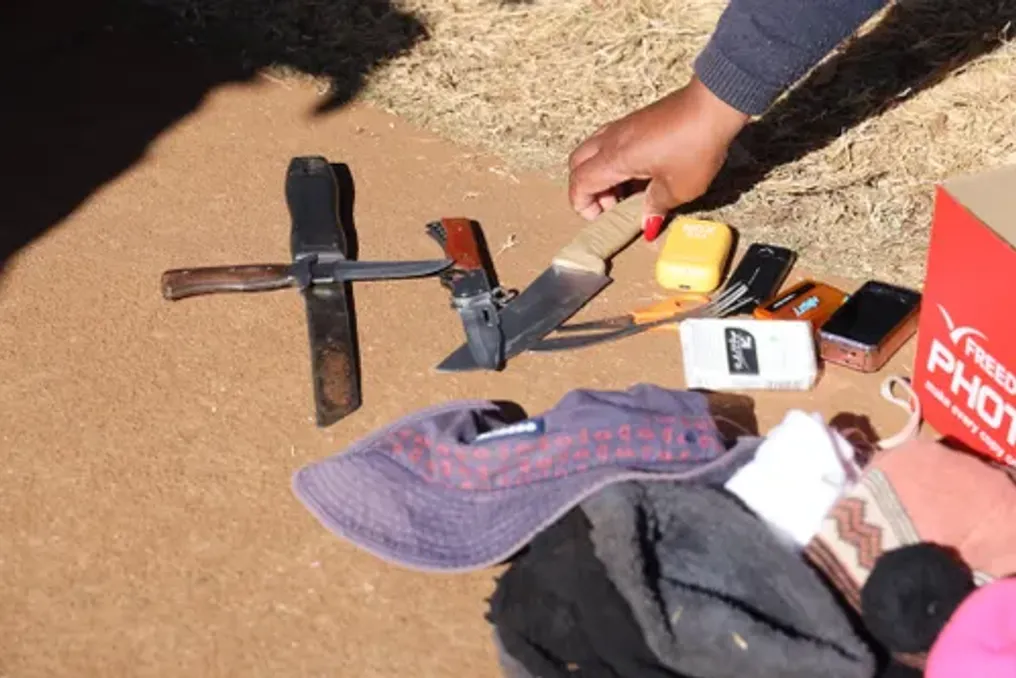
Recent concerns intensified at Badirile High School in Houghton, Carletonville, where knives, forks, scissors, and vapes were discovered among students during a check.
The Gauteng Minister of Education, Lebogang Mabile, stated: 'We condemn these senseless acts of crime in the strongest possible terms. Schools are sacred spaces dedicated to learning and teaching, and they should never become theaters of violence, fear, or intimidation.'
He noted that issues related to violence, gang activity, bullying, substance abuse, gender-based violence, vandalism, and criminal activity around schools have been repeatedly raised, leading to the implementation of stricter measures under the 'Safe Schools' program, enhanced anti-bullying measures, and improved collaboration between educational bodies, SAPS, communities, and NGOs.
Mabile emphasized that child safety cannot be solely the government's responsibility, calling for joint efforts from all citizens.
However, the crisis is not limited to Gauteng. In the Western Cape, the police recently began investigating a murder after a Grade 10 student died at Bellville South High School following an alleged attack by another student.
The province is also experiencing a problem with bullying: in February, six students from Milnerton High School were expelled following a bullying incident. The Western Cape Education Department (WCED) confirmed that eight students linked to this case face charges of assault with intent to cause grievous bodily harm, with six adults appearing in court and two minors undergoing separate procedures.
The scale of the crisis is reflected in the latest data from Statistics South Africa (Stats SA), which shows that 1,156,009 learners reported experiencing some form of violence at school.
DA Basic Education representative, Desire van der Walt, stated that these figures indicate a serious failure in protecting learners. She added that these statistics are not just numbers; behind each figure is a child whose trust has been undermined, whose confidence has been shattered, and whose educational prospects may be permanently ruined. School violence leads to decreased academic performance, increased dropout rates, mental health problems, and the normalization of violence as a means of conflict resolution.
A recent report by the South African Human Rights Commission (SAHRC) presented an even bleaker picture, extending beyond bullying and physical violence, revealing the widespread prevalence and deep-rooted nature of sexual violence in schools. The report mentioned alleged abuse affecting teachers, students, school staff, service providers, and outsiders.
The report recorded 26,855 cases of child abuse in 2024/25, including 9,857 cases of sexual violence. SAPS registered 2,826 charges related to sexual crimes against children, while the South African Teachers' Council received 826 complaints regarding sexual misconduct between 2021 and 2025.
The Commission found that only a small fraction of reported cases led to convictions, teacher suspensions, or inclusion in child protection registries. Legal experts warned that schools and provincial education departments could face costly civil lawsuits if they ignore repeated warning signs that result in harm to students.
Previously, in a report on school bullying, NAPTOSA representative Lorvika Matthews stated that schools must also be held accountable when repeated reports are ignored, but stressed that the responsibility lies with the entire education system. She insisted: 'When repeated reports are ignored or proper procedures are not followed, accountability is fully justified. Every bullying report must be taken seriously and addressed immediately.'
Matthews also noted that provincial education departments are obligated to ensure that schools have clear protocols, sufficient staffing, timely support, and access to counselors, psychologists, and social workers. She added that teachers cannot simultaneously function as educators, counselors, psychologists, and social workers without appropriate training and support.
In Matthews' view, bullying is also a reflection of broader societal issues, as students are exposed to violence, crime, poverty, inequality, family conflicts, and harmful social norms that can normalize aggression. She concluded: 'Bullying persists because it reflects wider societal challenges, rather than being an issue that starts and ends at the school gate. Schools are often mirrors of the communities they serve.'
In the modern world, a good job at a reputable company is a dream for every young person, especially if that job is related to the technology sector and offers an annual income of 13 lakh rupees. However, stories often appear on social media where young people refuse jobs to follow their passions. One such example is the story of Aditya Arepally.
He decided to leave a job with an annual salary of 13 lakhs to go to America and study artificial intelligence. Arepally successfully obtained a Master's degree in AI in the USA. He did not expect this decision to be so successful. After completing his studies in the USA and strengthening his skills, he was reportedly offered a job with a package reaching 1.5 crore rupees.
It should be noted that Aditya Arepally initially received a Bachelor of Science degree in Computer Science from IIT Dharwad. After finishing his engineering education, he started his career in the technology sector. Initially, he was hired by a private company where his annual income was 13 lakh rupees. Aditya worked at this firm for more than a year but did not abandon his aspirations.
Aditya realized that the technological world is undergoing rapid changes, and the role of AI will only increase in the future. At such a time, simple work experience was not enough. He wanted to gain deeper knowledge in AI, so he decided to go to America, leaving his position.
After obtaining a Master's degree in AI, Aditya received a job offer in America with a compensation package of about 1.5 crore rupees. If he had accepted the initial job with a salary of 13 lakhs, the difference with the 1.5 crore package would have been quite significant. This increase not only raised his salary but covered the entire journey—from studying AI and acquiring new skills to obtaining certifications and working on projects.