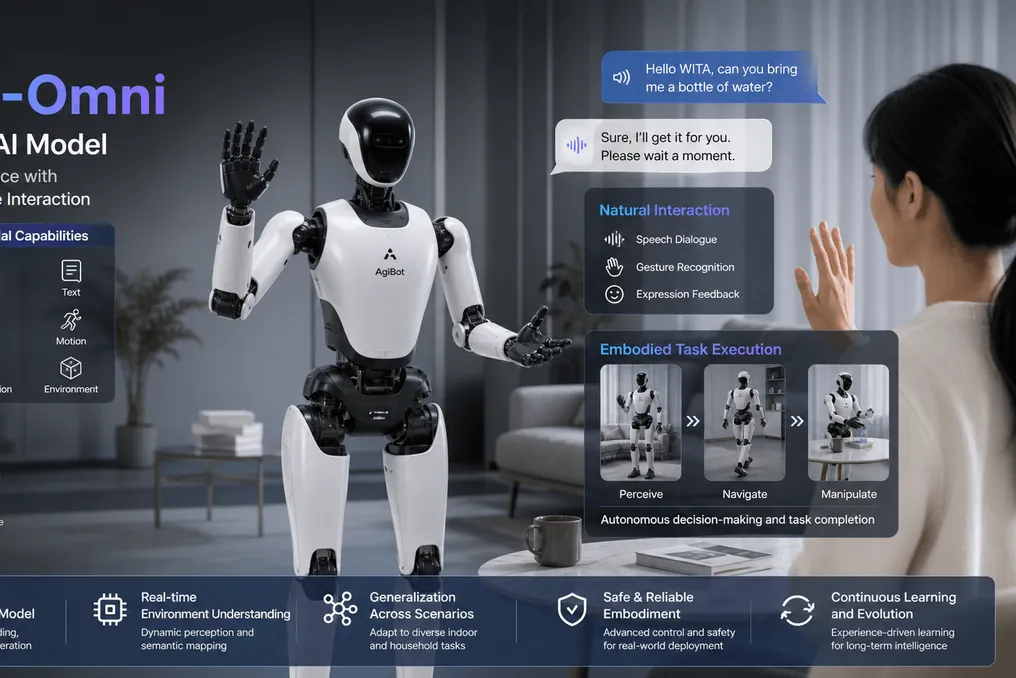
Researchers from Nanyang Technological University, Peking University, HKUST (Guangzhou), and Beijing Academy of Artificial Intelligence (BAAI) have released Omega-0—a world-class action model based on latent prediction. This model enables humanoid robots to move, look, and perform tasks simultaneously. When executing 11 real-world household tasks, the model achieved an 81.8 percent success rate, significantly surpassing the results of pi-0.5, EgoVLA, GR00T-N1.7, and psi-0.
The main contribution of the model lies not so much in the final number, but in its architecture: instead of predicting future pixels, Omega-0 predicts future visual features using a diffusion transformer to generate full-body actions.
The Omega-0 model has a three-stage training architecture. The first stage is pre-training the vision and language model for full-body actions. The team trained the Whole-Body FAST tokenizer to convert continuous, high-dimensional full-body trajectories into discrete action tokens. They then fine-tuned Qwen3-VL-2B-Instruct, transforming it into a specialized full-body action VLM with trainable first- and third-person viewpoint tokens.
The second stage is pre-training latent human and robot actions. Using the V-JEPA idea, the team combined vision, language, and robot proprioception by predicting future visual features via a video query, and then embedding the predicted environmental features into the action representation. A diffusion transformer generates the latent representation of the full-body action.
The third stage involves fine-tuning in real home environments using a real-time chunking strategy to ensure action continuity.
The Omega-HOME dataset was created to train this architecture. It includes 40.3 hours of real-world data, 4827 trajectories, and 24 task types. Each trajectory contains synchronized language instructions, first- and third-person video, proprioception data, and full-body motion. This dataset covers eight categories of household chores, such as object gathering, surface cleaning, appliance usage, and tidying up. The trajectories are teleoperated and converted into supervisory signals for end-to-end training.
The benchmarking methodology is a more rigorous part of the research. To prevent contamination of the pre-training data, the team excluded 11 fine-tuning tasks from Omega-HOME and combined the remaining ones with publicly available human demonstration data for the second stage pre-training. Thus, the resulting gain is real, not an artifact of test set leakage. The model name is minimalist: omega-zero is the first in what seems to be a series.
The broader significance lies in its application in embodied AI. The home represents the most challenging target for deploying humanoid robots, as it requires constant environmental perception and full-body coordination. Omega-0 links future environment prediction with full-body action generation, which is one of the most substantiated approaches currently for solving this joint problem within a single model. The path to a robot that reliably folds laundry is still long, but the architectural direction is less ambiguous than six months ago. Open questions remain regarding long-term autonomy, safe interaction, task generalization, and adaptation to complex environments. The 81.8 percent figure is a useful benchmark, not a final goal.