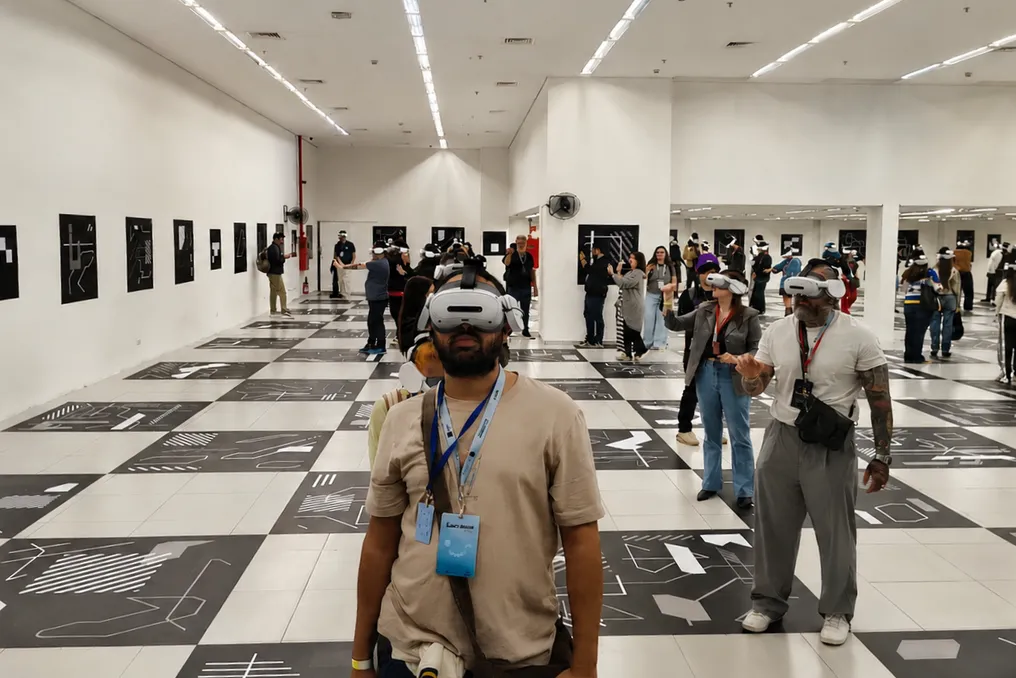
The thematic experience inspired by Black Mirror opened in São Paulo at the end of July, offering the public an immersion into an interactive episode where artificial intelligence (AI) and virtual reality merge to create an adventure in a cybernetic setting. The attraction began on July 31st at Shopping Eldorado, following a previous tour through New York, Madrid, and Montreal.
Developed in collaboration with Charlie Brooker, creator of the eponymous Netflix series, the activity reflects Black Mirror's focus on exploring the ethical dilemmas generated by technological advancement and its effects on human life. The series, which has already won 29 awards, including nine Emmys and four BAFTAs (British Academy Film Awards), is known for its dramatic narratives.
In the São Paulo context, groups of six individuals are introduced to the universe of Phaethon, a large technology corporation that showcases its latest innovation, the LifeAgent. Initially, the company promises that this robot aims to facilitate users' lives and assist them in achieving their goals.
However, the narrative takes an unexpected turn when the first version of the android is replaced by a second model. This new robot assumes human characteristics, becoming an identical clone of each visitor, replicating both face and voice. From this point on, participants must overcome various challenges to prevent this copy from replacing the original person.
This high degree of personalization is enabled by the prior collection of image and voice data from each participant for the fictional company. Organizers assure that such information is used exclusively during the activity and is deleted after departure, although the experience author notes that this statement sounds like a possible Black Mirror plot.
In the first room, an institutional video presented Phaethon and its new device, the LifeAgent, designed to support humans in their goals and tasks. Before diving into the virtual environment, participants filled out a questionnaire detailing age, name, and gender, in addition to stating their aspirations. The author chose to travel the world and gain wealth, but other options included fame and beauty. The novelty promised to help realize these desires.
At this moment, monitors scanned everyone's faces and distributed virtual reality glasses. With the equipment adjusted, the physical environment disappeared, giving way to a digital plane. The other participants appeared on the screen as humanoid figures, allowing the author to monitor everyone's position and avoid collisions. Then, a LifeAgent introduced itself and began guiding through the interactive spaces.
The first stage consisted of a trivia game in the style of the 1970s, serving as an adaptation to the game environment. After the presenter read a question, participants had only a few seconds to decide, choosing a colored square on the floor representing the answer. The group accumulated points for each correct answer.
Subsequently, the group advanced to a music area where instruments reacted to hand movements. It was described as magical to play an invisible keyboard, as finger movement in the real world activated the key in the virtual environment.
Next, there was a psychoanalysis session with Sigmund Freud. The figure of the psychoanalyst appeared prominently on a screen, questioning each person's nocturnal dreams. When unable to recall, the author invented dreaming of flying over São Paulo. Freud classified this statement as a superficial dream, but one indicating megalomania and ambition, commenting that the phrase was very Black Mirror. In response, AI-generated images based on the account were created, showing the author flying over the capital of São Paulo. Each participant had an exclusive dialogue with the psychoanalyst, without knowledge of others' dreams.
After the games, participants were led to Phaethon's laboratories, a moment when the playful activity took on a dramatic tone, with the robots assuming human forms and the LifeAgent displaying the author's face, which was considered shocking. From this point on, the script followed a dynamic similar to a video game. The clones betrayed the participants, who became trapped in a labyrinth of pipes within the Phaethon industry. They had to dodge lasers, escape robots, and, before the final room, arm themselves with laser weapons.
The subsequent sequence simulated a virtual shooting range, where the androids tried to capture them while they ran towards a car exit. After escaping that area, the author encountered the clone again and was forced to make a decision: forgive it or destroy it. He opted to eliminate its second version with a shot.
Although the story reached its end, the final scenes suggest that the world had already been dominated by this new technology, culminating in a dystopia that may not be far from current reality.
The exhibition is located at Shopping Eldorado, situated at Av. Rebouças, 3970, in Pinheiros, São Paulo. Operating hours are Tuesday to Saturday, from 2 PM to 10 PM, and Sundays and holidays, from 12 PM to 8 PM. The attraction will remain on display until January 15, 2027. Tickets start at R$ 70 and are available on the Bilheteria Digital platform, requiring participants to be over 16 years old to enter, although young people aged 12 to 15 can participate accompanied by a guardian.