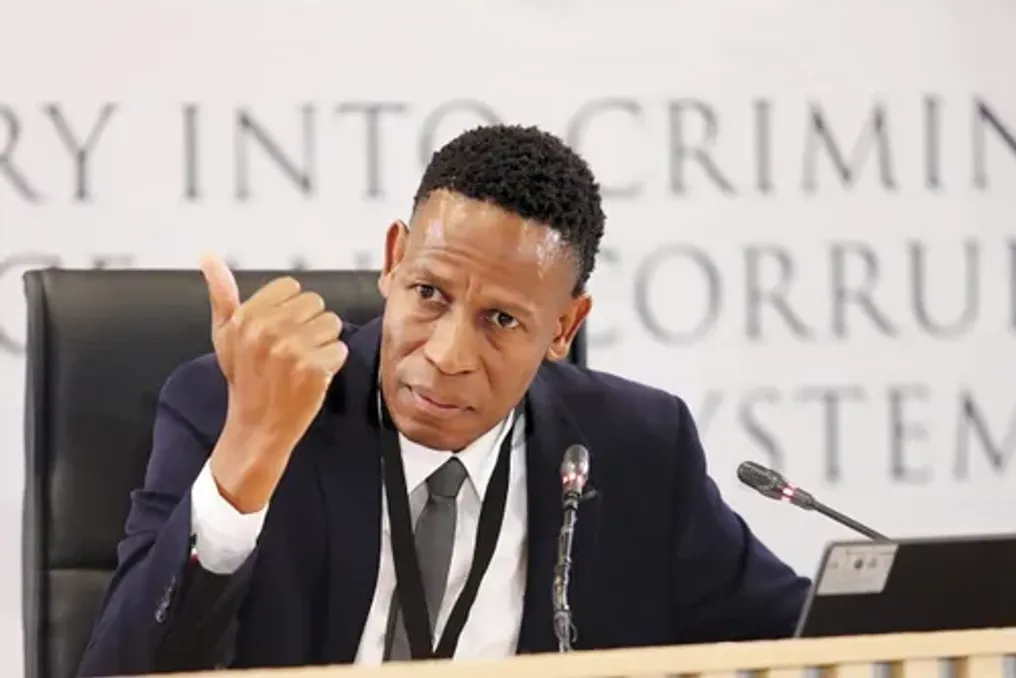
IDAC Investigator Mantsha Robert Rapesu appeared before the Madlanga Commission on Friday, expressing serious concern regarding discrepancies in the Section 27 affidavit submitted to Parliament, as he intends to initiate criminal prosecution.
The Senior Investigator of the Independent Directorate of Corruption and Economic Crime (IDAC) informed the Madlanga Commission on Friday that the Section 27 document presented during the investigation does not match the document he was briefly shown before the investigation into high-ranking intelligence service officials.
He testified that key allegations he remembered were absent from the version subsequently presented to Parliament and the commission.
Mantsha Robert Rapesu also disclosed his plan to file criminal charges regarding matters under the commission's review and requested that the commission ensure the independence of any investigation.
The Commission, chaired by current Deputy Chief Justice Mbuyiseli Madlanga, is investigating issues arising from IDAC investigations following a Section 27 referral made by MP Fadiel Adams.
Rapesu's testimony was the latest in a series of statements where other witnesses raised questions about how IDAC handled Adams' referral and the documentary materials relied upon in subsequent investigations.
Under the guidance of Evidence Head Advocate Tabanga Pue, Rapesu stated that IDAC State Attorney Drushanta Ramsami briefly showed him the Section 27 affidavit before the case was assigned, gesturing that he should review it quickly before it was taken back.
Rapesu noted that he immediately realized he shouldn't see the document, and he only had five to ten minutes to read it, after which Ramsami took it back. Despite the limited time, he stated that the allegations were so serious they remained firmly in his memory.
According to Rapesu, the affidavit he glimpsed contained allegations concerning the Political Killings Task Team (PKTT), alleged misuse of secret service funds, luxury items, living expenses, property, and other matters.
He testified that he immediately realized something was wrong when Advocate Andrea Johnson later presented what was described as the Section 27 affidavit in Parliament.
Rapesu stated: 'The affidavit before this commission is not the affidavit I saw.' He insisted that the allegations he recalled were missing from the version presented to Parliament and the commission, asserting it was not the affidavit he had seen.
Chairman Madlanga repeatedly questioned Rapesu on how he could confidently recall the contents of a document he saw for only a few minutes. Rapesu stood firm, asserting that he was recounting what he personally read, not speculating, insisting that the seriousness of the allegations made the document unforgettable.
The witness also described what he considered deviations from standard investigative procedures. He showed that Johnson herself presided over the allocation meeting, and that investigators were told they would not receive the initial Section 27 referral from Adams, although it usually forms the basis of the investigation.
Rapesu informed the commission that he participated in four cases, which he termed the 'Lushaba case,' the Mokwele case, formerly known as the Mandondo case, the forklift case, and the PKTT case.
He said he was the lead investigator in the investigation of the intelligence service brigade commander appointment, Dioneo Mokwele, but later discovered that the investigation team interviewed witnesses and obtained affidavits without notifying or consulting him.
'Despite being the lead investigator on the Mokwele case, the team consulted with witnesses on this matter without informing me,' Rapesu stated.
Rapesu deemed these events irregular and requested to be excluded from the Mokwele case. After being removed, Rapesu testified that he himself became the subject of an investigation.
He informed the commission that he was later charged with disciplinary offenses related to leaking confidential information concerning Cedric Nkabinde, chief assistant to the suspended Police Minister Senzo Mchunu. He denied this charge, stating that he voluntarily agreed to undergo a polygraph test and provide records from his mobile phone because he wanted to clear his name.
He further testified that he believed Dylan Perumal and Colonel Brian Padayachi played a role in the events that ultimately led to the investigation against him. These allegations became part of his evidence before the commission, which has not yet reached any conclusions on them.
Explaining why he did not file a criminal case earlier, Rapesu said he deliberately waited until the investigation against him concluded because he did not want it to appear as if he was obstructing or impeding the process. He explained: 'I didn't open the case then because I didn't want it to look like I was opposing what they were investigating against me. I wanted their process to finish.'
Now, having appeared before the commission, Rapesu stated that he decided to pursue criminal prosecution. He stated: 'My intention is to open a criminal case, and I hope the commission will also assist by providing investigators to handle this case, because I do not want it to fall into the wrong hands anywhere.'
Rapesu's evidence corroborates the testimony given on Thursday by IDAC colleague Drushanta Ramsami, who also claimed that the Section 27 affidavit initially available to investigators differed significantly from the version later presented to Parliament and the commission.
The commission has not yet made any findings on these allegations. Johnson denied guilt during her testimony before the commission and disputed the accusations made against her by several witnesses.
The investigation will resume on Tuesday, when Ramsami is expected to continue his testimony after completing his second statement.