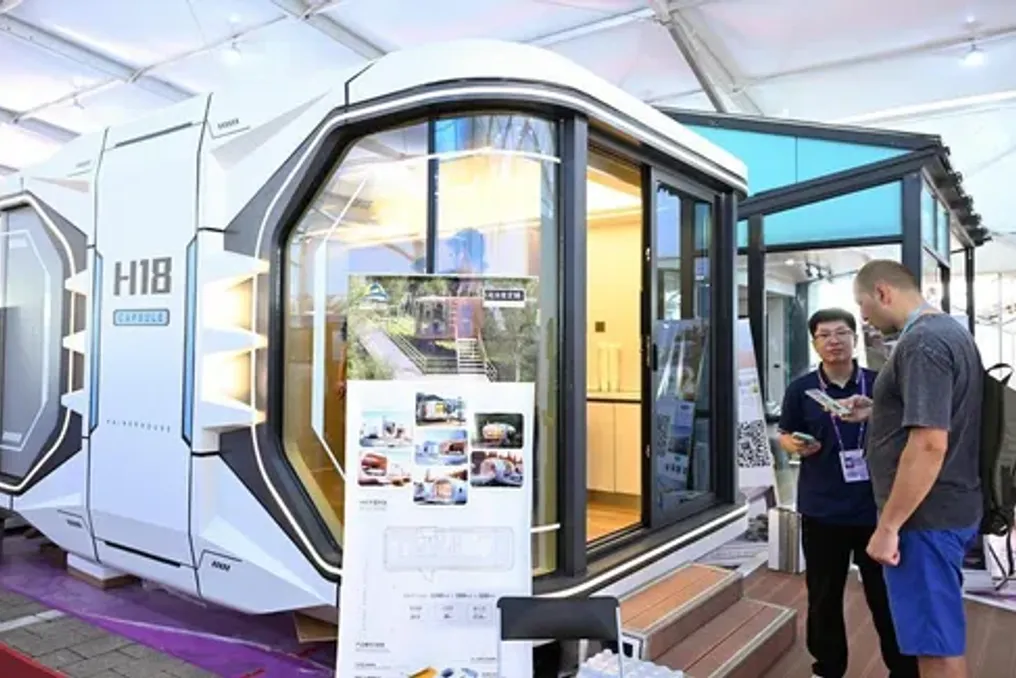
At the Dongguan port in Guangdong province, China, container cranes load modular blocks onto ocean-going vessels bound for Australia, North America, and the Middle East. Each block represents a complete room that can be assembled like building blocks to construct hotels, hospitals, and apartments abroad.
In the Huiyang area of Huizhou city, Guangdong province, at the CSCEC Science and Industry factory—a subsidiary of Chinese construction giant CSCEC—a fully automated production line spanning over 400 meters operates. This facility produces steel frame modular products where robotic manipulators work in synchronization with automated vehicles.
One room on the factory floor is disassembled into six separate elements: floor, ceiling, and four walls. These parts are manufactured in parallel and then assembled into a single module at the end of the production line. Li Huakun, chief engineer of CSCEC Science and Industry subsidiary, noted that this line can produce 50 units per day, which is ten times the output of comparable factories in North America. He also emphasized that thanks to robots following digital instructions, accuracy in the 'smart digital workshops' is controlled with a margin of only 1–2 millimeters.
In the construction industrial park managed by China State Construction Hailong Technology Company Limited in Longgang, Shenzhen, Guangdong province, a fully integrated module comes off the conveyor belt every 20 minutes. Wang Qun, the chief engineer of this company, explained the operating principle: 'Sand and concrete enter from one end, and the house exits from the other.' The company developed the world's first flexible, intelligent production conveyor for integrated construction (MiC) using concrete. Robots can plaster 70 square meters of walls in 20 minutes, a task that would take a person an entire day. Each module is equipped with a unique QR code that serves as an identifier, allowing all production data to be tracked with a single scan.
Wang Qun added that over 70 percent of the construction process has been moved to the factory, which has reduced project implementation times by more than 60 percent. The annual production capacity of the conveyor ranges from 20,000 to 30,000 prefabricated concrete modules.
The Chinese prefabricated housing sector focuses on steel and concrete structures. Steel is preferred due to its lightness and suitability for sea transport and high-rise construction, while concrete better aligns with traditional Chinese housing preferences and is therefore more sought after in the domestic market.
In New South Wales, Australia, a residential complex is being built using Chinese-made modules, requiring less than half the workforce needed with traditional methods and reducing construction time to a few months compared to two and a half years for conventional construction. In Australia, labor typically accounts for 30–40 percent of total construction costs when using traditional methods. The advantage of modular construction lies in transferring most of the work to factories in China, which reduces the need for on-site labor and cuts construction time by more than half. Li also noted that overall construction costs can decrease by more than 10 percent.
In Dubai, China State Construction Hailong Technology Company Limited received preliminary approval from the Dubai Municipality for MiC high-rise buildings in 2025. Wang described this achievement as proof that Chinese construction technologies are transforming 'from meeting international standards to shaping them.' Jian Li, Deputy General Manager of CSCEC Science and Industry, stated that foreign clients primarily care about three aspects: delivery quality, delivery speed, and delivery cost. With the support of robotics, digital factories, and eco-friendly materials, Chinese construction firms are capable of satisfying all these requirements simultaneously. A clear trend is emerging: these companies are evolving into providers of comprehensive solutions that integrate products, standards, and branding.
Behind this shift is the most complete supply chain in construction globally. From steel and concrete to plumbing and home appliances—any component can be quickly sourced in China. Chinese firms also design each module to withstand the stresses of sea transport. Wang concluded that modular construction represents a new qualitative productive force for the construction industry. As a first step, China State Construction Hailong Technology Company Limited has achieved industrialized production and data-driven management throughout the process. In the future, the company is confident it can contribute to transforming Chinese modular construction technologies into a key driving force for the global construction sector's industrialization.