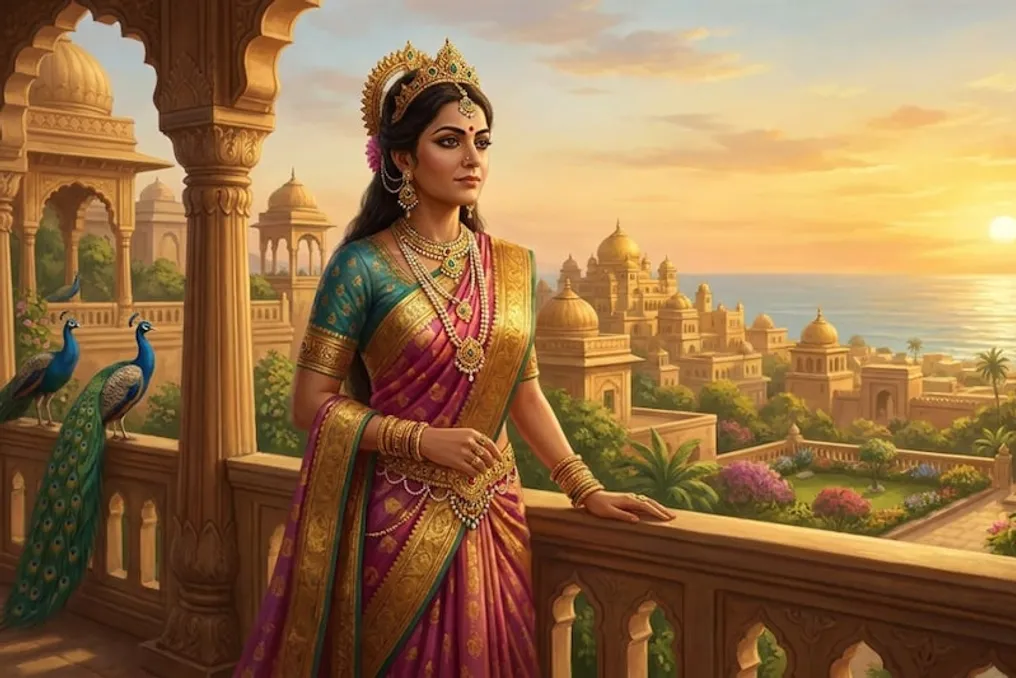
Amidst the majestic figure of Ravana, associated with Lanka, his arrogance, the abduction of Sita, and the war with Rama, there existed a woman who possessed her own intellect, vision, and pain. This was Mandodari. Within the entire kingdom of Lanka, she was one of the few who realized that the path Ravana was taking would inevitably lead to ruin. Nevertheless, in the popular memory of the Ramayana, Mandodari is not depicted over the centuries as a personality with her own perspective, political understanding, or moral voice.
To understand Mandodari's dissent, one must first understand the Ramayana. The central theme of the Ramayana revolves around the confrontation between Rama, Sita, and Ravana. Sita is at the center because her abduction drives the entire plot forward. She becomes the emotional core of the events, from Rama's exile to the conquest of Lanka. Ravana is considered the central figure because he acts as Rama's greatest opponent. Regardless of how important Mandodari's role was in this conflict, she does not become the heroine driving the narrative; she remains a voice within the empire, one who sees the approaching crisis, tries to stop it, but cannot change the decisions of power.
This distinguishes Mandodari from other female characters. Kaikeyi made the decision that determined the direction of Rama's exile. Mantra influenced Kaikeyi and initiated the decisive event. The incident with Surpanakha set the stage for the conflict between Rama and Ravana. The abduction of Sita itself became the main cause of the war, but what about Mandodari? She was not one who made decisions, but one who foresaw the consequences of those decisions.
In Valmiki's Ramayana, Mandodari repeatedly tried to convince Ravana. She advised him to return Sita to Rama and explained that hostility with Rama could prove devastating for Lanka. She was not unfamiliar with Ravana's power, and perhaps that is why her warnings were so significant. While acknowledging her husband's might, she also recognized the danger of his arrogance. The interesting aspect of Mandodari's character is that, despite being Ravana's wife, she did not agree with everything he said. She saw in him not only love and grandeur but also his greatest weakness—his pride.
However, in popular interpretations of the Ramayana, Mandodari is often remembered merely as Ravana's wife, as if she had no independent identity, and her entire character was dictated by Ravana. This is where the image of Mandodari diminishes in our collective memory. We forget that being inside power and being part of power are not the same thing. Mandodari was the queen of Lanka, but she did not have the final say on Lanka's political decisions.
Another characteristic of Mandodari is that she is among the women of the Ramayana whose moral stance does not require her to take up a sword in battle. Her struggle is a struggle of dialogue. Facing Ravana, she persuaded him that his attachment to a woman could jeopardize the entire kingdom. She was the voice of reason before male authority, where the king's pride surpasses the wife's counsel. In this sense, Mandodari seems not just Ravana's wife, but the conscience of that power, constantly warning, yet her warnings are constantly ignored.
After the war, Mandodari's grief adds depth to her character. After Ravana's death, she mourns not just as the wife of a defeated king. Before her collapses the entire world that was built upon Ravana's arrogance. At this moment, Mandodari's position becomes extremely human. She has to mourn the death of a husband whose erroneous decisions she challenged. This paradox makes her character exceptional. She does not justify Ravana's crimes, yet she is a loving wife. In her coexist the sorrow of a wife and the consciousness of reason.
Perhaps Mandodari's greatest sorrow was that she did not consider her husband weak, but knew his strength perfectly. She knew that Ravana had conquered the gods and many mighty warriors, but she also understood that his attachment to Sita was leading him to ruin. This is why, in the final stages of the war, her concern was not only for her husband but also for the future of all of Lanka. This is why calling Mandodari simply Ravana's wife means ignoring the most important part of her character. She was the voice of reason within that monarchy, which was constantly suppressed by Ravana's arrogance.
Mandodari's tragedy is that she was the wife of the wrong man, but she was not responsible for every one of his wrong decisions. Hence her deeply human character. She is not the wife who justifies Ravana's crimes, nor the woman who leaves her husband. She stays with him, convinces him, disagrees with his decisions, and finally mourns his downfall. This paradox constitutes the greatest strength of her story.
