The Indian electric vehicle market is projected to nearly triple by 2032, with the majority of this growth attributed to two- and three-wheeled vehicles providing last-mile mobility.
The Indian electric vehicle market is projected to nearly triple by 2032, with the majority of this growth attributed to two- and three-wheeled vehicles providing last-mile mobility.
However, many manufacturers entering the country's market lack a clear plan for managing vehicles after they are sold to customers. They have limited information regarding vehicle location, battery status, or malfunctions.
Nexular, a Mumbai-based company, aims to change this situation. The startup provides connected hardware, cloud software, and an artificial intelligence-based intelligent layer that allows electric vehicle manufacturers in India, Southeast Asia, and Africa to monitor, manage, and monetize their vehicles.
Nexular was founded in 2023 by computer scientists trained in Sweden—Joel and Emma Rosada, who co-founded over 10 companies, along with Matthias Hulten. They created Nexular with Matthias Hulten, an expert in mobility, operations, and product development. Joel serves as Chairman, Emma as CFO, and Matthias as CEO.
Joel Rosada notes: 'Manufacturers have already decided to connect their vehicles. The only open question was which supplier to use and at what price.'
This defined Nexular's concept: in-vehicle hardware, data management software, and an intelligent layer that transforms this data into useful functions. A compact device is installed near the battery, tires, and engine on the production line. It collects data such as location, battery status, and speed, and can remotely disable the vehicle if necessary. Different hardware options are available for various markets.
Each manufacturer operates within its own dedicated software environment, where data is stored on private local servers. This configuration ensures customer data privacy and security, helping manufacturers comply with local data regulations as Nexular expands into new markets.
The third layer, according to Nexular, is its distinguishing feature. Since the company owns the entire technology stack, it can release new features significantly faster than competitors working with multiple suppliers. Features such as payment tools, analytics dashboards, and remote control functions can be added without needing a complete platform overhaul. Rosada asserts that this approach allows Nexular to advance 100 times faster than traditional development cycles. He gives an example: 'A project that usually takes a year, we can do in two days.'
Unlike gasoline cars, which are largely disconnected after sale, electric vehicles remain digital throughout their service life. Manufacturers can manage battery swap networks, leasing programs, and after-sales service, but only if they know how the vehicles are being used.
This transparency also impacts financing. If lenders know where the financed vehicle is and how it is being used, risks decrease, and borrowing costs may reduce. Rosada emphasizes: 'For couriers and freelance drivers, this interest rate gap can be the deciding factor between the ability to acquire a vehicle and the income it generates, or the lack thereof.'
For couriers, the technology is presented as a simple mobile application displaying location, battery charge level, and a digital key. Meanwhile, manufacturers and fleet operators gain access to monitoring dashboards showing real-time vehicle location, service alerts, and maintenance warnings. This data can be integrated into existing systems or used to create branded applications for customers and leasing partners.
Nexular receives a one-time fee for each hardware unit sold, as well as a recurring software subscription. Manufacturers can choose individual products or implement the full platform.
The company is also developing software that uses vehicle data to automate financing, leasing, and battery swap services, especially in markets where vehicle financing remains slow and paperwork-heavy.
Creating the technology was only half the task; convincing manufacturers to adopt it required integration into the existing automotive supply chain. Instead of selling directly to couriers, Nexular acts as a Tier 1 supplier to vehicle manufacturers. Among its clients are the motorcycle company Roam, as well as micro-mobility players Clean Motion and EVX Mobility. The platform supports all types of vehicles—from two-wheelers to quadricycles and commercial vehicles.
Nexular competes with players such as Vecmocon Technologies, which handles battery and smart system management for EV OEMs, and Intangles, known for its AI-based predictive fleet maintenance.
The company has signed three contracts with OEMs worth over $400,000 and is negotiating five more. According to Nexular, its commercial portfolio exceeds one million vehicles in India, Southeast Asia, and Africa, representing a potential first-year opportunity of $10–20 million.
Rosada compares today's Indian EV industry to China's early rise, pointing to companies like BYD, which transformed from domestic producers into global brands within a decade. He states: 'We are building the infrastructure for those who will do it.'
Nexular positions itself as 'Made in India, international standard,' combining local manufacturing with export-ready technology.
Rosada insists that speed remains its main advantage. Owning the entire technology stack allows the company to develop and deploy products much faster than competitors operating through disparate systems.
Rosada initially invested about $3 million of his own capital before Nexular raised another $550,000 from Saganaki Ventures, 8+ Ventures, Lindia Invest, Skare Invest, and a group of European angels in March 2026. These funds were used to finance production, hire staff, and acquire customers, and the company's Edge Series is now in full production in India.
With production underway, Nexular's immediate goal is order fulfillment and market share growth. A Series A round will follow sales growth. In the near term, Nexular aims to become the leading connectivity platform for EVs in India and Southeast Asia. In the long term, Rosada believes connectivity will form the basis of a broader mobility ecosystem.
He expects that within the next two years, the platform will feature AI-driven financing, leasing, and rentals. 'We will be able to automate vehicle-level financing decisions and lower the cost of credit. This will make electric vehicles accessible to people who use motorcycles as their business, not just for transport.'
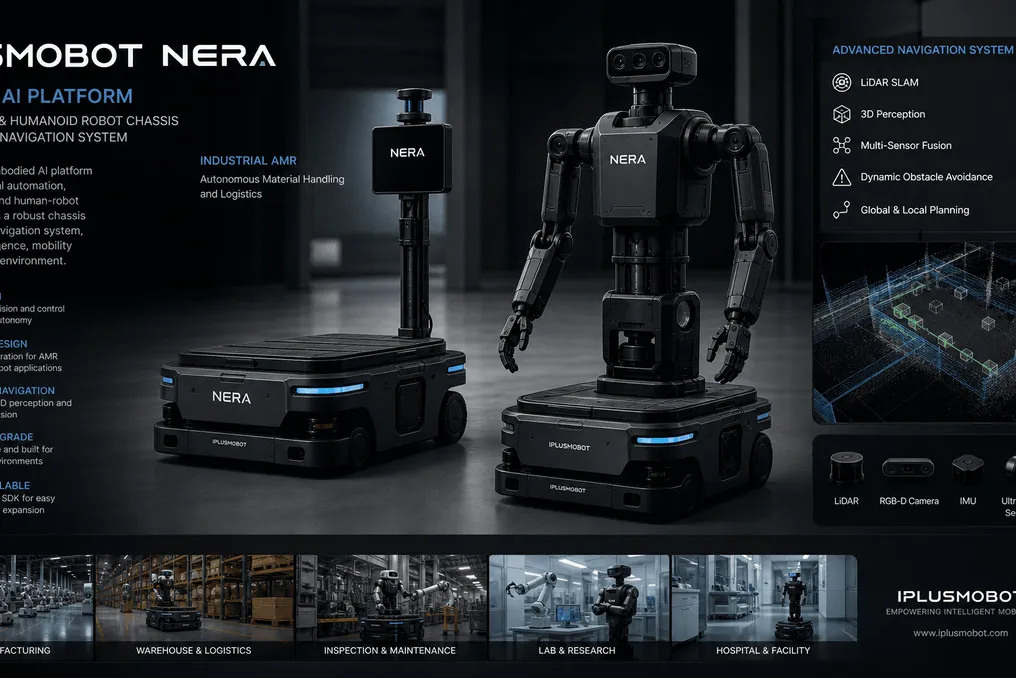
Zhejiang IPLUSMOBOT Technology introduced its NERA embodied intelligence line at the WAIC 2026 exhibition. This presentation expanded the proven capabilities of Autonomous Mobile Robots (AMRs) into a standardized industrial embodied artificial intelligence platform.
As part of the launch, the company demonstrated the omnidirectional NERA-P chassis and the NERA-C controller. These components transform years of implementation experience into infrastructure that other robotics companies can utilize. IPLUSMOBOT leverages expertise gained from the Zhejiang University robotics team, possessing knowledge in multimodal perception, autonomous navigation, and multi-robot task planning, while also operating a 16,000 square meter production base.
The core idea is that the value of embodied intelligence depends not only on cognitive abilities but also on the AI's ability to reliably act through physical objects in the real world. Industrial robots must handle atypical conditions over long operational periods while adhering to safety, precision, production rhythm, reliability, and return on investment requirements. While industry attention is focused on humanoid forms, VLA models, and general cognitive intelligence, mobility is often treated as a solved problem.
IPLUSMOBOT asserts that factors such as positioning loss, downtime due to collisions, and scheduling conflicts continue to directly affect the pace of the production line and system availability. The NERA-P chassis incorporates industrially validated multimodal fusion positioning and navigation algorithms, along with standardized mechanical and electrical interfaces. This allows humanoid robot integrators to avoid conducting their own chassis research and focus on body design, end-effector manipulation, and application scenarios.
The NERA-C controller is designed for deploying wheeled-legged and quadruped robots. It integrates mapping, positional navigation, motion control, and payload management into a single platform supporting mixed indoor and outdoor mapping. The CLOUDIA system enables cluster management and heterogeneous mixed robot planning. For inspection system integrators, NERA-C provides low-code graphical deployment tools, which reduces the development cycle by centralizing navigation, control, and cluster management, allowing integrators to focus on business processes, scenario adaptation, and customer service.
These two products together form the foundation of IPLUSMOBOT's current embodied AI lineup: NERA-P handles the mobility of the entire humanoid robot, and NERA-C handles application development for wheeled-legged and quadruped systems. IPLUSMOBOT positions itself as a foundational platform rather than a manufacturer of complete humanoids, betting on specialization and open collaboration as the industry scales. Standardized interfaces reduce redundant construction and accelerate partner delivery. Regardless of which form or architecture of intelligence prevails, stable, safe, and efficient movement remains a prerequisite for industry. This approach represents an emerging division of labor, where mobility infrastructure providers offer the foundation, and specialists create the intelligence and applications.