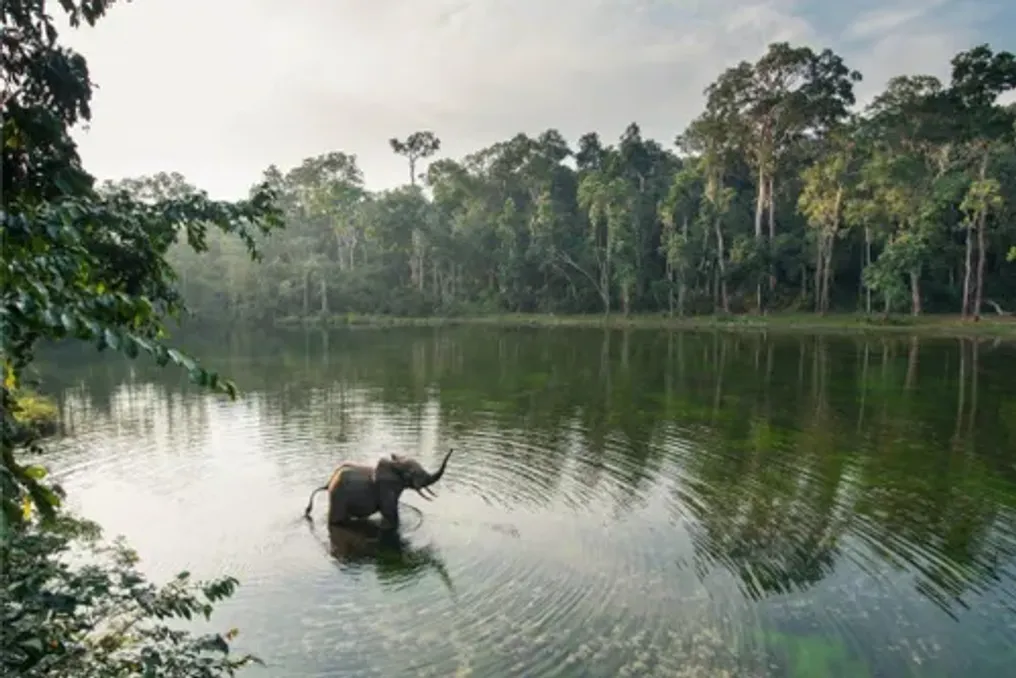
The Congo Basin represents the world's largest tropical carbon store; its forest expanse stretches across almost the entire African continent and covers an area larger than India. Despite its colossal importance, very little is known about it.
The Congo Basin represents the world's largest tropical carbon store; its forest expanse stretches across almost the entire African continent and covers an area larger than India. Despite its colossal importance, very little is known about it.
Currently, about 200 scientists comprising the Congo Basin Scientific Group are making efforts to change this situation. The panel presented its first report in Brazzaville, Republic of the Congo, in May, aiming to attract funding to train thousands of doctoral students over the next decade.
Experts note that intensifying scientific research is necessary to understand and protect this vast territory. The forest regulates the climate of an entire continent, is home to one-fifth of the world's species of living organisms, and absorbs as much CO2 as Germany emits annually. However, the forest is threatened by slash-and-burn agriculture, deforestation, mining, and the demand for charcoal used by growing populations for cooking.
The panel's Special Envoy, Lee White, a zoologist born in the UK and formerly Minister of Environment of Gabon, stated: 'We need investment in better understanding the Congo Basin and in creating a generation of Congo Basin scientists who will protect the ecosystem. I am convinced that if we lose the Congo Basin, Africa will become uninhabitable.'
These efforts echo the work conducted by Brazilian researchers over the last three decades in the Amazon Basin, significantly expanding knowledge of tropical forests. According to surveys, about 120 scientists from Congo Basin countries publish on issues related to this forest, which is a small fraction of the thousands of researchers studying the Amazon.
White noted: 'It is quite disheartening. That is why we know much more about the Amazon than we do about the Congo Basin.' The panel is appealing to potential funding sources, such as the African Development Bank and the Hassoplatner Foundation, established by co-founder of German software giant SAP SE, to support this initiative, which White estimates will cost tens of millions of dollars. Currently, the UK government has provided £9 million ($12.1 million), enough to fund up to 30 master's and about 15 doctoral degrees.
Universities in Congo Basin countries often suffer from resource shortages, and local scientists have limited career opportunities. Bila-Isia Inogwabini, a professor of biodiversity at the Catholic University of Congo in Kinshasa, Democratic Republic of Congo, said: 'When people get doctorates in the Congo Basin, they go into ministries doing administrative work; they leave the scientific field. Or they stay in the Western world, where they are offered better jobs. Many people I studied with in the UK consider me crazy for coming back.'
White and the scientists, including Inogwabini, argue that partnerships must be established between wealthier universities in places like Europe and the US and institutions in the Congo Basin, which stretches from the Cross River in Nigeria to the Rift Valley in East Africa. Panel scientists teach at universities in Cameroon and Gabon, as well as in the US, UK, and the European Union.
Emma Torres, Strategic Coordinator of the Amazon Science Group, reported that support from the Brazilian government was vital for a similar initiative in the Amazon, which launched its scientific panel in 2019. She emphasized that the continuity of this support across different political cycles played a key role.
Central Africa is home to some of the poorest countries in the world, which limits state support for scientists and generates stigmatization, despite significant achievements in nature conservation. White stated: 'There is a negative perception that this is the heart of darkness in the Congo Basin, and that little can be achieved. I clearly disagree with this. If you look at the results of the Congo Basin in terms of establishing new protected areas and so on, they are probably world leaders in progress.'
This stigma has also affected the careers of scientists from the region. Lydie-Stella Kutika, a soil scientist from the Republic of the Congo and one of the three co-chairs of the scientific panel, shared: 'I received my doctorate on the Amazonian Brazilian ecosystem. So it's quite funny. I saw the Amazon forest before I saw the forest ecosystem in the Congo Basin.'
Global seas demonstrated record temperatures for July, and the combination of heat and drought has led to a drop in water levels and deterioration of water bodies in Europe. Specialists attribute these phenomena to the intensification of climate extremes.
According to a BBC report, the average sea surface temperature outside the polar zones was approximately +21°C, exceeding the previous record set in 2023. The highest readings were recorded off the Atlantic coast of Europe and in the western part of the Mediterranean Sea. Thus, July became the second warmest month globally in observation history.
Western Europe experienced its hottest June and July on record: the average temperature over these two months was 2.79 degrees above the established norm. This heat and drought triggered large-scale forest fires, resulting in the burning of about 500 thousand hectares in the EU since the beginning of the year.
According to The Guardian, the drought has already impacted energy infrastructure operations. In Poland, two coal-fired power plants were forced to shut down due to insufficient water for cooling, and the only nuclear power plant in Hungary stopped operating. The preliminary estimate of economic damage from the summer heat for grain producers in Europe is two billion euros.
In the UK, July was declared the driest for England and Wales in the last 190 years of observations. Large areas of England and the entire territory of Wales were declared drought zones, and water levels in the Seine, Rhine, and Danube rivers dropped significantly below normal.
Water resource problems in Britain are not solely due to drought. As reported by New Civil Engineer, a new classification by the Environment Agency of England shows that only 14.3% of more than 4,600 surface water bodies meet the criteria for good ecological status. The remaining 65.4% received a 'satisfactory' rating, 17% a 'poor' rating, and 3.1% a 'very poor' rating. Furthermore, all surface waters in the country do not meet chemical composition requirements.
The new assessment demonstrates a decrease in the proportion of water bodies in good ecological status compared to 2019, when this figure was 16.3%. However, the Environment Agency emphasizes that a direct comparison is impossible due to the use of more extensive monitoring data and updated analysis methods for the current assessment.
Simultaneously, improvements are observed in some individual parameters. In 82% of cases, individual ecological indicators of water bodies were rated as 'good' or 'high'. For example, phosphate levels in the River Roch improved from poor to good after the implementation of a special permit for wastewater treatment facilities located upstream.
Scientists warn that ocean warming contributes to an increase in marine heatwaves, sea-level rise, and potential intensification of tropical storms and precipitation. On land, heat and drought mutually reinforce negative effects, and the formation of El Niño in the Pacific Ocean could further raise global temperatures in the coming months.
Additionally, it should be noted that the past July was one of the hottest in Uzbekistan. The average temperature there exceeded the climatic norm by 1.3–2.8 degrees, and in desert regions, air temperatures approached 50 degrees. In Kyzylkum, up to 19–23 days with temperatures above 40 degrees were recorded.
According to data from the Special Commission for implementing urgent measures to improve the environmental situation, cases of non-compliance with medical waste management standards have been found in Tashkent. These violations include mixing hazardous waste with household waste and subsequently transporting it to landfills or placing it in unauthorized locations.
Inspections revealed that several medical institutions failed to separate hazardous waste from domestic waste. As a result, the waste was transported to landfills or stored in undefined areas.
The World Health Organization indicates that 15% of medical waste is hazardous. Improper handling of such waste can lead to the spread of diseases, poisoning, and environmental pollution.
In accordance with Presidential Decree No. PP-263 dated July 17, 2024, the American company SAYAR LLC established the foreign enterprise Sayar Green. This company is implementing an investment project worth 115 million US dollars, but the mechanism is not fully functional because medical institutions refuse to transfer hazardous waste to the investor.
Two facilities for processing medical waste have been established in Tashkent, with a total daily capacity of 12 tons. Nevertheless, they receive only about 3 tons of waste daily, operating at 25% of their capacity.
In the first six months of 2026, a total of 3239.05 cubic meters of medical waste were collected in the capital. Among the specified medical institutions, Clinical Hospital No. 16 generated the largest volume of waste (1795.40 cubic meters), Clinical Hospital of Infectious Diseases No. 3 (445.44 cubic meters), and the Clinic of the Research Institute of Virology (382 cubic meters).
Furthermore, violations were identified in the field of service at the Republican Children's Center for Phthisiology and Musculoskeletal Rehabilitation, the City Branch of the Tashkent Center for Dermatology and Venereology and Cosmetology, City Clinical Hospital of Infectious Diseases No. 1, the Scientific and Practical Medical Center for Phthisiology and Pulmonology, and the Hospital of Skin and Venereal Diseases.
Appropriate measures are being taken against the individuals responsible for the identified facts. The Special Commission and law enforcement agencies are conducting similar inspections in other regions of Uzbekistan.
The International Conference on Water Challenges and Solutions (ICWCS 2026) is being held in Richards Bay and will run until Wednesday, August 13th. The conference aims to brainstorm global problems related to water.
The event, organized by the University of Zululand, the Chang'an University, and the Water Science and Technology Research Centre, focuses on exploring new issues in the field of water resources. The main objective of the conference is to exchange achievements in water resource management, discuss practical experience, seek innovative solutions for combating scarcity and purifying water, as well as address regional and global problems.
Deputy Minister of Water Resources and Sanitation David Makhlobo will be one of the leading thinkers, among whom experts on water, representatives from academia, government, civil society, and other stakeholders gathered to find solutions. Makhlobo will deliver the keynote speech on Wednesday.
Makhlobo stated: 'I will emphasize the global responsibility to invest in science, improve management, implement innovations, and develop sustainable water systems to support sustainable development.'
Meanwhile, water supply problems in Dubai continue to cause inconvenience to residents and businesses. On Tuesday, there were water outages in several areas of Dubai. Advisor Etkivini Alicia Kissun reported that due to malfunctions at the Wiggins Water Treatment Works, reservoirs in the Sherwood, Chesterwell, and surrounding areas are under severe strain. To restore levels, the Sherwood 3 pumping station has been temporarily closed. Kissun also mentioned the failure of a pump at the Wiggins facility.
A reduction in water supply via the southern aqueduct in the Etkivini municipality is planned from August 12th (Wednesday) to August 14th (Friday). The municipal water operations department plans to shut down the existing 1200 mm concrete pipeline so contractors can carry out sectional repairs as part of preparations for the modernization of the new southern aqueduct. The existing 1200 mm steel pipeline will remain in operation and continue to supply water to the western, central, and southern areas.
Sectional repairs will take place at the intersection of Perth Road and High Wycombe Road in Westville. The municipality stated that it will closely monitor reservoir storage levels. Depending on water demand and reservoir levels, outlets may be temporarily closed to conserve existing reserves and reduce the time needed to recover after resuming main water supply. Areas that might be affected include Nortden, Queensmead Industrial, Queensburg, Chalkross, Hillary, Malvern, Umbilo, Umkhlatkhuzana and Umkumbane, Chatsworth, Umlazi, Draaihoek, Ensimbini, Mahlabatini, Mangamazini, Mkhazini and Ntabankulu, Folweni, as well as Clearwater, St-Vendolins area, Savannah Park, Dambuza, Demat and surroundings.
Some parts of Johannesburg have also experienced water supply interruptions for three days. Residents of Savoy, Waverley, Bramley, Q, and Grasswold remain without water. Councillor Belinda Kaiser-Echeozondjoku from Ward 74 reported that the issue has been passed on to Johannesburg Water. She noted: 'We are awaiting confirmation regarding repairs in Korlett and an estimated time for restoration. Questions about recurring leaks in Savoy have also been raised with management.'
Residents in areas supplied by the Linkfield reservoir, Ward 81, are also dissatisfied. Daniel Kalyan, a candidate for councillor from the DA party, explained that the team is still pumping water from the pipeline as part of preparations for necessary welding work. He added: 'Welding can only begin after the pipeline is completely drained. There is currently no estimated completion time. We are also awaiting a response from Johannesburg Water regarding repairs on Club Street and the restoration of water supply.'