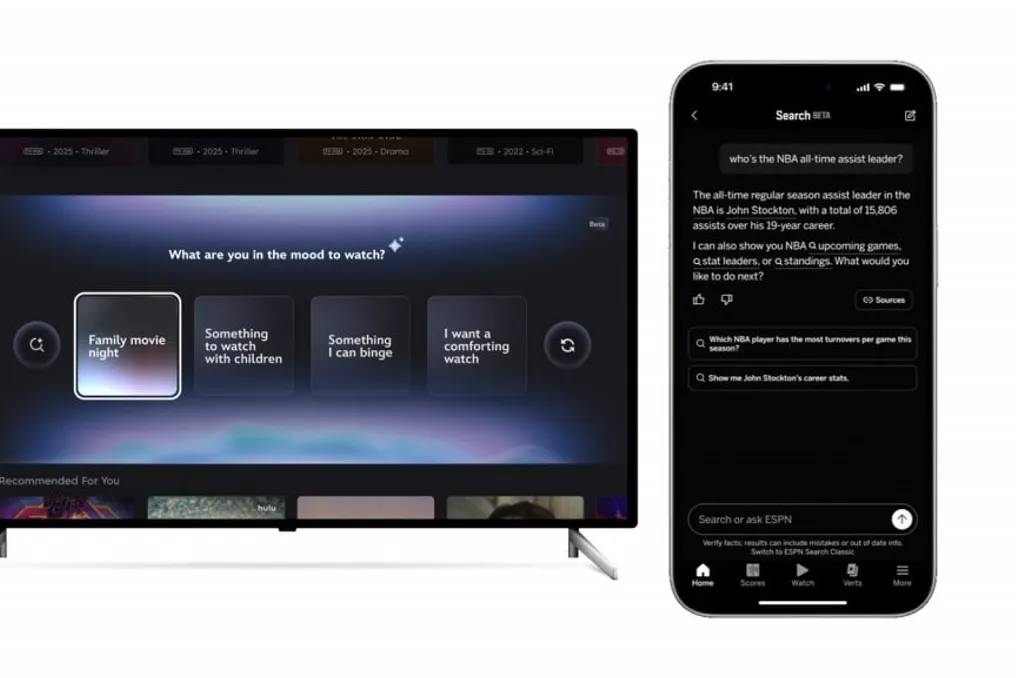
The Walt Disney Company began testing artificial intelligence features this year in August, focused on optimizing content search and discovery on both ESPN and Disney+. These experiences are currently in beta phase and are available to limited groups of users and subscribers.
Within ESPN, the innovation allows users to ask sports questions using natural language and receive answers, statistics, related materials, and suggestions in return. On Disney+, the proposal aims to understand what the subscriber is looking for at the moment, whether through text, voice, or predefined suggestions.
These implementations aim to reduce the difficulty users face when trying to locate specific information or decide what to watch, leveraging various datasets and Disney's own content to make navigation more aligned with the individual's immediate intent.
This strategy arises from a common difficulty in digital platforms: the user does not always know exactly which term to use in the search or what content they wish to find. In other instances, the desire is simply to explore options without primarily relying on consumption history.
In this context, Disney has begun experimenting with features capable of interpreting requests made more spontaneously. The company also plans to use these tests to monitor user interaction and identify ways to refine navigation mechanisms, results, recommendations, and content discovery in the future.
On the ESPN streaming service, the experimental feature was named ESPN Search. Available in beta version to some users, this tool allows users to pose questions about sports in colloquial language. Based on these requests, the system can compile answers, relevant materials, statistics, and recommendations.
The database used in this experience aggregates multiple sources belonging to the ESPN sports ecosystem. These sources include articles and videos published by the company, statistical data generated by ESPN Research, sports metadata, internal knowledge repositories, and structured sports data systems.
Thus, the functionality is not limited to pointing to a specific page. It is designed to link a question to various types of information accessible within the universe of ESPN content and data, allowing the user to reach elements related to what they are looking for more quickly.
On Disney+, the approach follows a different logic. Although the platform already uses personalization based on viewing history, the test considers scenarios where the subscriber's current interest may diverge from their usual patterns. For example, a viewer who usually watches crime dramas might want something lighter at a certain time.
The experimental tool tries to capture precisely this circumstantial change to offer alternatives suitable for the subscriber's mood or stated need. This feature is being evaluated with a small, selected group of subscribers, and interaction may occur via natural language, voice command, or suggestions provided by the platform itself.
Instead of solely depending on consumption history, the system allows the user to describe in their own words the type of experience they seek. The goal is to convert a generic search for something to watch into recommendations connected to the present context.
Both initiatives remain in the testing phase. Disney intends to use the feedback collected during the tests to improve how its services present information, content, and suggestions. This move also signals an attempt to make the relationship with platforms less dependent on traditional menus, categories, and searches, seeking alternative paths for users to find what they want by interpreting requests closer to everyday speech.