A total solar eclipse can be seen in an area covering Greenland, Iceland, Spain, and a part of northeastern Portugal this Wednesday (12). In other parts of Europe, the event will be observed partially.
This is the second solar eclipse predicted for 2026; the first, which occurred on February 17, was of the annular type, popularly called the 'Ring of Fire.' This same type of phenomenon will return to Brazil in 2027, coinciding with the Carnival period.
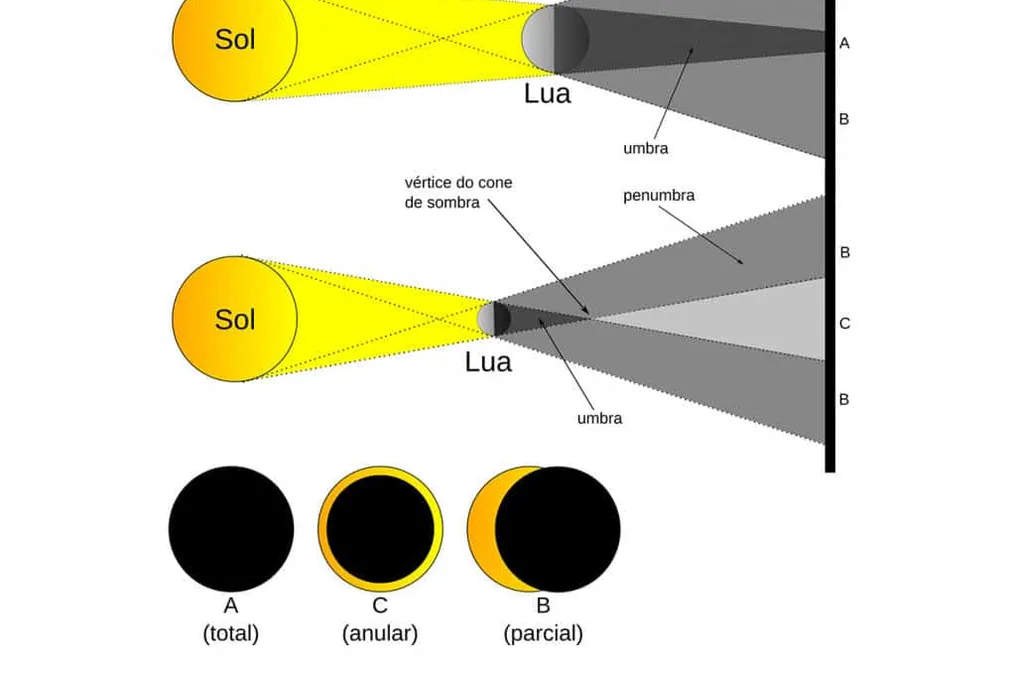
Solar eclipses occur when the Moon is positioned between the Sun and the Earth, obscuring the sunlight totally or partially. Different types of eclipse depend on the distance and position of these three celestial bodies.
In a total eclipse, the Moon completely covers the solar disk for those in the visibility path. In a partial eclipse, only a section of the star is covered, without causing intense darkening in the sky.
In the case of the annular eclipse, the Moon is farther from the Earth, making it appear smaller in the sky and consequently unable to cover the Sun entirely. This leaves a luminous circle around the Moon, giving rise to the nickname 'Ring of Fire.'
There is also the hybrid eclipse, considered the rarest, as it mixes characteristics of total and annular eclipses, depending on the observation point. An example of this type occurred in April 2023, as reported by Olhar Digital.
Observation of the Annular Eclipse in 2027
Although the 2026 annular eclipse was not visible in Brazil, the scenario will be different in 2027. On Carnival Saturday, February 6, the entire country will have the opportunity to see at least part of the spectacle.
According to the Time And Date platform, the narrowest band where the 'Ring of Fire' can be viewed will mainly pass through the Southern Region areas. In Rio Grande do Sul, the annular phase can be seen near Santa Vitória do Palmar, Paso Real, and Picada da Mata.
In Paraná, certain southern cities of the state will be within this band, including Pato Branco, Francisco Beltrão, and Palmas. In Santa Catarina, the phenomenon will be perceptible mainly in the far south, in municipalities such as Criciúma, Araranguá, and Sombrio.
For areas outside this band, the eclipse will be partial, but the Moon will still hide a considerable part of the Sun in some locations. In Rio de Janeiro, for example, the capital, the city of Niterói, and the municipalities of Baixada Fluminense will register about 90% coverage.
The percentage of coverage will decrease as one moves to other regions of the country. In Roraima, the state that will show the lowest coverage, approximately 7.7% of the solar disk will be covered by the Moon.
According to Brasília time, the partial eclipse will begin at 10:53 AM. The annular phase is scheduled to start at 12:42 PM and end at 12:49 PM. The complete eclipse will finish at 4:53 PM. It is important to note that these times may vary slightly depending on the chosen city for observation, so it is advisable to consult the specific forecast for the location.
With about six months until Carnival 2027, the 'Ring of Fire' promises to illuminate the parades. Even if the full viewing of the VIP eclipse is restricted to a few, both those in the general seating and in the stands will be able to follow a good part of the event, since the popular festival is accessible to everyone, just like the eclipse.