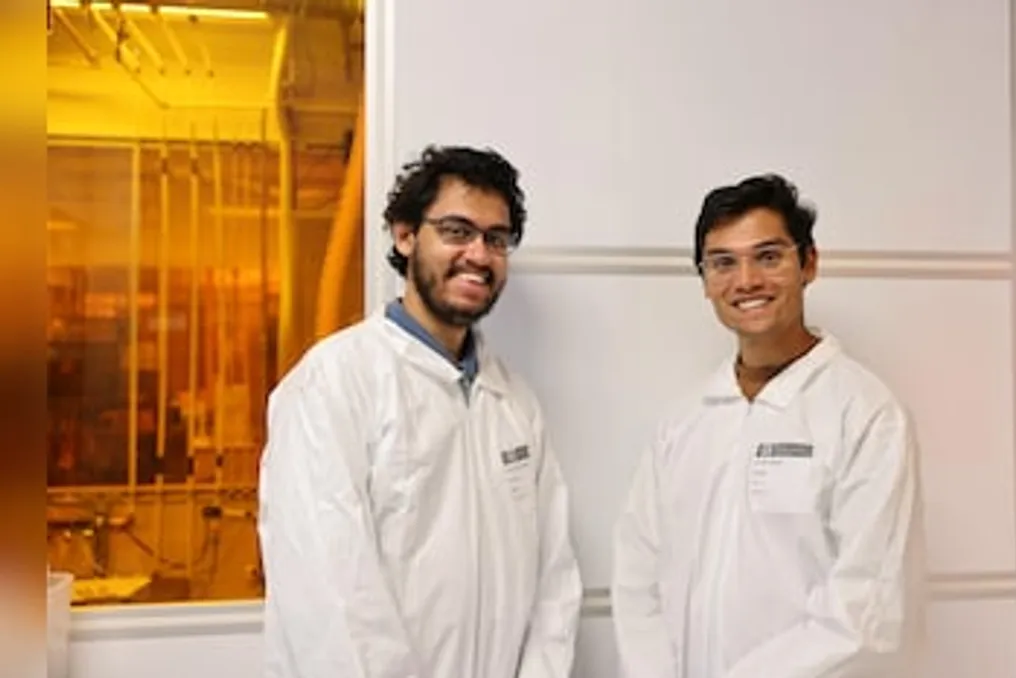
Discovered Materials, a company founded by IIT Madras graduates, has raised $9 million (equivalent to approximately 85 crore Indian rupees) in seed funding. The goal of this round is to create AI agents capable of discovering new materials and accelerating their integration into semiconductor chips.
Alongside this startup, hundreds of AI-discovered materials and the Material Discovery Bench tool were presented. This tool is positioned as the first benchmark for evaluating AI agents in solving real-world material search problems for semiconductors.
The round was led by Lightspeed India Partners, with participation from Y Combinator, Peak XV Partners, and angel investors including Paul Graham, Gokul Rajaram, and Tarik Shihipara. The funds will allow the company to advance its mission: making the process of discovering new materials fast enough to meet the growing demand for computational power from AI.
By using AI to compress months of interdisciplinary research into a matter of days, Discovered Materials aims to accelerate breakthroughs that can improve chip performance while reducing energy consumption and heat generation.
Progress in Computing and New Materials
Akash Ramdas, co-founder of Discovered Materials, noted that while advances in computing have driven most technological progress over the last fifty years, modern chips consume thousands of times more energy than the human brain. He emphasized that new materials are key to bridging this gap, citing the development of new thermal materials in the last three months that match the performance of products requiring many years of development by the world's largest chemical companies.
Co-founders Advait Sridhar and Akash Ramdas met more than ten years ago while studying at IIT Madras, one of India's leading engineering institutions. Sridhar holds a Ph.D. in materials science from Stanford University and spent the last 11 years researching new materials for semiconductor chips; his work on novel nanoscale interconnects became the most talked-about story of the Stanford School of Engineering in 2025. Ramdas studied AI at Carnegie Mellon University and worked as a research engineer creating video models and agents at Persona AI (acquired) and Luma Labs.
The seed funding will be used to expand the team and laboratory, as well as to scale the company's research AI agents. Hemant Mohapatra, a partner at Lightspeed India Partners, stated that AI is creating unprecedented demand for improved chips, but progress is slowed by how slowly new materials enter production. He expressed enthusiasm for partnering with Discovered Materials to build the future of semiconductor innovation, starting with the critical area of improving heat dissipation from increasingly hot chips.
Thermal management is one of the industry's most serious challenges, as modern AI chips generate enormous amounts of heat. New materials can radically improve chip efficiency, enabling advanced packaging technologies such as 3D stacking, as well as dissipating heat more effectively. Discovered Materials' AI agents operate at all stages—simulation, synthesis, and experimental verification—helping researchers find promising materials much faster than traditional R&D methods.
To showcase the rapid progress of these AI agents and measure their capabilities, the company also presented hundreds of new materials discovered by advanced AI models for use in semiconductors. Concurrently, the Material Discovery Bench was introduced—a standard developed in collaboration with experts from academia and industry. This benchmark evaluates advanced AI models based on real-world semiconductor material search problems and will continue to be refined through simulations and experimental verification.