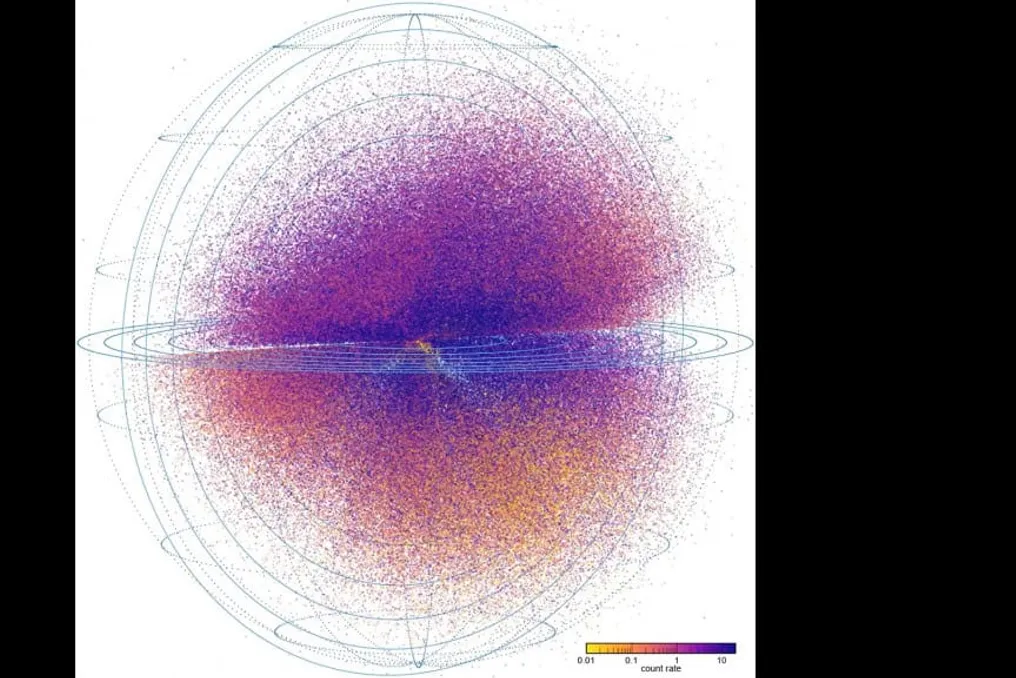
Astronomers have managed to identify nearly two million X-ray sources through the second large public catalog generated by the eROSITA space telescope. This survey significantly expands the inventory of known objects in the high-energy universe, encompassing supermassive black holes, stars, galaxy clusters, and remnants of exploded stars.
The catalog, named DR2, was compiled from the first three complete sky surveys conducted by the observatory, totaling 556 days of observation. The vast quantity and consistency of the records enable investigations into extreme phenomena, aiding in the search for answers regarding black hole growth, galactic evolution, and the formation of the largest cosmic structures.
The eROSITA mission, led by Germany, not only produces this survey but also increases the capacity to correlate X-ray sources with objects detected in other electromagnetic spectrum bands. This allows scientists to differentiate between various types of celestial bodies and define their position on the universal distance scale with greater accuracy.
The majority of the DR2 discoveries consist of point sources, exceeding 1.9 million records. These are mainly active supermassive black holes located in the cores of distant galaxies and stars belonging to the Milky Way. Active black holes are crucial for understanding the transformation of galaxies over billions of years, while stellar sources help study stellar life cycles and activities.
The catalog also includes about 64 thousand sources classified as extended objects. Among these are large galaxy clusters, nearby galaxies, and remnants of stellar explosions. Such clusters serve as markers for the distribution of the largest cosmic structures and can contribute to studies on the influence of dark matter and dark energy on the evolution of the universe.
X-ray observation is fundamental because it reveals environments that do not easily stand out in visible light. For example, as matter approaches a black hole, it can reach temperatures of millions of degrees before crossing the event horizon. Other emitters detectable in this range include neutron stars, supernova remnants, and the extremely hot gas found in galaxy clusters.
A notable aspect of this new survey is the correlation established between X-ray sources and corresponding observations in the infrared and optical light. This combination enables astronomers to determine whether a specific record belongs to a nearby star, a distant galaxy, an active black hole, or another energetic phenomenon.
In the parts of the catalog where such correspondences have already been confirmed, approximately 88% of the objects are linked to distant galaxies that possess actively feeding supermassive black holes.
Miriam E. Ramos-Ceja, manager of the ground segment of the eROSITA instrument and lead author of the publication on DR2, stated that the catalog constitutes an exceptionally vast inventory of the X-ray sky, creating solid foundations for statistical analyses of cosmic populations.
Mara Salvato, spokesperson for eROSITA and president of the group responsible for monitoring the sources, emphasized that detecting X-ray emission is only the starting point. Identifying the counterparts in other spectral bands makes it possible to define the nature of the objects, their location on the cosmic distance scale, and the formation of better structured datasets.
The magnitude of DR2 offers researchers the opportunity to compare large groups of objects under similar conditions, which can facilitate the discovery of patterns that would be overlooked in smaller observational samples. Study possibilities range from reconstructing the growth trajectory of supermassive black holes over billions of years, mapping galaxy clusters, and searching for rare or unique objects.
Although eROSITA concluded its scientific observations in early 2022, the material collected before the shutdown was sufficient to support new public data releases. The next iteration of the catalog, named DR3, is scheduled to be released in 2028.