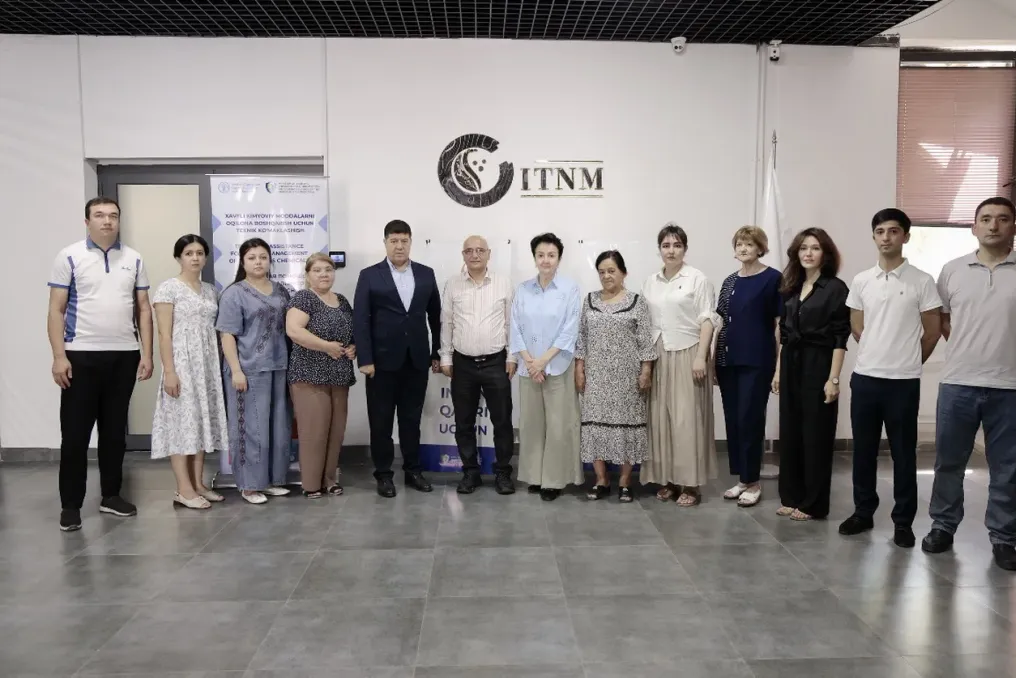
The Food and Agriculture Organization of the United Nations (FAO), in collaboration with the European Union, has launched the second stage of specialized training for employees of the National Center for Environmental Monitoring (NCEM) in Uzbekistan. This initiative is part of the project 'Technical Assistance in Proper Management of Hazardous Chemicals,' funded by the European Union.
The four-day training, taking place in Tashkent from August 10 to 13, aims to enhance national capabilities in chemical substance analysis, pesticide residue testing, and environmental control.
The program consists of four parts, and this stage covers the third and fourth modules. The goal of the program is to improve the technical qualifications of NCEM specialists and facilitate the accreditation of the laboratory at an international level. Continuing the work started in June 2026, the program focuses on verifying analytical methods according to ISO/IEC 17025:2017 requirements, as well as on chemical safety management and hazards in laboratory settings.
The first module of this stage, scheduled for August 10–11, provides practical knowledge on method verification principles and key performance characteristics such as selectivity, calibration, recovery, accuracy, as well as limits of detection and quantification. Participants also receive specialized recommendations on verification methods for the LC-MS/MS and GC-MS/MS analytical systems purchased under the project. During the training, participants will develop a draft plan for verifying multi-component pesticide analysis methods and conduct a data assessment exercise.
The second module, which will take place on August 12–13, is dedicated to chemical safety and risk management in analytical laboratories. Topics include identifying chemical hazards, risk assessment, safe storage and handling methods, engineering controls, personal protective equipment, emergency preparedness, and hazardous waste management. The training also includes a practical chemical safety audit designed to strengthen compliance with occupational health, safety, and environmental requirements. Expected outcomes include workplace risk assessment, a hazardous waste management plan, and a draft standard operating procedure for chemical safety.
Mohammad Nazem Shirazi, an FAO specialist in international laboratories, noted: 'Strong laboratories are built on confidence in every result obtained, and that confidence begins with well-verified analytical methods.' He added that through this training, NCEM specialists acquire practical skills to independently verify analytical methods, implement reliable quality control procedures, and obtain credible, internationally recognized results for pesticide residues in environmental samples. These capabilities are critically important for evidence-based decision-making, environmental monitoring, and proper hazardous chemical management in Uzbekistan.
The FAO project 'Technical Assistance in Proper Management of Hazardous Chemicals,' funded by the European Union, is an initiative worth 3.9 million euros that supports Uzbekistan in reducing environmental degradation by improving pesticide management, strengthening state regulation in the field of chemicals, and promoting sustainable agricultural practices.