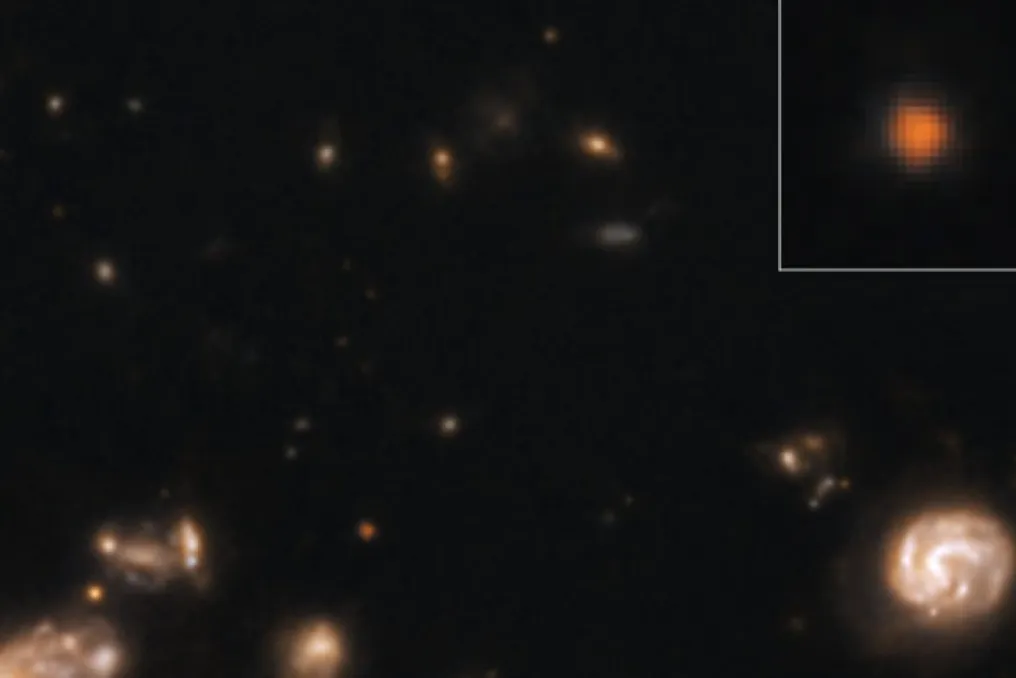
Astronomers have determined that the object previously considered a candidate for the record-distant galaxy Capotauro is actually one of the most distant known Y-type cold brown dwarfs. This dwarf is located within the Milky Way.
Astronomers have determined that the object previously considered a candidate for the record-distant galaxy Capotauro is actually one of the most distant known Y-type cold brown dwarfs. This dwarf is located within the Milky Way.
This discovery highlights the importance of verifying hypotheses about the detection of distant galaxies, which is carried out using data obtained through spectroscopy and astrometry methods. The full text of the study is available as a preprint on arXiv.org.
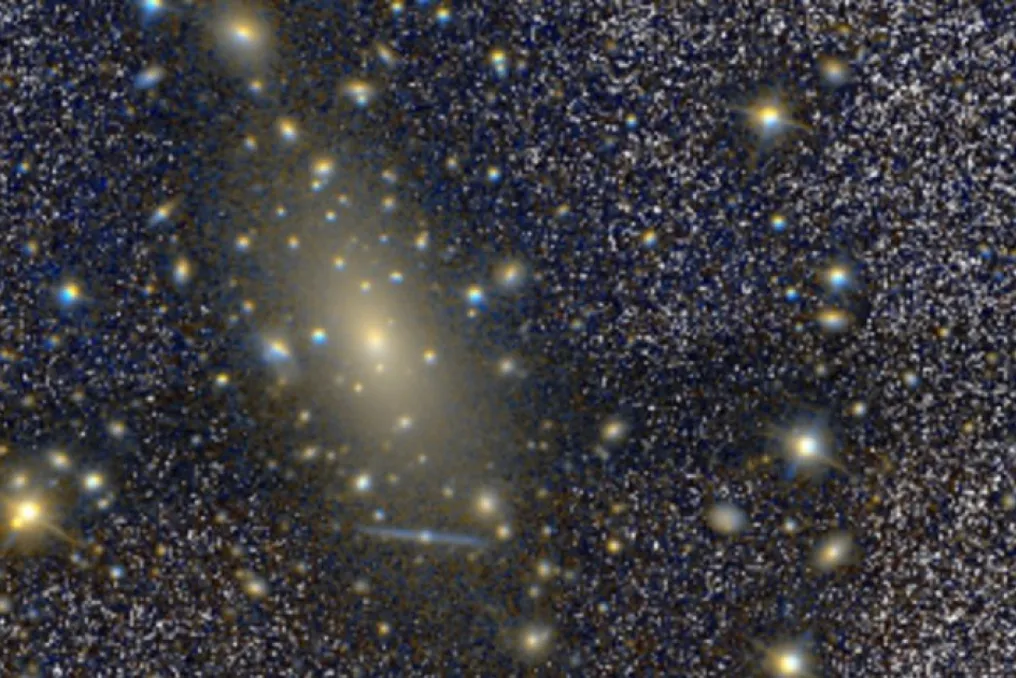
Researchers estimated the effective diameter of the elliptical galaxy IC 1011 to be over 1.6 million light-years, confirming its status as the most extended of currently known galaxies. It is hypothesized that it will maintain its trend of increasing size by accreting surrounding diffuse matter. The results of this study are presented in a preprint on arXiv.org.
The size of galaxies in the Universe varies from a few tens of light-years for compact dwarfs to hundreds of thousands of light-years for massive elliptical systems. This size correlates closely with the galaxy's stellar mass and age, increasing due to active star formation and merger processes. Nevertheless, scientists do not yet have a definitive answer regarding the maximum sizes galaxies can reach, and searches for the largest systems, including central and bright cluster galaxies, are underway to answer this question.
A group of astronomers led by Carlos Marrero-de la Rosa from the Canary Institute of Astrophysics presented the results of analyzing deep images of the elliptical galaxy IC 1011. These observations were conducted between May 27 and May 30, 2022, using the WFC camera on the 2.5-meter INT telescope located at the Roque de los Muchachos Observatory. Archival data from the SDSS and DESI ground sky surveys were also utilized in the work.
IC 1011 is the brightest galaxy in the massive galaxy cluster Abell 2029, with a redshift of 0.077. Its total luminosity reaches $10^{12}$ solar luminosities, and its stellar emission was detected at a distance of 1.97 million light-years, making it one of the brightest central cluster galaxies and potentially the most extended. This galaxy hosts one of the largest galactic nuclei, which likely formed through the merger of a binary system of supermassive black holes and exhibits radio jet activity.
The main goal of the study was to estimate the galaxy's extent down to very low surface brightness values (29.5 magnitudes) and to search for any faint structures at its edges that might indicate past accretion or merger events. It was established that IC 1011 is indeed the most extended among known galaxies. Its effective radius is approximately 238 thousand light-years, and its outer radius is estimated at about 848 thousand light-years. The stellar mass within the outer radius reaches approximately $3.69 imes 10^{12}$ solar masses, while the total stellar mass in the region described by the surface brightness profile down to 29 magnitudes (with a radius of 2.127 million light-years) is $4.2 imes 10^{12}$ solar masses, including the contribution from the circumgalactic medium.
The parameters of IC 1011 align with the upper limit of the stellar mass-size relation, consistent with theoretical predictions. WFC observations revealed several faint structures near the galaxy, interpreted as traces of accretion by other galaxies and disturbances in the hot gas of the cluster. Considering previous X-ray data on core activity and jets, as well as the presence of large-scale spiral structures in the cluster center, these faint structures are considered evidence of a cluster merger with a subcluster or group of galaxies that occurred about 2–3 billion years ago. The transition from the main body of the central cluster galaxy to its outer, more rarefied envelope and further to the circumgalactic medium indicates that the galaxy continues to gain mass at its periphery.
Previously, astronomers recorded a jet system extending about seven megaparsecs from the active galaxy Porphyrion, demonstrating the ability of jets to remain stable over cosmological distances even during periods of denser universe states.
Separately, planetary scientists noted that Neptune's moon Nereid is the only intact regular satellite of the planet. Researchers concluded that Nereid formed concurrently with the ice giant, rather than being captured from outside or formed through collisions with other satellites. Its current irregular orbit is attributed to gravitational influences from Triton in the past. This information was published in the journal Science Advances.