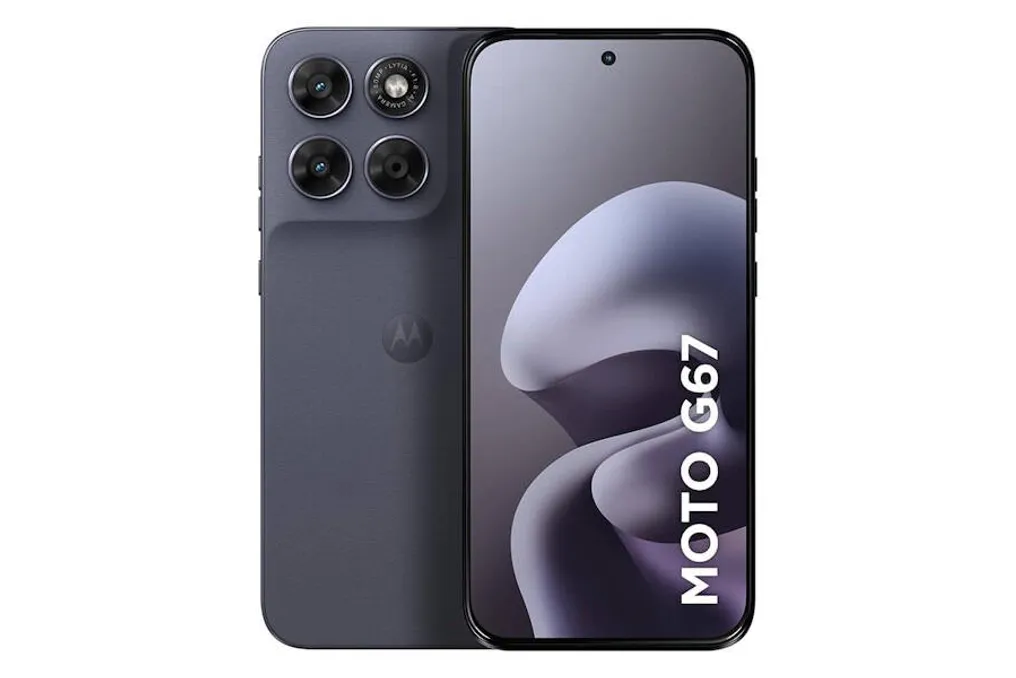
The Moto G smartphone line is popular among Brazilians due to its ability to offer good features, adequate performance, and competitive prices in its mid-range models. The Moto G67, one of the latest releases, arrived in Brazil in the first half of 2026, featuring a large AMOLED screen, long-lasting battery, and a 50 MP rear camera.
Moto G67 Technical Specifications
In terms of the screen, the device has a 6.78-inch AMOLED display with 1.5K resolution (1220 x 2712 pixels) and a 120 Hz refresh rate. Processing is handled by the MediaTek Dimensity 6300. Regarding storage, it offers options of 128 GB or 256 GB of internal memory, which can be expanded via microSD, accompanied by 4 GB of physical RAM plus virtual expansion.
Battery and Cameras
The Moto G67 battery has a capacity of 5,200 mAh and supports 33W fast charging. In terms of photography, it features a 50 MP main rear camera with optical stabilization, complemented by an 8 MP ultrawide lens, and a 32 MP front camera.
Design and Build
The Moto G67's design aims for a more sophisticated look, presenting only 7.3 mm in thickness, making it one of the thinnest smartphones in its category, providing an elegant feel. The back uses a leather-simulating coating, offering better grip and resistance to fingerprints. Furthermore, the device has IP64 dust and splash resistance certification, Gorilla Glass 7i protection, and MIL-STD-810H military certification, indicating robustness and durability.
Visual Experience and Performance
One of the device's highlights is the AMOLED screen, which delivers vibrant colors, high contrast, and deep blacks, characteristics usually found in more expensive devices. The combination of 1.5K resolution and a 120 Hz refresh rate ensures extremely smooth navigation, ideal for watching videos or using social media, with a good brightness level even under intense light.
However, despite the superior screen, the internal performance is limited by the MediaTek Dimensity 6300 processor, which is adequate for daily tasks such as browsing and messaging. The main weakness lies in the 4 GB of physical RAM; although there is a 'RAM Boost' feature to virtually increase memory to 12 GB, the scarcity of physical RAM is noticeable when keeping multiple applications open or running heavy games, resulting in slowness and the need to reload background apps.
Software and Future Support
The Moto G67 is launched with modified Android 16, using the Motorola interface, known for being discreet and not overloaded with pre-installed applications. It maintains typical Motorola functionalities, such as gesture recognition to activate the flashlight or camera, and includes security and productivity tools. Motorola promises the user at least two major Android updates and up to four years of security updates for the device.
Autonomy and Photographic Quality
The 5,200 mAh battery meets expectations for the category, offering enough autonomy for a full day of moderate to intensive use. The 33W fast charging, included with the device, allows the charge cycle from 0% to 100% to be completed in just over an hour. Regarding cameras, the setup is satisfactory for casual use. The 50 MP main sensor with optical stabilization produces balanced and colorful images in well-lit environments, suitable for social media. The 32 MP front camera also performs well in good lighting conditions. Limitations appear in night photos, where sharpness decreases, and rear video recording is limited to 2K, which may be insufficient for those seeking high quality.
Conclusion: Pros and Cons
The most positive aspects of the Moto G67 include its refined design, excellent AMOLED screen quality, long-lasting battery, and lightweight software, ensuring a pleasant daily experience. On the other hand, the mere 4 GB of physical RAM is the biggest obstacle for advanced multitasking, and performance in demanding games is considered modest, in addition to the basic camera setup.
This smartphone is recommended for users looking for a reliable device for daily use, media consumption, and simple photos, taking advantage of the high-quality screen and good autonomy at a lower cost than premium models. More demanding users, however, may feel limited by the RAM and performance in heavy tasks or 4K content creation.