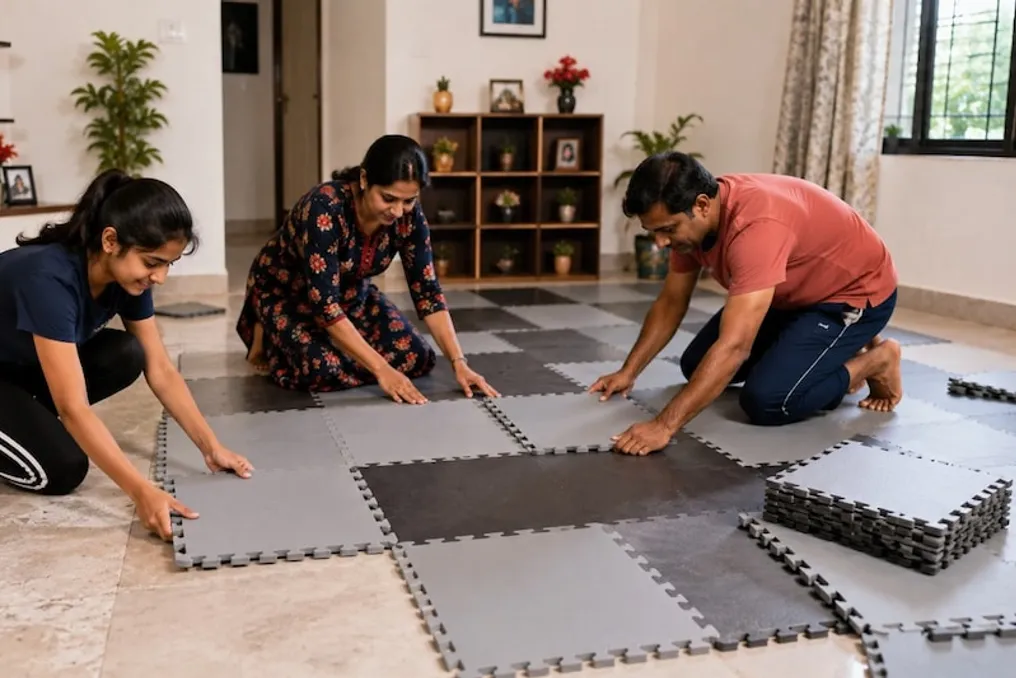
After building a house, it is crucial to furnish it. For this, one must first decide on the color and design of the walls and floor. There are many options, such as tiles, marble, wallpaper, paint, and wooden flooring. Among these, modular interlocking tiles stand out.
Modular interlocking tiles are flooring elements that can be connected to each other like puzzle pieces without using glue or cement. They remain stable due to their own weight. This type of flooring is suitable for places such as gyms, garages, and yards. They are easy to dismantle and reuse.
The main advantage of these tiles is the ability to install them over existing marble or tile. No cement or glue is required for installation; it is enough to connect the edges manually or with a light hammer. Repair and maintenance are also very simple: a damaged tile can be replaced with a new one. These tiles come in various styles, with holes or textured surfaces, and they can be disassembled and moved to another room or a new house.
Modular interlocking tiles are made from plastic, PVC, and rubber. Soft foam or rubber tiles provide floor protection and comfort for the feet. While hard plastic tiles are suitable for use near garages or pools, giving a clean look and withstanding the load from heavy vehicles.
The cost of installing these modular interlocking tiles is approximately from 40 to 150 rupees per square foot. If only considering labor costs for laying, it is very low, about 10–20 rupees per square foot, as no special construction work or cement is required.
Plastic or PVC modular interlocking tiles cost from 30 to 120 rupees per square foot, depending on quality and design. If installed by oneself, there is no charge for labor. However, if a specialist is hired, the cost is 10–20 rupees per square foot. When laying directly on the ground, an additional small fee for surface leveling may be required.