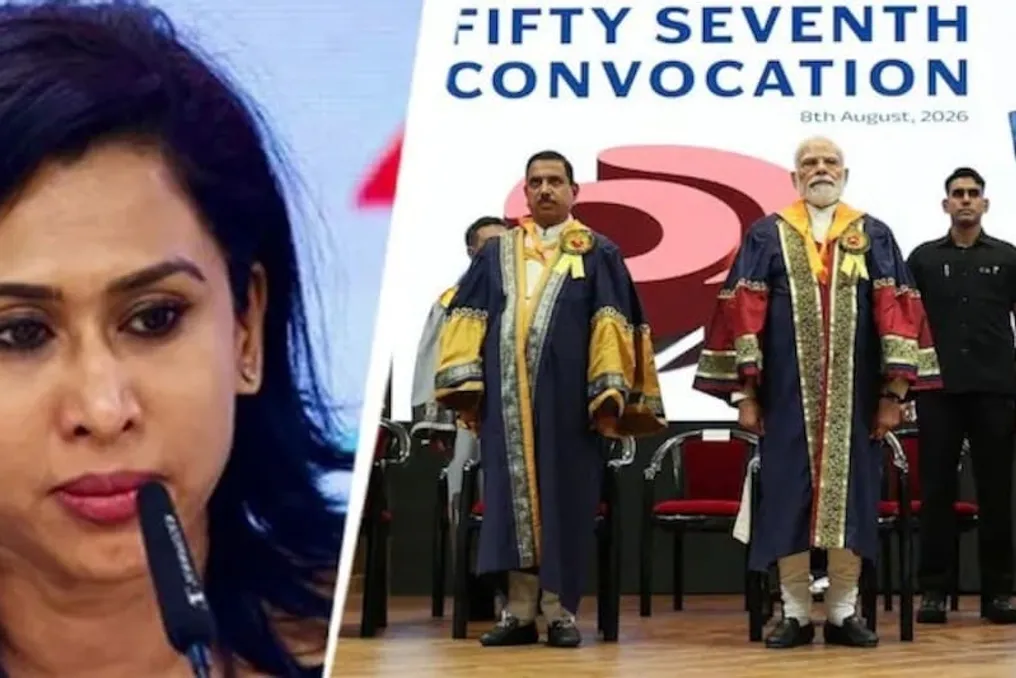
A dispute arose during the 57th convocation ceremony at IIT Delhi concerning the recitation of Sanskrit verses. Congress representative Shama Mohammad raised the issue, referring to it as the Gayatri Mantra, and questioned why a religious mantra was being recited at an academic event.
However, Gyan S. Mehta, a former student of IIT Kanpur, refuted her claim as factually incorrect. He stated that the Gayatri Mantra was not recited at the ceremony, but the verses were taken from the Taittiriya Upanishad. Against this backdrop, when Prime Minister Narendra Modi was present at the ceremony, Shama Mohammad's remark quickly turned into a political debate.
What did Shama Mohammad state?
Shama Mohammad questioned the reason for reciting the Gayatri Mantra at the IIT convocation. She clarified that she personally does not object to the Gayatri Mantra; she noted that her cooks recite this mantra daily upon entering the kitchen, and she likes it.
Nevertheless, she questioned why the Gayatri Mantra was recited specifically at the IIT convocation. She emphasized that it was not a religious event and insisted that educational institutions should be free from religious slogans and mantras of all faiths. Her objections were based on two points: the recitation of the Gayatri Mantra at the ceremony and the inadmissibility of including any religious or spiritual exclamations in curricula.
Former IIT Kanpur student calls statement incorrect
Gyan S. Mehta, an alumnus of IIT Kanpur, rejected Shama Mohammad's initial statement. He asserted that the text read at the ceremony was not the Gayatri Mantra.
Mehta noted: 'I certainly do not want to argue with your cooks, but the basis of your post is factually wrong. The mantra being read is not the Gayatri Mantra. Although there is nothing bad in the Gayatri Mantra itself. As a proud alumnus of IIT Kanpur, I find this disappointing.'
Following this response, the focus of the dispute shifted to the question: what exactly was read at the IIT Delhi ceremony?
Verses are related to the Taittiriya Upanishad
It is reported that the Sanskrit verses read at the ceremony belong to the Shikshavali Taittiriya Upanishad. These verses relate to education and the relationship between teacher and student. The text contains a prayer such as 'tanmamvtu, tadbktaramvtu', which expresses a wish for protection for both the student receiving knowledge and the teacher imparting it.
Thus, before the exchange of knowledge, both participants—student and teacher—were united by a single prayer.
57th Convocation Ceremony of IIT Delhi
IIT Delhi held its 57th convocation on August 8. More than 3000 students and 587 PhD scholars participated. Prime Minister Narendra Modi addressed the students, advising them to maintain curiosity, challenge established notions, and show courage in finding solutions to problems. His speech touched upon topics such as education, research, technology, innovation, semiconductors, and the role of youth in India's development.
This Sanskrit text is also viewed in the context of the ancient Indian tradition of 'Samavartana'. Samavartana is a ritual associated with a student entering social life after completing their studies. The Shikshavali Taittiriya Upanishad emphasizes truth, duty, discipline, respect for the teacher, and moral life.
Two separate issues arose from this dispute. Firstly, what specific Sanskrit text was recited at IIT Delhi and was it the Gayatri Mantra? Secondly, is it appropriate to include religious or ancient traditional texts in public educational institutions? Shama Mohammad presented this as an issue related to secular educational institutions, while Mehta focused the argument on the main fact—the identification of the text itself.